Veterans make up 1 in 4 homeless in US
Updated: 2007-11-08 11:24
WASHINGTON - Veterans make up one in four homeless people in the United States, though they are only 11 percent of the general adult population, according to a report to be released Thursday.
And homelessness is not just a problem among middle-age and elderly veterans. Younger veterans from Iraq and Afghanistan are trickling into shelters and soup kitchens seeking services, treatment or help with finding a job.
|
|
The Veterans Affairs Department has identified 1,500 homeless veterans from the current wars and says 400 of them have participated in its programs specifically targeting homelessness.
The Alliance to End Homelessness, a public education nonprofit, based the findings of its report on numbers from Veterans Affairs and the Census Bureau. 2005 data estimated that 194,254 homeless people out of 744,313 on any given night were veterans.
In comparison, the VA says that 20 years ago, the estimated number of veterans who were homeless on any given night was 250,000.
Some advocates say such an early presence of veterans from Iraq and Afghanistan at shelters does not bode well for the future. It took roughly a decade for the lives of Vietnam veterans to unravel to the point that they started showing up among the homeless. Advocates worry that intense and repeated deployments leave newer veterans particularly vulnerable.
"We're going to be having a tsunami of them eventually because the mental health toll from this war is enormous," said Daniel Tooth, director of veterans affairs for Lancaster County, Pa.
While services to homeless veterans have improved in the past 20 years, advocates say more financial resources still are needed. With the spotlight on the plight of Iraq veterans, they hope more will be done to prevent homelessness and provide affordable housing to the younger veterans while there's a window of opportunity.
"When the Vietnam War ended, that was part of the problem. The war was over, it was off TV, nobody wanted to hear about it," said John Keaveney, a Vietnam veteran and a founder of New Directions in Los Angeles, which provides substance abuse help, job training and shelter to veterans.
"I think they'll be forgotten," Keaveney said of Iraq and Afghanistan veterans. "People get tired of it. It's not glitzy that these are young, honorable, patriotic Americans. They'll just be veterans, and that happens after every war."
Keaveney said it's difficult for his group to persuade some homeless Iraq veterans to stay for treatment and help because they don't relate to the older veterans. Those who stayed have had success -- one is now a stock broker and another is applying to be a police officer, he said.
"They see guys that are their father's age and they don't understand, they don't know, that in a couple of years they'll be looking like them," he said.
After being discharged from the military, Jason Kelley, 23, of Tomahawk, Wis., who served in Iraq with the Wisconsin National Guard, took a bus to Los Angeles looking for better job prospects and a new life.
Kelley said he couldn't find a job because he didn't have an apartment, and he couldn't get an apartment because he didn't have a job. He stayed in a $300-a-week motel until his money ran out, then moved into a shelter run by the group US VETS in Inglewood, Calif. He's since been diagnosed with post-traumatic stress disorder, he said.
"The only training I have is infantry training and there's not really a need for that in the civilian world," Kelley said in a phone interview. He has enrolled in college and hopes to move out of the shelter soon.
The Iraq vets seeking help with homelessness are more likely to be women, less likely to have substance abuse problems, but more likely to have mental illness -- mostly related to post-traumatic stress, said Pete Dougherty, director of homeless veterans programs at the VA.
Overall, 45 percent of participants in the VA's homeless programs have a diagnosable mental illness and more than three out of four have a substance abuse problem, while 35 percent have both, Dougherty said.
Historically, a number of fighters in US wars have become homeless. In the post-Civil War era, homeless veterans sang old Army songs to dramatize their need for work and became known as "tramps," which had meant to march into war, said Todd DePastino, a historian at Penn State University's Beaver campus who wrote a book on the history of homelessness.
After World War I, thousands of veterans -- many of them homeless -- camped in the nation's capital seeking bonus money. Their camps were destroyed by the government, creating a public relations disaster for President Herbert Hoover.
The end of the Vietnam War coincided with a time of economic restructuring, and many of the same people who fought in Vietnam were also those most affected by the loss of manufacturing jobs, DePastino said.
Their entrance to the streets was traumatic and, as they aged, their problems became more chronic, recalled Sister Mary Scullion, who has worked with the homeless for 30 years and co-founded of the group Project H.O.M.E. in Philadelphia.
"It takes more to address the needs because they are multiple needs that have been unattended," Scullion said. "Life on the street is brutal and I know many, many homeless veterans who have died from Vietnam."
The VA started targeting homelessness in 1987, 12 years after the fall of Saigon. Today, the VA has, either on its own or through partnerships, more than 15,000 residential rehabilitative, transitional and permanent beds for homeless veterans nationwide. It spends about $265 million annually on homeless-specific programs and about $1.5 billion for all health care costs for homeless veterans.
Because of these types of programs and because two years of free medical care is being offered to all Iraq and Afghanistan veterans, Dougherty said they hope many veterans from recent wars who are in need can be identified early.
"Clearly, I don't think that's going to totally solve the problem, but I also don't think we're simply going to wait for 10 years until they show up," Dougherty said. "We're out there now trying to get everybody we can to get those kinds of services today, so we avoid this kind of problem in the future."
In all of 2006, the Alliance to End Homelessness estimates that 495,400 veterans were homeless at some point during the year.
The group recommends that 5,000 housing units be created per year for the next five years dedicated to the chronically homeless that would provide permanent housing linked to veterans' support systems. It also recommends funding an additional 20,000 housing vouchers exclusively for homeless veterans, and creating a program that helps bridge the gap between income and rent.
Following those recommendations would cost billions of dollars, but there is some movement in Congress to increase the amount of money dedicated to homeless veterans programs.
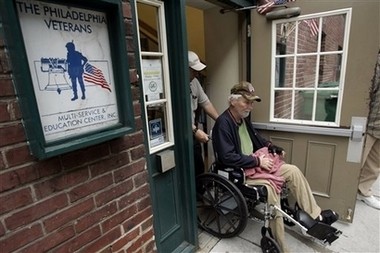
On a recent day in Philadelphia, case managers from Project H.O.M.E. and the VA picked up William Joyce, 60, a homeless Vietnam veteran in a wheelchair who said he'd been sleeping at a bus terminal.
"You're an honorable veteran. You're going to get some services," outreach worker Mark Salvatore told Joyce. "You need to be connected. You don't need to be out here on the streets."
|
|
|
||
|
||
|
|
|
|