|
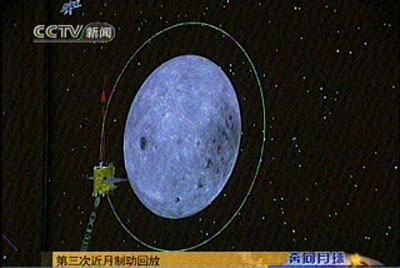
The CCTV footage shows that China's first lunar probe Chang'e-I successfully completed its 1,580,000-km flying journey to the moon after entering its final working orbit on Wednesday's morning, Nov. 7, 2007. [CCTV.com]
|
China's first lunar probe, Chang'e-I, completed its nearly two-million-km flying journey to the moon successfully on Wednesday morning and entered its working orbit.
The probe, following instructions of the Beijing Aerospace Control Center (BACC), started its third braking at 8:24 a.m. and entered a 127-minute round polar circular orbit at 8:34 a.m. after completing the braking.
The TV pictures showed work staff in the ground control center hailing the success with colored newsletters featuring a black headline "Circling the Moon, We Made It!" on the frontpage.
TV scenes also highlighted gray-haired Luan Enjie, chief commander of China's lunar probe project, and also silver-haired Sun Jiadong, chief designer of the project, wearing smiles and holding hands together tightly.
"It puts a successful end to the probe's long flight to the moon," Luan said.
"The satellite entered the designed working orbit just in time and very accurately today," said Sun, who has joined hands with Luan for more than a decade to develop, test and carry out the country's ambitious lunar probe project.
Ye Peijian, chief commander and designer in charge of the satellite system, said that all the maneuvers in the flight have been completed precisely. "The accuracy is much higher than our expectation."
"It's a landmark moment. It proves that we have the ability to send our satellite to circle around the moon," Ye said.
China sent its first satellite into the Earth orbit in 1970, with major new breakthroughs in its space program achieved in recent years.
The country carried out its maiden piloted space flight in October 2003, making it the third country after the former Soviet Union and the United States to have sent men into space. In October 2005, China completed its second manned space flight, with two astronauts on board.
"Chang'e-I has presented an extraordinary achievement, since it's the first time that Chinese scientists manage to maneuver a satellite 390,000 km away from the earth," said Wang Yejun, chief engineer of the Beijing Aerospace Control Center (BACC).
"The probe will travel along the orbit at a stable altitude of 200 km above the moon's surface. In each circle, it will always pass the two polars," Wang said.
The round orbit is also the final destination of the probe, where it is supposed to start carrying out all the planned scientific exploration tasks.
"The probe's precise entry into the orbit has laid a solid foundation for its future work, and we are confident that Chang'e-I will continue to fulfill the aims step by step," said Ma Xinrui, general manager of the China Aerospace Science and Technology Corporation (CASTC) in charge of the rocket and satellite systems.
The 2,350-kg satellite carried eight probing facilities, including a stereo camera and interferometer, an imager and gamma/x-ray spectrometer, a laser altimeter, a microwave detector, a high energy solar particle detector and a low energy ion detector.
According to the project's plan, Chang'e-I will open all the instruments aboard it to start scientific explorations after a period of orbit testing.
"Currently, all the facilities are in very good conditions. Next, scientists need to maintain smooth communications between the ground and the satellite and keep it in the orbit," said Zhang He, director of the CASTC's space technology research institute.
Chang'e-I is expected to fulfil four scientific objectives, including a three-dimensional survey of the Moon's surface, analysis of the abundance and distribution of elements on lunar surface, an investigation of the characteristics of lunar regolith and the powdery soil layer on the surface, and an exploration of the circumstance between the earth and the moon.
"One of its major tasks is to probe the mineral elements on the moon, especially those not existent on the earth," Zhang said.
"The lunar regolith is abundant in helium-3, a clean fuel that may support the earth's energy demands for more than a century," she said, admitting that there is still a long way to go from the probing of the element to its actual use.
Chang'e-I was originally designed to stay on the orbit for one year, but Tang Geshi, an official in charge of the orbital control with BACC, estimated that smooth operations and precise maneuvers may have saved 200 kg of fuel and help prolong the probe's life span.
"The satellite is designed to take ground orders on November 18 to position all the instruments towards moon, a posture facilitating the probing work, and the maneuver may last 100 minutes," said Li Jian, an official with the BACC.
However, Zhou Jianliang, deputy chief engineer of the BACC, revealed that they are considering to give the order ahead of the schedule, since the satellite is in "a very good state".
In addition, the satellite will also position its solar panel towards the sun for power generating and the directional antenna towards the earth to allow data to be transmitted back to the earth.
Chang'e-I will relay the first black-and-white picture of the moon after the instruments are positioned to the moon.
"Actually, what the probe transmits back is just abstract data, which will need six hours to be processed into a two-dimensional picture and about a day into a three-dimensional one," Li Jian said.
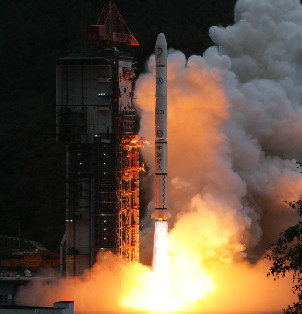
Chang'e-I, named after a legendary Chinese goddess who flew to the moon, blasted off on a Long March 3A carrier rocket on October 24 from the Xichang Satellite Launch Center in southwestern Sichuan Province.