中國網(wǎng)站品牌欄目(頻道)
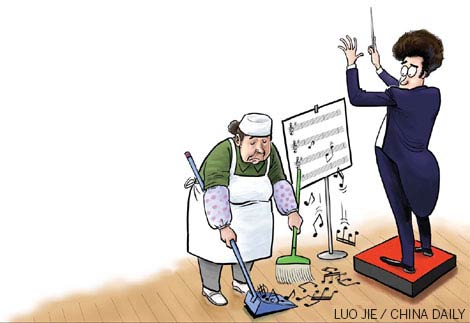
These are the good days for domestic symphony orchestras, but while some are shining musically others are searching for ways to regain their relevance in a society where music is mainly served in mp3 format and on karaoke channels.
A quick question: How many professional symphony orchestras does China have?
You don't know? I didn't either, but I found out at the 2010 China Symphony Summit early this week.
There are 45 professional symphony orchestras on the mainland. Does that surprise you? Of course there are orchestras in Beijing, Shanghai or Guangzhou, but more surprisingly, Qingdao has three, and even the hinterland city of Guiyang boasts one.

The reason most of these orchestras have low visibility is they do not perform that much. Some put on as few as 30 shows a year and have an operating budget of just 1 million yuan ($146,475) - a pittance compared with sky-high housing prices. Many are remnants from the old days when they were called bands and the personnel and equipment were inadequate. They are "hungry", but not to the extent they'll "starve to death".
What can they do?
"If they do not reform, they'll just wait for death. If they do, they'll be looking for death."
That's how Wang Hongbo sums it up. The spokesman for China Arts and Entertainment Group, under the Ministry of Culture, was blunt in describing the complacency of many orchestras: "For a 1,000-seat venue, you give out 2,000 free tickets and, when the curtain rises, you still find most seats are vacant."
Chinese musicians take comfort from the knowledge that their Western peers also rely on government subsidies for survival. Most have turned it into an art to plead with government officials for an endless stream of "blood transfusions". And they are succeeding.
Many cities in China, flush with cash from the economic boom, want the kind of cachet that cash alone cannot provide. They have found the answer through making official tours of Western countries: the triumvirate of a symphony orchestra, an opera company and a ballet company. They crave the ornate palaces of high art. There are so many grand theaters sprouting in China's cityscapes you'd be forgiven for believing there is an artistic renaissance sweeping across the nation.
The interest in classical music is mainly what they call "hardware-driven". First, we build the state-of-the-art facilities; then we need performers to fill them. Only then is it discovered that it is easier to fill the stage than audience seats.
Hence the development of outreach programs to familiarize the public with this genre of performing arts, usually considered as lofty and aloof. This is like building a castle from top to bottom and, finding it does not have support, reaching down one level at a time until it touches the ground.
More than 20 years ago, then Minister of Culture Wang Meng floated the idea that the State should take care of just one performing arts troupe of each genre - the top one - and leave the rest to the market. However, if each level of government sponsors one orchestra, China would have as many orchestras as television stations.
So, will China then be crowded with mediocre orchestras? The past three decades of reform are having an impact on these cultural institutions. More orchestras have adopted a mechanism that incorporates competition and inducements for top talent. And surprise, money does make a difference.
The picturesque city of Hangzhou, capital of entrepreneur-rich Zhejiang province, has a musical heritage that goes back to the South Song Dynasty (1127-1279), when the sound of zithers and arias soared over the legendary West Lake. The city wanted a modern symphony orchestra. In January last year, it started recruiting talent. Out of 600 applicants, they picked 76. On April 20, the new orchestra went into rehearsal. On July 20, it debuted with Beethoven's Ninth Symphony.
I didn't catch that one, but I did attend Tuesday's performance of Rachmaninoff's Symphony No 2. It was surprisingly good. It was not just the raw talent, but the youthful energy, that touched me. Rarely have I seen musicians on a Chinese stage who so obviously loved what they were doing. As Zhang Guoyong, a Shanghai-based conductor, put it: "Usually you can tell which players hate the conductor, which hate the president of the company, and which ones are in a hurry to go to their midnight gigs at cafes or hotels, where they can bring in extra cash". But at the brand-new Hangzhou Philharmonic, now resident in Hangzhou Grand Theater, musicians exude passion and, at the average age of 25, are good-looking too.
All of this is made possible with money - lots of money, to the tune of tens of millions of yuan each year. And that's not counting the housing subsidy in one of the most expensive real estate markets in the whole country.
As Zhang, the Shanghai conductor, says, "You cannot have a good symphony orchestra without money, though it does not necessarily mean money can make a good orchestra."
Those vying for a top position in the country are all sufficiently funded. For the rest, it's more practical to aim for the grassroots market. Classical music is by nature upscale, but it takes education to cultivate a core audience.
In the southern city of Shenzhen, the municipal government spends 40,000 yuan ($5,858) each week on a free weekend concert, which has become something of a local tradition.
A charity in Beijing, Wings of Music, has a different approach. It uses music education not to cultivate good taste but to boost self-confidence in a demographic that's falling through the cracks of our society. Funded by the China Symphony Development Foundation, it collects musical instruments and donates them to a school in the Beijing outskirts where poorly educated and financially strapped migrant workers send their kids. These children have never seen a violin or a cello and now they are experiencing the joy that only music can bring.
It is similar to the story in the movie Music of the Heart, starring Meryl Streep, only more poignant. When Guo Shan, president of the foundation, talks about using music to care for these children, she can't contain her tears.
There are so many ways an orchestra can excel, if not in artistic brilliance, then in social relevance.
raymondzhou@chinadaily.com.cn
相關(guān)閱讀:
(作者周黎明 中國日報網(wǎng)英語點津 編輯陳丹妮)
 |
 |
 |
 |
 |
 |