中國網站品牌欄目(頻道)
A humorous column in the paper this week has caused ructions, begging the question: Why do foreigners always take us so seriously?

When a Chinese person uses comic irony, others tend to be confused. But sometimes, it is the best option to get a point across.
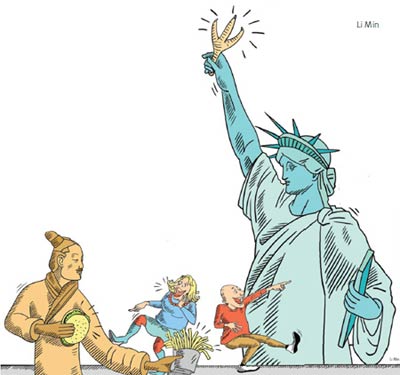
An American friend of mine once had a vigorous argument with me over what was important to learn in the United States. My feeling was that appreciating fast food was an entre to American culture.
"It's really stupid of you to gorge yourself on so much fast food," he said.
"But it's important for me. If I cannot distinguish between a KFC burger and a McDonald's burger, my credibility as an American-trained Chinese will suffer. Nobody back home will believe I spent so much money and effort in the birthplace of fast food," I defended myself.
"But this is junk food. It'll kill you," he warned.
"Where I come from, the Golden Arches are the symbol of the best American cuisine," I said.
"But that's wrong. You should try something else."
"Other burgers?"
"There is more to American cuisine than burgers."
"Like what? French fries? I thought they were from France."
My friend is a serious guy, not the typical American with a strong sense of humor. Had he adopted a different approach, say comic irony, I would have had an easier time accepting his point.
For example, he could have extolled the virtues of US fast food thus: "There's no point trying our burger, you'll never get our culture. You think it's just a burger, but it's the quintessence of American gastronomy - munchable Americana, so to speak."
My curiosity would have been piqued.
"I see, I really have to savor this burger and appreciate its American-ness next time," I might have told myself. Then, it would occur to me he was being sarcastic, and this would make my burger-odyssey appear foolish. I might wake up and broaden the scope of my culinary adventure.
Now, if you place the above two approaches in a Chinese environment and substitute "burger" with "chicken feet" and "sea cucumber", you should get the scenario in Tuesday's "China Chic" column (Jan 12, page 18).
Huang Hung's article, Dear laowai, don't mess with our Chinese-ness has been getting a lot of negative comments. These people angrily asked: "How can a mainstream newspaper like China Daily use such words as 'barbarians' to refer to citizens of a foreign country?"
Well, it was tongue-in-cheek and said for comic effect.
I'm not speaking for Ms Hung. But from what I know, no way could this thoroughly US-educated woman (from the age of 12) be a xenophobe. If anything, she is a darling of the Western press in Beijing, acting as a conduit between Chinese phenomena and Western interpretation.
Comic irony is a tool rarely employed by Chinese writers - less by Chinese writers who write in English. We Chinese have this image of being hard working, but no fun to be with. Our press used to translate Onion pieces as straight news. We don't have a TV talk show like Jon Stewart's - and we probably never will, as things stand. Our movie comedies bomb in Hong Kong and have no chance of crossing the Pacific. When Zhang Yimou made his folksy farce, A Simple Noodle Story, even our own literati sneered at him.
When a Chinese person tells a joke, it can be really confusing. A few years ago, Time magazine selected "You" as Person of the Year and included blogger Wang Xiaofeng as the only Chinese person in its honors list. For that type of recognition, a typical Chinese response would run like this: "I'm really honored to be chosen by such a prestigious publication. I'm just one of millions of bloggers in China. This honor belongs to all of them. I'll work harder to make China's blogosphere a wonderful platform for world peace and harmony."
But instead of such clichs, false modesty and nonsense, Wang wrote a vivid "account" of how he chanced upon Time's editor-in-chief and bribed him into giving him the honor. It was so hilarious and un-Chinese I decided to translate it into English for our Hotpot column (Read the article). I dithered for hours as to whether I should put an explanatory note at the end to the effect this was fictional and meant to be self-deprecating. With the note, I'd spoil the fun; without it, at least half the readers, I figured, would take it wrong. In the end, I opted for no note. (Our editors had the same hesitation for Hung's controversial column.)
I heard the Time editors in Beijing were really upset. Had they studied Wang's blog, they should have known he throws barbs at everything and everyone, which is what makes his writing so outstanding.
Sometimes we use sarcasm out of necessity. We don't say "You're bad" to mean "You're good" - or vice versa - just to be cool, but to circumvent certain constraints. At one time, Chinese intellectuals were so adept at this game that the ensuing riddles were a hundred times more complicated than the Da Vinci code. You had to read between the lines to detect the author's true intention. The only rules were unspoken rules. I see a lot of that in Chinese movies nowadays, where the messages are so layered you can get multiple interpretations - some contradictory.
I wonder why few people deliberately misunderstand an American comedian. If every joke or parody on Saturday Night Live was accompanied by a disclaimer, it would be unthinkable. The reason could partly be the context. Because Chinese are not known for humor and satire, our double entendres must be taken at face value. Because China Daily is a "serious" newspaper or "poker-faced mouthpiece", a humorous piece in the Life section is tantamount to an editorial. Because Chinese writers shift tones from piece to piece, you cannot tell when they are being serious or when they are being ironical.
In a sense, it is just like making a food choice. As satire is considered more an American than a Chinese art form, does it make me less Chinese if I embrace it? Does it turn me into a pale imitator, or shanzhai version, as we term it in Chinese?
I once wrote a defense of Zhang Ziyi dating non-Chinese men (Read the article). If I had adopted the usual commentary style, it would have boiled down to just one sentence: She has a right to date whomsoever she wants.
But my message would have been lost in cyberspace. So, instead of espousing the obvious, I adopted comic irony. I argued Zhang should marry only a Chinese man because she could help solve one 20 millionth of the country's gender imbalance. Fearing my sarcasm was not obvious enough, I ended up saying Zhang should not marry anyone, but put herself on a pedestal and declare herself a chaste goddess.
I got quite a few responses from expats accusing me of racism.
But how else could I expose the absurdity of the original arguments from China's "angry youth" netizens (which were indeed tinged with racism) if I did not push it one step further? We live in a cauldron of black humor. For those who believe it is still the age of innocence, all I can say is, sorry folks, I don't want to burst your bubble, but it's a jungle out there and I'm using a double-edge sword.
raymondzhou@chinadaily.com.cn
相關閱讀:
Behind the Scenes - BT cracked down
(作者周黎明 中國日報網英語點津 編輯陳丹妮)
 |
 |
 |
 |
 |
 |