中國網站品牌欄目(頻道)
|
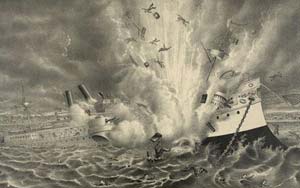 The destruction of the U.S. battleship Maine in Havana Harbor in 1898. |
SHIRLEY GRIFFITH: Welcome to the MAKING OF A NATION -- American history in VOA Special English.
During the second half of the 19th century, the United States was not concerned much with events in other countries. It was too busy dealing with events inside its own borders. At that time, the nation was recovering from the Civil War. It was expanding to the West. And it was developing industries.
As production increased, the United States began trading more and more with other countries. At the same time, it needed a new foreign policy to defend its interests.
This week in our series, Maurice Joyce and Larry West discuss America's foreign policy in the late 1800s.
LARRY WEST: A growing number of lawmakers called for a new foreign policy. One was Henry Cabot Lodge of Massachusetts. Lodge said the great nations of the world were taking control of the world's undeveloped areas. As one of the great nations, Lodge said, the United States must not fall out of this line of march.
Another lawmaker said: "Fate has written our policy. The trade of the world must and shall be ours." Some of these ideas came from the writings of Captain Alfred Mahan. He was head of America's Naval War College.
Mahan wrote that all the great nations in history had possessed great sea power. He said the United States must build up its sea power, too, if it wanted to be a great nation.
Sea power, Mahan said, was more than a strong navy. It was an economy that could produce goods for export. It was trade ships that could carry the goods. It was colonies that could supply raw materials and markets. And it was overseas naval bases that could defend American interests far from home.
MAURICE JOYCE: The Washington Post newspaper described America's growing power this way:
"A new understanding seems to have come upon us, an understanding of our strength. And with it, a new feeling -- we want to show our strength. We are face-to-face with a strange fate. The taste of empire is in the mouth of the people."
The Washington Post was not speaking for everyone, of course. In fact, many American presidents of the late 1800s did not have this taste for empire. Yet they were forced to face the future. Changes were coming. And it was their responsibility to guide the nation through the changes.
For this reason, the United States entered into several agreements with foreign lands during the late 1800s.
LARRY WEST: In 1878, for example, the United States signed a treaty with Samoa. The United States agreed to help the South Pacific islands settle any differences with other nations. A few years later, the treaty was put to a test.
A group of Germans living in Samoa forced the islands' ruler from power. They replaced him with a ruler who was more friendly to Germany.
For a time, it seemed the United States and Germany would go to war. But when American warships arrived in Samoa, so did a big storm. The storm smashed both American and German ships. Neither side was left with a force strong enough to fight.
In 1889, the United States, Germany, and Britain agreed that Samoa should be an independent kingdom. For ten years, local leaders attempted to establish a strong government. Their efforts failed. In 1899, Germany took control of Samoa's large western islands. The United States took control of the smaller islands to the east.
MAURICE JOYCE: Events in another group of Pacific Ocean islands affected American foreign policy in the late 1800s. These were the Hawaiian islands.
|
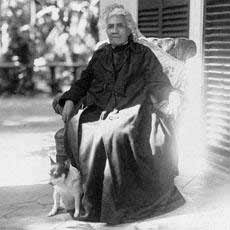 Queen Liliuokalani of Hawaii. |
In 1891, Liliuokalani became queen of Hawaii. She was not friendly to the United States. A group of American businessmen and planters in Hawaii plotted to oust her.
The group started an uprising. Then it called on the United States for protection. Queen Liliuokalani was forced to surrender. The businessmen and planters formed a new government. They wanted Hawaii to be part of the United States. By the end of the century, Congress had made Hawaii an American territory.
LARRY WEST: The United States also offered to serve as a negotiator in several international disputes during the late 1800s. One dispute involved Britain and Venezuela.
Both countries claimed land that bordered the British colony of Guiana on the northeast coast of South America. The situation became tense when gold was discovered in the disputed area. The United States offered to negotiate an agreement. Britain refused the offer. The United States offered again. Britain refused again.
Finally, President Grover Cleveland asked the United States Congress to appoint a committee to decide the border. Before the American committee had a chance to meet, Britain and Venezuela agreed to let an international committee decide.
MAURICE JOYCE: In 1895, Cuban rebels revolted against the colonial government. They tried to destroy the economy of the island by burning private property.
Spain sent a large force to Cuba to crush the revolt. Thousands of persons were arrested and put into prison camps. Many died of hunger and disease. Spain was denounced for its cruelty.
LARRY WEST: It was difficult to get a true picture of what was happening in Cuba. American newspapers sent reporters to the island. But much of what they wrote about never happened. The reporters knew very well that exciting and horrifying stories sold newspapers. So, they made up stories about bloody battles and Spanish cruelty. One incident has become famous in American newspaper history.
|
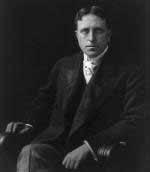 William Randolph Hearst |
MAURICE JOYCE: The newspaper built up strong public feeling against Spain. Soon, many Americans were calling for war to free Cuba from Spanish rule.
William McKinley was president. He did not want the United States to become involved. He did, however, offer to help Spain find a solution that would return peace to the island. Spain refused the offer. It attempted to improve the situation in Cuba by itself.
Spain called home the military commander accused of cruelty. It stopped putting people in prison camps. It offered equal political rights to all Cubans. And it promised them self-rule in the future.
LARRY WEST: President McKinley welcomed Spain's policy statements. He felt Spain should be left alone to honor its promises to the Cuban people. He said the United States would not interfere. At about that time, however, riots broke out in Havana. President McKinley said it was his responsibility to protect the lives and property of Americans living there. So, he sent the battleship "Maine" to Havana.
During the early weeks of 1898, President McKinley waited for Spain to act on its promises to Cuba. He saw little progress. Relations between the United States and Spain became tense. Then, on the night of February 15th, a powerful explosion shook the battleship Maine in Havana harbor. The ship sank. More than 250 American sailors were dead.
MAURICE JOYCE: No one knew what caused the explosion on the battleship Maine. The United States said it was an underwater bomb. Spain said it was something on the ship itself.
There was some evidence the explosion was caused by an accident in the ship's fuel tanks. Yet some people in the United States blamed Spain anyway. They demanded war. They cried: "Remember the Maine!"
That will be our story next week.
(MUSIC)
SHIRLEY GRIFFITH: Our program was written by Frank Beardsley. The narrators were Maurice Joyce and Larry West. You can find our series online with transcripts, MP3s, podcasts and images at voaspecialenglish.com. You can also follow us on Facebook and Twitter at VOA Learning English. Join us again next week for THE MAKING OF A NATION -- an American history series in VOA Special English.
American history: McKinley and the ‘gold standard’ win out in 1896
American history: labor unrest grows as Cleveland's measures fail to ease recession
American history: Cleveland backs ‘gold standard’ to cure economic downturn
American history: Cleveland returns to office facing farm, labor unrest
American history: Harrison's presidency marked by anger over trusts
American history: Benjamin Harrison defeats Cleveland over tariffs in 1888
American history: Cleveland opposes anti-immigration laws and high tariffs
American history: immigrants from Europe seek a better life in a new land
American history: labor unrest marks Cleveland’s first term
American history: Chester Arthur's term marked by disputes within his party
American history series: Garfield's short presidency ends in tragedy
American history: settlers rush to claim western land
American history: Custer's last stand against the Indians
American history series: Indian wars
American history: songs cowboys sung
American history: gold, land drive settlers West
President Hayes promises only one term in office
Hayes wins hotly disputed 1876 election
Grant’s second term worse than first
American history series: Grant's political battles
American history series: the election of 1868
American history series: rebuilding the South
American history series: Trial of Andrew Johnson
Andrew Johnson faces a fight over aiding South
American history series: the final surrender
American history series: after Lincoln's murder
President Lincoln is shot at Ford's Theater
American history series: Robert E. Lee's surrender
American history series: Confederate capital falls
Lincoln defeats McClellan in 1864 election
Sherman burns Atlanta in March to the Sea
American history series: the battle of cold harbor
Victory at Vicksburg splits the Confederacy
American history series: Lincoln at Gettysburg
South sees protests in North as an opening
American history series: Lee and his army cross into the North
The South wins a battle, but loses Stonewall Jackson
American history series: at Bull Run, a terrible defeat for the North
American history series: South defends its capital
American history series: the Civil War at sea
Lincoln names a general to defend Washington
American history series: the North loses the first major battle of the war
American history series: the Civil War's first days
(來源:VOA 編輯:陳丹妮)
 |
 |
 |
 |
 |
 |