The battles are often forgotten, but the Union victory might not have been possible without its naval victories.
Welcome to THE MAKING OF A NATION – American history in VOA Special English.
The American Civil War in the 1860s was fought not only on land. There was a great deal of fighting between the Union and Confederate navies.
This part of the war -- the sea war -- is often forgotten, but it was important. The Union victory might not have been possible without the successes of its navy.
Many battles took place just off the coast of the United States. Many others took place farther away, in international waters.
This week in our series, Kay Gallant and Harry Monroe talk about the naval side of the Civil War.
VOICE ONE:
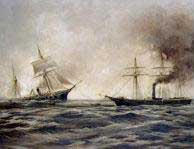
As soon as the war started, President Abraham Lincoln wanted to block the South's major ports. He wanted to prevent the South from shipping its agricultural products to other countries in exchange for industrial goods.
Lincoln's plan was good. But it had one major weakness. The Union navy was too small for the job.
The Confederate seacoast was long. It extended from Chesapeake Bay to Mexico, a distance of 5600 kilometers. There were not enough ships in the Union navy to blockade all of it. Many months would pass before the Union could build up an effective naval force.
VOICE TWO:
The Confederacy had no navy at the start of the Civil War. The Confederate government had little money to create one. And the South had no factories to build one.
For a while, the Confederacy was able to get warships from Britain. Then the Union put diplomatic pressure on Britain to stop this support. For the most part, the Confederacy depended on privately owned ships to get goods in and out of the South.
About 20 of these private ships flew the Confederate flag. Most were very successful in the beginning.
The Florida, for example, captured more than 30 ships before being captured itself off the coast of Brazil in 1864. The Alabama captured more than 60 ships. It was finally sunk in a battle with the Kearsarge off the coast of France.
The Shenandoah sailed in the Pacific Ocean. It captured 40 ships. After the war ended, the Shenandoah tied up in Liverpool, England.
VOICE ONE:
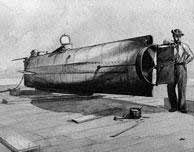
In addition to these victories, the Confederacy claimed responsibility for several new naval technologies during the Civil War. One was the first modern submarine.
This ship was ten meters long. It sank four times while being tested. It was raised each time and put back into service. One night, it fired its torpedoes at a much larger Union ship and sank it. But the explosion was so great that it tore apart the submarine. And it sank, too.
The Confederacy also developed very effective underwater explosive devices for use in the harbors.
VOICE TWO:
Even with its victories and technologies, however, the Confederacy could not stop the Union navy. The Union navy was bigger to begin with and grew much faster.

During the first two years of the Civil War, the Union captured several southern ports: Fort Hatteras and Roanoke Island, North Carolina. Port Royal, South Carolina. Pensacola, Florida. And -- perhaps most importantly -- New Orleans, Louisiana.
New Orleans lay near the mouth of the Mississippi River. It was the largest city in the south. It was the largest seaport. It had become a busy industrial center, producing war equipment for Confederate forces. If the Union could capture New Orleans, it would control the Mississippi River.
President Lincoln appointed navy officer David Farragut to lead the attack on New Orleans.
VOICE ONE:
To reach the city, Farragut had to sail his ships past two Confederate forts on the Mississippi River. He shelled the forts for six days and nights. But the forts were so strong that the shells caused little damage. He decided not to wait any longer.

One dark night, Farragut led 17 Union warships up the river in a line. The Confederate forces heard them and began to fire. One ship was sunk. Three others were damaged so badly that they could not continue. But 13 made it safely past the forts.
When Farragut reached New Orleans, he found the city defenseless. Several thousand Confederate soldiers had fled. They knew they could not defend against the bigger Union force. Only civilians remained. Farragut captured New Orleans without a fight.
The Confederate flag was lowered. And the United States flag was raised over the city.
VOICE TWO:
Several weeks before Farragut captured New Orleans, a new kind of navy battle was fought off Hampton Roads, Virginia. It was the first battle between iron ships.
On the Confederate side was the Virginia. It had been built from what remained of a captured Union warship called the Merrimack. The Virginia was like no other warship ever seen in the world.
It was 80 meters long. The part that showed above the water line was built of wood 60 centimeters thick. This part was covered with sheets of iron ten centimeters thick.
Ten windows were cut into it. Behind each window was a cannon. In a battle, the windows would open, the cannons would fire, and the windows would close again. At the front was a sharp point of iron that could smash through the sides of wooden ships.
The Virginia could not move fast. And it was difficult to control. It took almost 30 minutes to turn around. Still, there seemed to be no way to stop this iron monster. It already had destroyed two Union warships. And it was coming back for more.
VOICE ONE:

The Union ship chosen to fight the Virginia was the Monitor. It, too, was covered with iron. But it was much smaller than the Virginia. And it carried only two cannons.
These two cannons, however, were on a part of the ship that could turn in a complete circle. They could be aimed in any direction.
The Monitor and the Virginia faced each other on the morning of March 9th, 1862. They moved in close -- very close -- then began to fire.
A Confederate cannon ball hit the iron side of the Monitor and bounced away. Union sailors cheered. The cannons of the Virginia could do no damage! But the Union sailors soon discovered that their cannons could do no damage, either.
VOICE TWO:
The men inside the two ships suffered from noise, heat, and smoke. The roar of their own cannons was extremely loud. Even louder was the crash of enemy cannon balls and explosive shells on the iron walls.
Some of the men suffered burst eardrums. At least one man was struck unconscious from the force of a cannon ball against the iron. The men quickly learned to stay away from the walls.
Smoke from the cannons filled the ships. Then it floated out over the water. At times, the two ships could not see each other.
VOICE ONE:
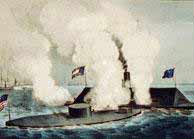
The Virginia and the Monitor fought for three hours. Neither ship scored an important hit. Neither suffered serious damage.
Then the cannons of the Virginia fell silent. The Confederate ship had used up its gunpowder. It also had used up much of its fuel. It was lighter now and was floating higher in the water. A well-aimed cannon ball could hit below its iron covering and sink it.
The Confederate captain decided to withdraw. The Union captain, too, was ready to break off the battle. He decided not to follow.
Neither ship could claim victory. But the Monitor had kept the Virginia from destroying more of the Union's wooden warships.
The Virginia itself was to live just two more months. Union forces seized the Confederate navy base at Norfolk, where the Virginia was kept. And the iron monster was sunk to keep it from falling into Union hands.
VOICE TWO:
The battle at Hampton Roads between the Virginia and the Monitor was undecisive. It did not have much effect on the final result of America's Civil War. But it was still an important battle. For it marked the beginning of the end of the world's wooden navies.
We will continue our story of the Civil War next week.
(MUSIC)
ANNOUNCER:
Our program was written by Frank Beardsley and Christine Johnson. The narrators were Kay Gallant and Harry Monroe. Transcripts, MP3s and podcasts of our programs can be found along with historical images at voaspecialenglish.com. Join us again next week for THE MAKING OF A NATION -- an American history series in VOA Special English.
blockade: obstruct access to 封鎖(blockade a harbor 封鎖海港)
torpedo: any of various submarine explosive devices, especially a submarine mine 魚雷
Related stories:
Lincoln names a general to defend Washington
American history series: the North loses the first major battle of the war
American history series: the Civil War's first days
The rise of the movement against slavery
(Source: VOA 英語點(diǎn)津編輯)


