Global tech partnerships highlighted at major tech show







Chinese technology companies are enhancing collaboration and partnerships with global technology leaders in the age of AI, a trend that executives said will better support global development and shared benefits.
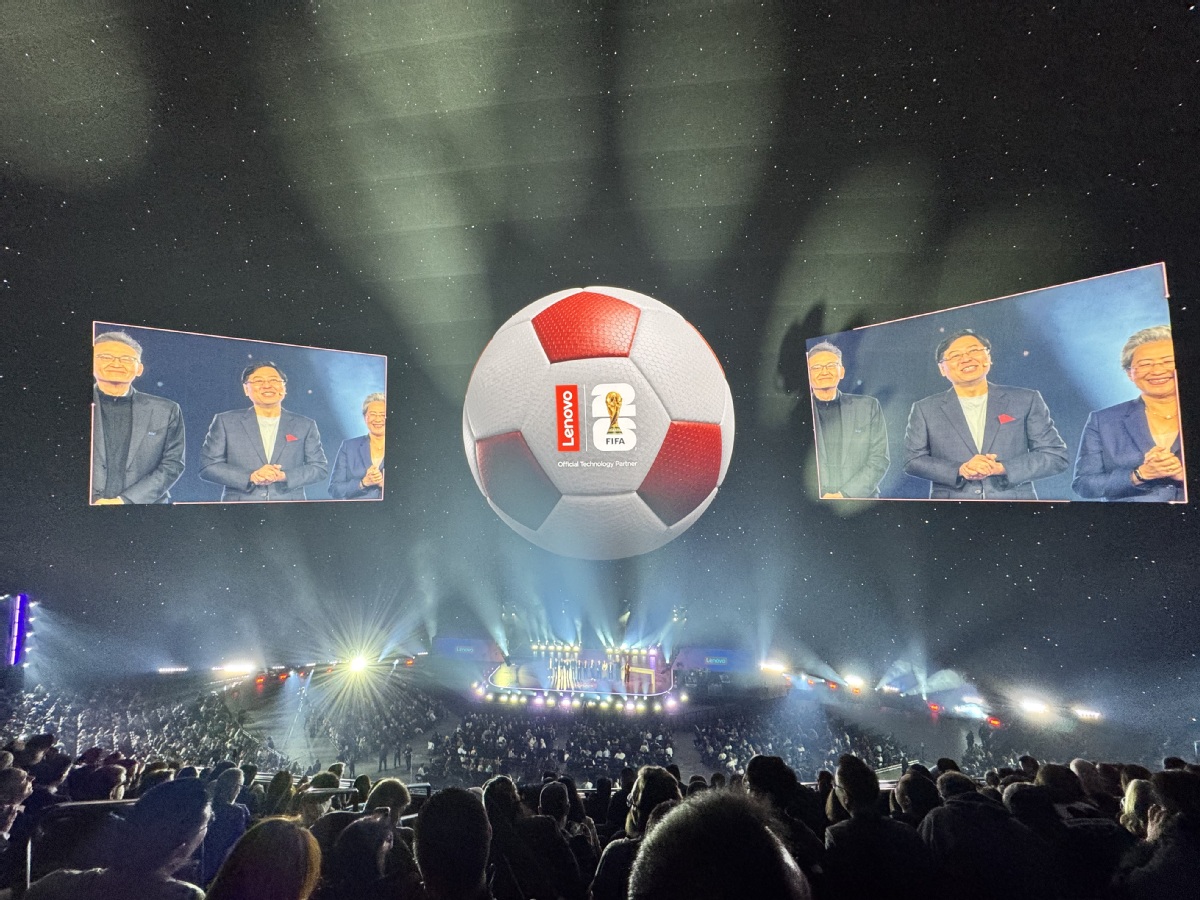
Presided over by Yang Yuanqing, chairman of Lenovo, a high-level event held during the Consumer Electronics Show brought together leading US semiconductor executives, including Jensen Huang of Nvidia, Lisa Su of AMD, Cristiano Amon of Qualcomm, and Lip-Bu Tan of Intel.
Observers said the executives' appearance on a stage convened by a Chinese technology company sent a key message throughout CES that global innovation increasingly depends on cross-border cooperation across industries and value chains, rather than isolated technological breakthroughs. Yang described the moment as a "new milestone" built on decade-long partnerships, particularly in the emerging field of hybrid AI.
That spirit of partnership was reflected in remarks at the CES show, when Huang noted Nvidia is working with Lenovo to build an AI gigafactory aimed at reshaping intelligent manufacturing.
Reflecting on the journey of the partnership, Huang said with humor that he and Yang met in their late 20s and early 30s. Together, they have witnessed successive platform shifts from mainframes to PCs, the internet, cloud and now AI — each fundamentally reshaping application development.
"One of the things that inspired this collaboration between us is the fact that Lenovo builds most of the world's supercomputers," Huang told the audience. "Very few people know that one-third of the world's Top 500 supercomputers are built by Lenovo."
The two companies unveiled a new gigawatt-scale AI factory program, designed to help AI cloud providers bring next-generation workloads and applications online faster, moving customers from creation to production at unprecedented scale.
"We are pushing AI factories to the gigawatt level to help move AI into production faster and more efficiently," Yang said.
Experts said the initiatives show a growing consensus that foundational technologies are not enough and that large-scale AI adoption requires close cooperation with partners that provide strong manufacturing, integration and global deployment capabilities.
Su said her company is focused on enabling enterprises to more quickly realize the benefits of AI through Lenovo's infrastructure platforms.
"Together with Lenovo, we are delivering performance, openness and choice, so AI investments can translate into real-world business outcomes," said Su.
Amon also highlighted Qualcomm's collaboration with Lenovo, noting that its Snapdragon platform is deeply integrated into Lenovo's AI PCs and new devices.
Partnership-driven innovation was further reflected in product collaboration. The Lenovo Aura Edition, developed with Intel, delivers an intelligent PC experience through enhanced AI performance.
"It is a major milestone in a multi-year journey, redefining what is possible when two global innovators come together to shape the future of the PC," said Tan.
Similar partnership-driven strategies were highlighted by other Chinese companies. Kenneth Hong, head of public relations for the Americas at Hisense, stressed the importance of partnerships in strengthening international brand recognition.
"You cannot succeed in today's business world without partnerships," Hong told China Daily. "We have partnerships with so many companies like Google, Amazon and others. The partnerships are essential to our business."
Hong cited Hisense's collaboration with a French audio company, whose technology is integrated into many of the firm's televisions and laser projectors, allowing Hisense to complement its strengths by tapping external expertise. He also noted that the company is leveraging its third FIFA World Cup sponsorship to enhance brand recognition, particularly in North America.
"We are a very big lifestyle company, not just a tech company," Hong said. "The ability to talk to soccer fans about our products and services will be a huge opportunity for us."
Despite intense competition, Hong said Hisense benefits from agility and faster decision-making. "Our competitors are very strong, and many are older than Hisense, but our speed allows us to make decisions quickly," he said.
The importance of integrating global and local technologies was also emphasized by Miles Han, senior vice-president of iSoftStone, a Beijing-based firm.
"We leverage Nvidia's hardware and software to provide full solutions for enterprise customers in China," Han said. "At the same time, we work with Nvidia outside China, in markets such as the Middle East and Southeast Asia."
This hybrid model, he said, enables Chinese companies to offer comprehensive solutions by integrating hardware from different manufacturers, creating value for both local and global partners.
Discussions throughout CES underscored that the next phase of AI development will be driven by coordinated execution from translating advanced chips and algorithms into scalable, real-world applications, making collaboration across the technology value chain indispensable.
From a consumer perspective, executives said such partnerships are ultimately aimed at delivering faster and more practical AI experiences to everyday users. Oliver Rootsey, executive director for Lenovo in Germany, said AI development is inherently ecosystem-driven.
"AI is an ecosystem. No single company can develop everything at the speed customers expect," Rootsey told China Daily. "It requires teamwork, open partnerships and strong commitments with other organizations to deliver products and solutions that really matter for customers."
renali@chinadailyusa.com