Himalayas warming 50 percent faster than global average: Study







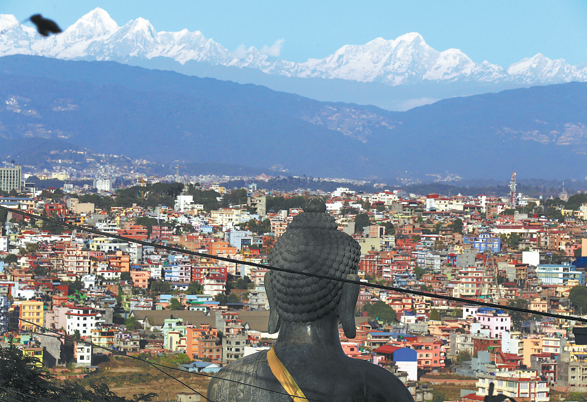
With global warming accelerating, the Himalayas and high altitudes in the mountain range are warming 50 percent faster than the global average since 1950, according to a new study. The study revealed the phenomenon can have devastating consequences for the people living or dependent on these regions.
Globally, compared to lowlands, mountains were expected to experience enhanced warming of 0.21 degrees per century during the period between 1980 and 2020, enhanced drying of 11.5 millimeters every century, and accelerated melting of snow of 25.6 mm every century, findings published in the journal Nature Reviews Earth and Environment show.
An international team of researchers from the University of Portsmouth observed the phenomenon, "elevation-dependent climate change", where changes in the environment accelerate at higher altitudes.
Factors triggering it include surface albedo, or radiation reflected by a surface compared to what falls on it, specific humidity, and aerosol levels in the air, according to the study.
"Mountains share many characteristics with Arctic regions and are experiencing similarly rapid changes," lead researcher Nick Pepin from the University of Portsmouth's Institute of the Earth and Environment said.
"This is because both environments are losing snow and ice rapidly and are seeing profound changes in ecosystems. What's less well known is that as you go higher into the mountains, the rate of climate change can become even more intense," Pepin said.
The team analyzed data from global datasets and reviewed evidence from case studies from mountain ranges.
"On a global scale, differences between mountain and lowland trends for temperature, precipitation and snowfall are 0.21 degrees Celsius per century (enhanced mountain warming), minus 11.5 mm per century (enhanced mountain drying) and minus 25.6 mm per century (enhanced mountain snow loss), respectively, for 1980-2020," the authors wrote.
"Such positive elevation-dependent warming is evident at historical and longer timescales, and despite much variation according to time of day, season and location, the mean warming at high elevations is nearly 50 percent faster than the global mean since 1950," the team said.
Most models were also found to predict continued warming of 0.13 degrees per century in the mountain regions throughout the 21st century, "but precipitation changes are less certain", they said.
Implications extend far beyond mountain communities. Over 1 billion people worldwide depend on mountain snow and glaciers for water, including in China and India, which receive water from the Himalayas, the researchers said.
"The Himalayan ice is decreasing more rapidly than we thought. When you transition from snowfall to rain because it has become warmer, you're more likely to get devastating floods. Hazardous events also become more extreme," Pepin said.
"As temperatures rise, trees and animals are moving higher up the mountains, chasing cooler conditions. But eventually, in some cases, they'll run out of the mountain and be pushed off the top. With nowhere left to go, species may be lost and ecosystems fundamentally changed," the lead researcher said.
THE STATESMAN, INDIA