The evolution of relic preservation
Role of science growing in unending pursuit of cultural inheritance







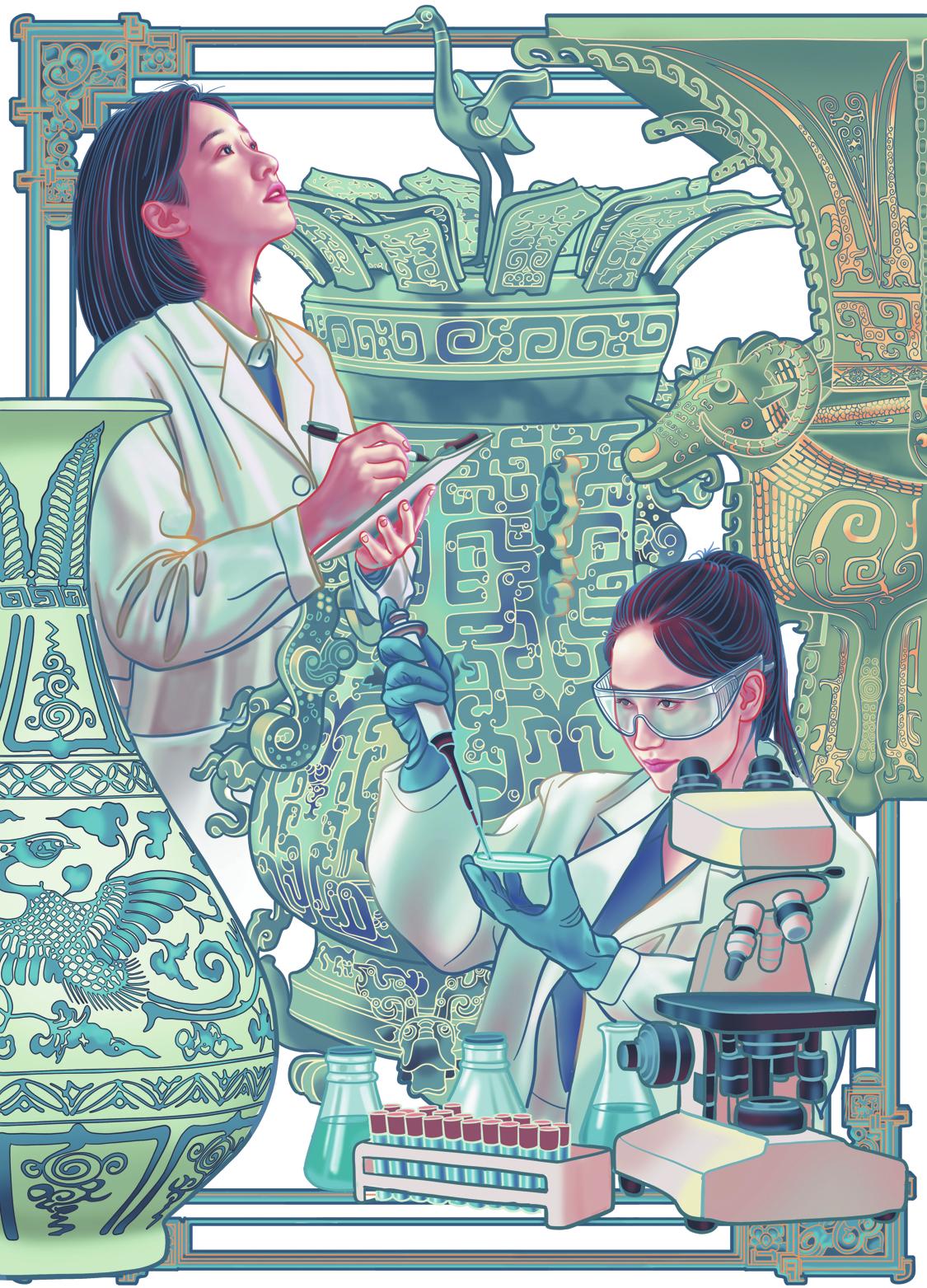
China is harnessing cutting-edge science and technology to preserve and study its rich cultural heritage, with national research bases leading groundbreaking work in fields ranging from ancient mural restoration to protecting relics in the event of an earthquake, according to a conference organized by the National Cultural Heritage Administration.
Held in Xi'an, Shaanxi province, in October, the conference gathered administrators and scientists from the administration's key technology and research bases to review achievements and future plans.
The meeting highlighted that the field of cultural relics is now at a critical juncture, with many important scientific questions and key technologies poised for revolutionary breakthroughs.
Officials said that innovation systems covering basic research, technology development and achievement transformation in the cultural heritage field will be built during the 15th Five-Year Plan (2026-30).
The conference aligned its mission with the broader national vision for cultural development. It resonates with the communique of the Fourth Plenary Session of the 20th Central Committee of the Communist Party of China, which called for "rooting the efforts in the profound depths of Chinese civilization, keeping pace with the trends in information technology, and developing socialist culture with Chinese characteristics for the new era — a culture with powerful capacity to inspire, great spiritual strength, strong appeal, and significant international influence".
Since 2004, the National Cultural Heritage Administration has established 40 key research bases, creating a comprehensive scientific research network that supports high-quality development in the country's cultural relics sector.
In recent years, these research bases have made progress while working toward their goal of becoming centers for technological research and development, talent cultivation, achievement promotion and international exchange, according to the conference.
In the field of risk prevention and control, they serve as guardians of cultural relics. Satellite remote sensing, drone patrols and real-time perception through the internet of things are among the advanced technologies being widely used to build intelligent firewalls for relics.
Ge Jiaqi, director of the key research base for the seismic protection of cultural relics and chief scientist from the China Aviation Planning and Design Institute, said at the conference that cultural relics have undergone fundamental changes in structural performance after thousands of years of erosion, often rendering current architectural safety theories ineffective.
To tackle this challenge, the base has proposed a discrete body mechanics theoretical model for predicting damage to brick-and-stone heritage structures, and developed new stability enhancement measures.
"The technology has been applied in the protection and display of heavy stone inscriptions such as Kaicheng Shijing (Kaicheng Stone Classics) in the Xi'an Beilin Museum," said Jia Qiang, head of the Shaanxi Provincial Cultural Heritage Administration.
In addition, the complete set of technical equipment for seismic protection of museum collections developed by the base is in use in more than 20 museums across the country and has withstood the test of multiple earthquakes measuring magnitude 6.2 or higher, according to Ge.
Yu Zongren, director of the conservation research institute at Dunhuang Academy, said in the field of conservation and restoration, these research bases are extending the life span of cultural relics. With complex disease mechanisms, restoration work often requires extreme caution. Through interdisciplinary research, the key research base for conservation of ancient murals at the Dunhuang Academy has built the world's first multi-field coupling laboratory for cultural relics, continuously deepening the understanding of relic diseases, he added.
"We have developed microbial treatment materials for tomb murals and weathering prevention technologies for sandstone grotto temples," Yu said, adding these innovations that have been applied in more than 200 projects across 16 provinces and regions are being promoted to countries involved in the Belt and Road Initiative, such as Kyrgyzstan, Nepal and Myanmar.
In the field of archaeological interpretation, these research bases act as decoders of civilization. The deep integration of technology has expanded archaeology beyond traditional tools like hand shovels and excavation units.
The integrated innovation of spatial science, molecular biology, nuclear technology and other methods has provided a more solid basis for revealing the origins, formation and development path of Chinese civilization.
The key research base for human evolution and genetics at the Institute of Vertebrate Paleontology and Paleoanthropology of the Chinese Academy of Sciences has achieved remarkable results over the past years.
Its ancient DNA team, through pioneering tracking, capture and in-depth analysis of genomes of modern East Asians and ancient humans, used key ancient DNA and ancient protein evidence to confirm that the Harbin cranium is linked to the early Denisovan lineage from Siberia, who were widely distributed in Asia, said Gao Xing, director of the base.
The team has published papers in international journals such as Cell, Nature and Science, proposing new hypotheses about the diverse ancestral populations and migration evolution patterns in East Asia, and constructing a China-Southeast Asia gene flow network.
Similarly, the key research base for metal and metallurgical heritage at the University of Science and Technology Beijing has clarified the origins of Chinese metallurgy.
These research bases serve as envoys of cultural dissemination, bringing cultural relics to life and into households.
In collaboration with the research institute of the Yungang Grottoes, the key research base for digital protection of grotto temple relics at Zhejiang University has created a 1:1 full-scale replication of Cave 3 of Yungang, allowing the magnificent grotto art to "travel" the world.
At the core of technological competition lies talent. Since their establishment, the research bases have made talent cultivation their key mission. After years of development, a professional team of scientific and technological talent has formed, becoming a valuable resource driving the high-quality development of the cultural relics sector.
As of last year, among the 1,436 permanent staff members in 40 research bases, 58 percent hold senior professional titles and 71 percent have master's degrees or higher, indicating a steady improvement in the talent hierarchy, according to the statistics from the National Cultural Heritage Administration.
At the key research base for metal and metallurgical heritage, the more than 40 full-time researchers have an average age of 39, with academic backgrounds spanning archaeology, metallurgy, materials and other disciplines, and 40 percent have overseas education experience, said Chen Kunlong, deputy director of the Institute for Cultural Heritage and History of Science and Technology at the University of Science and Technology Beijing.
Internationally, China's voice is becoming increasingly prominent. Various research bases have established stable academic cooperation with more than 20 countries, including the United States, Russia, the United Kingdom, France and Japan.
The key research base for conservation of textile cultural relics at the China National Silk Museum has initiated the World Silk Interactive Map project, attracting about 40 institutions from 13 countries to participate, constructing the world's first silk heritage database.
wangqian@chinadaily.com.cn