Deaf children's choir finds rhythm in verse







In May, primary-school teacher Li Bailin was approached by a Beijing-based musician who had formed a choir made up of deaf children.
"He wanted me to teach them poetry writing, which they could then weave into their stage performances," Li said.
She agreed, and soon set out from her home in Huitong county, Hunan province, to Guilin in the Guangxi Zhuang autonomous region, about 250 kilometers away.
Although a sign language expert was present to interpret, Li found it deeply frustrating to face a flurry of frantic hand gestures she could not comprehend. "They kept repeating them — again and again — their hands almost pleading to be understood," she said. "I felt helpless for them, and ashamed of myself."
She decided to put her thoughts into writing, but another challenge soon emerged — the children's Chinese vocabulary was limited, and long sentences were difficult for them to follow.
When it came to poetry, Li decided to let her students in Hunan introduce the deaf children to the art form.
"I had prepared recordings in which my students expressed their wish to be friends," she said. "Then I showed the deaf children The Field Poetry Class, a published collection of poems from my students, and let them choose their favorites — getting to know their new friends through poetry."
Yet most of the deaf children, unfamiliar even with basic punctuation, struggled to write their own poems.
Li found a creative solution: "I wrote each single line from the book on a slip of paper and let the children select the lines to assemble into new poems of their own."
The result was short, simple childlike poems filled with a sense of wonder. One 13-year-old deaf boy wrote: "Morning/I pluck a single blade of grass/Its roots entwined within my heart/My favorite — so lovely/So full of song."
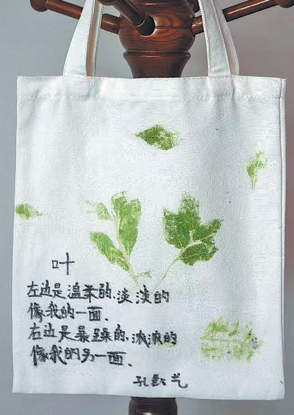
Another method involved the deaf children being blindfolded and feeling potted flowers, then drawing what they imagined from touch alone. The answer was revealed afterward, followed by careful observation — and a rubbing exercise, in which they transferred the plant's image onto cotton bags. "The process allowed them to engage all their senses except hearing, which they compensated for by sharpening the others," Li said.
The teacher quickly observed the children's writing was strongly shaped by their use of sign language. In other words, the order of words on the page mirrored the sequence of gestures they made.
"Instead of writing 'beat the drum', they would write 'drum beat', because in sign language, they first gesture for the drum and then for the act of beating," Li explained.
Rather than trying to correct them, Li allowed her deaf students to follow the natural cadence of their thoughts — a rhythm she believes lies at the heart of every poem.
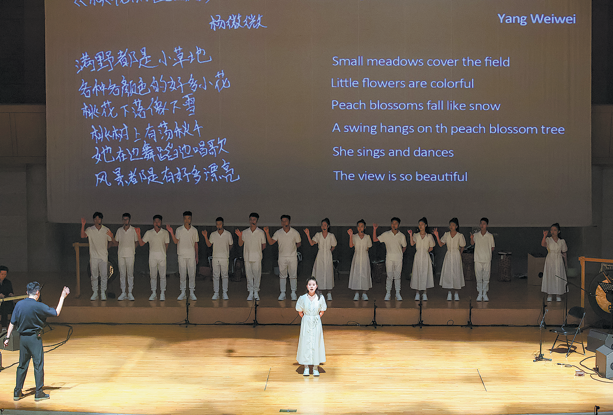
In September, 15 of the deaf children took the stage at Beijing's Forbidden City Concert Hall. As each of their poems appeared on a big screen behind them, they stepped forward one by one to perform — rendering their verse through movement and expression.
Then came the recitation — their voices, those of children too profoundly hearing-impaired to speak, rising and falling in waves of "ahs" and "ohs", a "language "that spoke straight to the heart.
Of all the poems, the one that touched Li most was written by the 16-year-old girl who had once likened the two leaves she had rubbed onto a cloth bag to the two sides of herself — one "soft and light", the other "tempestuous and dense".
In a poem titled "In Truth", the girl wrote:
"In truth,
I have never liked sign language —
not at all.
Yet it helps me when I want to say 'thank you'."




- 10 dead and 84 injured in explosion at steel plant
- China unveils flexible urban planning rules to improve lives, foster new industries
- Ex–China Construction Bank executive gets 18 years for bribery, loan violations
- First batch of eco-friendly pioneer zones for construction of beautiful countryside unveiled
- Woodpeckers, finches captured in Jilin winter scenes
- Mainland reiterates 1992 Consensus as foundation for resuming cross-Strait dialogue