Photovoltaic power can help boost rural incomes







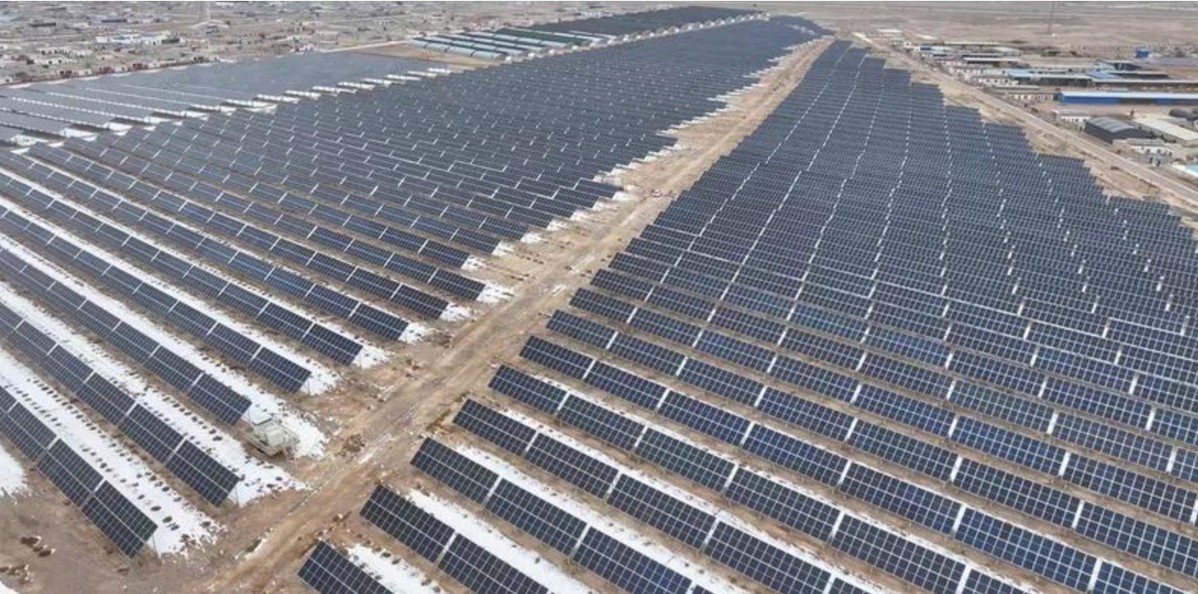
Household distributed photovoltaic (PV) systems have emerged as an essential driver of urban-rural green development and a powerful engine of rural vitalization in China in recent years. They will help advance all-around rural vitalization and create fine living spaces in rural areas, as outlined in the Recommendations of the Central Committee of the Communist Party of China for Formulating the 15th Five-Year Plan for National Economic and Social Development. By increasing the share of renewable energy supply, household PV will contribute to the orderly transition from fossil fuels during the 15th Five-Year Plan (2026-30) period.
The 14th Five-Year Plan (2021-25) period witnessed rapid growth in the installation of household PV systems in rural areas. By the end of September 2023, more than 5 million PV systems had been installed in rural areas with an investment of more than 500 billion yuan ($70.4 billion). As of June this year, the installed capacity of household PV systems was 180 million kilowatts, generating roughly 14 billion yuan in additional annual income for residents.
PV adoption by rural households has grown through three practical business models tailored to different regions in the country. The first model is a self-owned system, where residents pay the full installation cost that ranges from three to four yuan per watt, and earn an annual return of around 12 percent. The second model is co-development, where companies cover the installation expenses and residents provide the rooftops and both parties share the revenue in an agreed ratio. The third is roof leasing, where residents get a fixed rental income, typically between 800 and 2,000 yuan per year.
The phenomenal growth trajectory of PV systems has been propelled by supportive policies. Central authorities are promoting green urban-rural development and the transformation of energy production and consumption through subsidies and tax incentives, while some local governments, including Zhejiang and Guangdong, have added more incentives for solar power generation. Financial institutions have chipped in by offering "PV loans" at low interest rates to help cover initial costs. These measures have facilitated the adoption of PV systems and significantly boosted local household PV deployment, particularly in rural areas.
China's vast territory has significant geographical variations, which means the solar story varies widely across the country. Sun-rich provinces such as Shandong and Hebei, with more than 1,500 hours of average annual sunlight, enjoy a shorter payback period and dense rooftop coverage. In the south, Hunan and Jiangxi have innovated with "PV plus agriculture" models that enhance land use efficiency while increasing the number of installations.
The profusion of household PV systems has led to tangible benefits for residents in both rural and urban areas. A typical 10-kW system can generate 12,000-15,000 kWh of electricity a year, boosting the owner's annual income by several thousand yuan. Integrated models, such as the "fishery plus PV" projects in Rudong county, Jiangsu province, which combines PV power generation with aquaculture, have also enhanced earnings. For millions of residents, household PV systems have become a new source of income.
The additional income is not the only gain. The deployment of household PV has significantly advanced the transition to clean energy in rural China. The widespread installation has also reduced costs. Households in remote mountainous areas can now replace diesel generators with solar power systems.
The environmental and social gains are substantial to say the least. A single 10 kW household PV system can reduce carbon dioxide emissions by approximately 12 tons annually — equivalent to planting about 600 trees. The thriving sector has created numerous jobs in installation and maintenance. Jinzhai county of Anhui province is an example of how the PV industry has bolstered local employment.
Household PV has also paved the road for rural vitalization. In Shouguang county of Shandong province, PV projects have significantly boosted local income and facilitated investment in rural infrastructure. In the Ningxia Hui autonomous region, a pilot PV plus agriculture model generates power from solar panels installed atop greenhouses that grow mushrooms, effectively doubling the output value per unit of land.
Given the thrust on clean energy transition during the 15th Five-Year Plan period, the prospects for household PV development are very bright. However, several challenges need to be addressed.
The limited grid capacity in some regions restricts the integration of solar power into the grid. Despite significant investments in upgrading the rural grid, further efforts and funding are needed. Additionally, the quality of PV modules requires closer scrutiny. Relevant authorities have already introduced industry standards to strengthen oversight and ensure product quality. Furthermore, the financial risks associated with certain PV loans need careful monitoring.
China's household PV boom is not only driving economic growth and optimizing the energy mix, but also advancing rural vitalization and environmental protection. While challenges persist, ongoing innovation in policy design, technology and business models will forge a new path for green urban-rural development. The country's experience provides valuable lessons for other countries seeking to achieve green and low-carbon energy transitions.
The author is a senior counselor and researcher at the Institute of Energy Research of the Academy of Macroeconomic Research.
The views don't necessarily represent those of China Daily.