ASEAN urged to grow home solar market







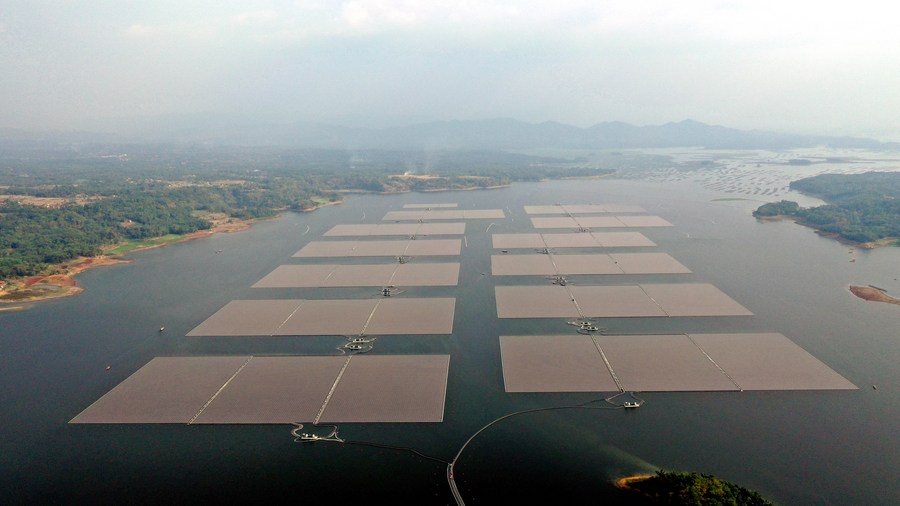
Southeast Asian countries should accelerate their energy transition and boost domestic solar demand to mitigate the potential effect of steep US tariffs on solar panels imported from the region, analysts say.
Boosting domestic renewable energy generation will protect the green technology industry that is being threatened by such tariffs, they said.
Starting June 9, the United States will impose tariffs ranging from about 14 percent to more than 3,400 percent on solar exporters in Cambodia, Malaysia, Thailand and Vietnam. The US Commerce Department said last month that imports of solar cells from the four countries "are being dumped into the US market" and are receiving government subsidies.
Putra Adhiguna, managing director of Energy Shift Institute in Jakarta, said, "Replacing a market the size of US will not be easy, but (the solar exporters) will need to try, including boosting domestic solar installation."
The barriers may open up a narrow window of opportunity for other regional countries not targeted by US tariffs, Adhiguna said. However, the opportunity cannot be sustained unless the Association of Southeast Asian Nations can bolster domestic demand, he said.
According to the US nonprofit Institute for Energy Economics and Financial Analysis, the US imported 55 gigawatts of solar panels last year, nearly 90 percent of which came from ASEAN members. The region also exported 14 GW of solar cells to US assemblers.
The institute has estimated that robust US demand for solar products could support some increased import costs, but any price increase beyond 250 percent would make most ASEAN imports untenable.
'Real opportunity'
Grant Hauber, the institute's strategic energy finance adviser, said the tariff hikes should encourage ASEAN to diversify its energy sources as domestic markets "represent a real, short-run opportunity" for its green technology sector.
This will also help ASEAN members to meet their decarbonization targets and protect domestic economies from global oil price volatility, Hauber said.
"Renewable energy is a hedge against global market changes because your cost of (installing) renewable energy (infrastructure) is your up-front cost of investment, and that's it. You don't have to (import) fuel."
However, analysts said that beyond boosting consumer demand, ASEAN members need to upgrade their power grid infrastructure to better accommodate renewable energy generation.
A study published in March by the ASEAN Centre for Energy in Jakarta revealed that ASEAN member states have distinct challenges integrating distributed energy resources, such as rooftop solar photovoltaic systems and battery energy storage, into the grid.
Vietnam, the renewable energy leader in the region on back of its high installed capacity, struggles with transmission congestion, forecast errors and low system inertia, the study said. Thailand also deals with major line tripping and generation trips.
Shabrina Nadhila, an Indonesian analyst for the global energy think tank Ember, said there is growing interest for renewables in the Asia-Pacific region and that Southeast Asian countries can leverage this momentum by diversifying their export destinations.
"The current trade landscape also opens the door for these (solar exporting) countries to regional partnerships within ASEAN and strengthen intra-regional trade," Nadhila said, noting that whether it is renewables or fossil fuels, it is risky for any country to rely on a single energy source.
"Building a diverse and resilient energy system is part of national energy security," she said.
Leonardus Jegho in Jakarta contributed to this story.
prime@chinadailyapac.com