'Overcapacity' just an excuse of US protectionism








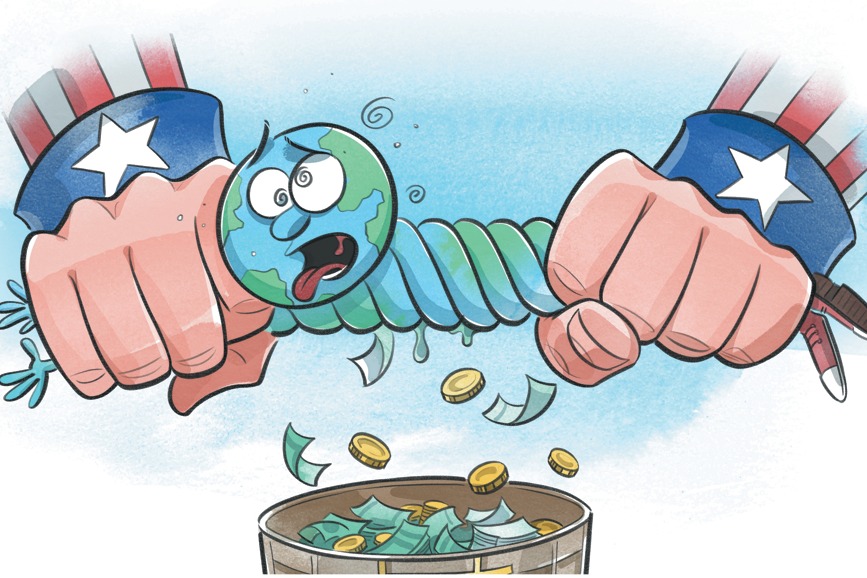
News has emerged that the US administration is anticipated to announce new tariffs on Chinese electric vehicles (EVs), semiconductors, batteries, solar cells, steel, and aluminum on Tuesday. Specifically, the tariffs on EVs are set to escalate to 100 percent, marking a quadruple increase from the existing 25 percent tariff. This decision, in excuse of China's purported overcapacity, is essentially a clear act of protectionism.
Since the global industrial sector has always endeavored to reduce overcapacity and strike a balance between supply and demand in the global market, one has to view overcapacity from the perspective of the market to truly understand the global industrial situation.
First, some countries produce more than what they need to meet their domestic demands, so they can export some of the products to countries which need them to complement their insufficient supply. In fact, Nicholas Lardy, a senior fellow at the Peterson Institute for International Economics, questions whether producing more than needed should be called overcapacity: if every country produces only to meet its own consumption demand, global trade would cease to exist.
China's recent significant increase in the exports of EVs, lithium batteries and solar photovoltaic (PV) products mainly reflect the increasing global emphasis on environmental protection and development of green technology and intelligent economies. More important, China has been exporting such products because the demand is real.
Second, surplus is always relative. So, aside from the relationship between supply and demand, we also need to consider the long-term, structural changes in supply and demand, as well as the changes in external factors that help form new supply and demand relationships in order to determine whether there is overcapacity. The fact is, demand for new energy products is rising because most countries are pursuing sustainable development. This trend is likely to continue.
According to the International Energy Agency, by 2030 the global demand for EVs will reach 45 million, which is 4.5 times that of 2022. Global demand for newly installed capacity for photovoltaic products will reach 820 gigawatts, which is about four times that of 2022. The current global capacity of new energy products is far from enough to meet the current and future demand of both developed and emerging economies.
Considering the trend of environmental protection in developing countries, it can be said that there is huge real and potential demand for new energy products in the world, which suggests there is insufficient supply instead of overcapacity. Hence, by exporting more new energy products, China is increasing global supply, alleviating inflationary pressure, promoting global environmental protection and meeting the global demand for green products.
It is misleading to assume that China's subsidies for the new energy industry have unfairly advantaged Chinese companies, leading to alleged “overcapacity”. Chinese products succeed in the market due to their competitive pricing and quality. Moreover, it is crucial to note that providing subsidies to the new energy sector is a widespread practice globally as countries strive for sustainable, environmentally friendly development.
Both the United States and the European Union grant huge subsidies to such industries. In 2022, the US passed the Inflation Reduction Act, providing $369 billion in tax incentives and subsidies for clean energy projects. And many EU states continue to give huge subsidies, from tax exemptions to purchase discounts, to both EV makers and buyers. On the other hand, China's subsidies to the new energy sector have been declining year by year due to the fast development of the industry.
The new energy industries, especially the EV sector, have developed rapidly because of the Chinese people's increasing awareness about the advantages of emissions reduction and environmental protection, massive investments by private enterprises in R&D, China's complete industry and supply chains, 5G connectivity for intelligent driving, and excellent mileage on highways.
And third, claiming that China's increase in EV exports signifies “overcapacity” is unfair, because the country exported only 12 percent of the EVs it produced. In contrast, Germany exported nearly 80 percent, Japan nearly half, the Republic of Korea about 70 percent and the US nearly 25 percent of their automobile productions. So which country (or countries) has overcapacity?
In 2023, China emerged as the leading auto exporter for the first time, shipping out 4.91 million vehicles, surpassing Japan's exports of 4.42 million vehicles. Additionally, several other countries also exported a substantial number of vehicles, for instance, Spain exported about more than 2.2 million. This data refutes the notion of overcapacity and underscores legitimate concerns regarding competition in the global automotive market.
In addition, the causes of overcapacity in a given period are complex, and need to be analyzed and handled on a case-by-case basis. For example, during the COVID-19 pandemic, the US and European countries helped their residents by giving them “l(fā)iving allowances”. At the time, the economic activity of these countries had almost come to a standstill, so they needed to import huge quantities of general consumer goods. China and other countries expanded their production capacity to meet the sudden increase in global demand. That demand, however, declined drastically with the end of the pandemic, creating “overcapacity” in those countries that had expanded their production capacity to meet other countries' demands.
So instead of discussing “China's new energy products and overcapacity”, the countries would do better to deepen cooperation, further promote the development of the new energy industry, establish a sound global new energy product chain, build a global production network of new energy products and meet the sustainable development needs of countries to achieve win-win results. China has set an apt example in this regard by lifting the entry barriers to its manufacturing sector.
Huang Weiping is a Jean Monnet chair professor at the School of Economics, Renmin University of China; and Wang Xiangran is an assistant researcher at the same school. The views don't necessarily reflect those of China Daily.
If you have a specific expertise, or would like to share your thought about our stories, then send us your writings at opinion@chinadaily.com.cn, and comment@chinadaily.com.cn.