Japan's dangerous shift threatens regional stability








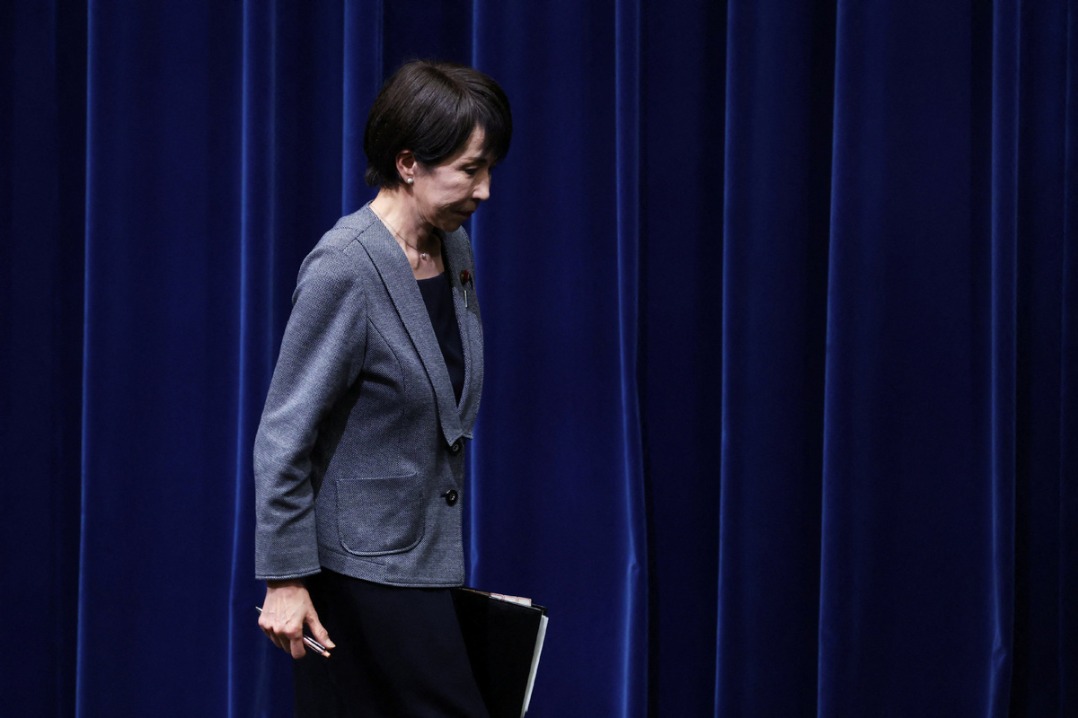
The Takaichi cabinet continues to close its eyes to reality. During a televised debate on Monday, Japanese Prime Minister Sanae Takaichi declared that Japan's strategic alliance with the United States would "collapse" if Tokyo were to turn away from a "conflict" in China's Taiwan. This follows her Nov 7 assertion that "a Taiwan contingency" could constitute a "survival-threatening situation" for Japan.
Japanese politics has drawn international attention in recent months for what is seen as a dangerous shift in the country's historical perception, diplomatic stance and security policy. The prime minister has evaded a clear position on whether Japan's Three Non-Nuclear Principles will be upheld during revisions of three key security documents, casting ambiguity on the country's nuclear policy pledges. At the same time, Japan's defense budget for fiscal year 2026 touched a record high of over 9 trillion yen ($58.25 billion) while the Takaichi Cabinet is seeking to ease restrictions on weapons exports to strengthen its defense industry. Such actions further erode Japan's "exclusively defense-oriented" policy and signal a resurgence of Japanese militarism.
What makes this trajectory particularly dangerous is Japan's failure to come to terms with its history of aggression. From the First Sino-Japanese War (1894-95), through the expansion of military aggression following the Sept 18 Incident in 1931, and culminating in the full-scale invasion of China in 1937, Imperial Japan inflicted immense suffering across China, the Korean Peninsula and Southeast Asia. Atrocities such as the Nanjing Massacre, biological warfare, forced labor and the sexual abuse of "comfort women" have been extensively documented and legally affirmed by the verdict of the International Military Tribunal for the Far East.
Postwar Japan's reintegration into the international community was based on its acceptance of the conditions stipulated under the Cairo Declaration and the Potsdam Proclamation. Japan had to surrender unconditionally, account for its aggression and renounce its right to engage in war, which is codified in Article 9 of Japan's Constitution. This also laid the foundation for Japan's postwar foreign and security policies.
But the actions of the Takaichi administration are steadily eroding this foundation. Historical perception is an integral component of national identity. A nation's understanding of its past shapes its perceptions of security and threats, and ultimately influences its policies. Germany played a stabilizing role in the postwar European order because it institutionalized the reflection on Nazi history. In contrast, the persistent historical revisionism in Japan has led to contradictions in its external narrative.
What's especially concerning is that this revisionism is influencing Japan's security policies. The Takaichi administration has consistently exploited regional security and the Taiwan question as pretexts to downplay Japan's history of aggression and to break free from postwar constraints on militarism. The political logic is unmistakable — and dangerous.
This shift hits at the core of China-Japan relations. It challenges Japan's acknowledgement of its wartime responsibilities and its commitment to peaceful development, as inscribed in crucial political documents such as the Sino-Japanese Joint Statement of 1972 and the Sino-Japanese Treaty of Peace and Friendship of 1978.
In the past, Japan has made some pragmatic choices regarding China. Although profoundly influenced by the United States in security and foreign affairs, Japan pursued limited economic and trade exchanges with China. During the 1950s and 1960s, political communication between the two countries remained restricted and non-official rather than normalized, reflecting the constraints of the US-led strategy to contain and isolate China. Even so, these pragmatic adjustments during the Cold War suggest that Japan's China policy was not always a simple or automatic alignment with external powers.
This pragmatism was institutionalized in 1972 with the normalization of Sino-Japanese relations. During the negotiations for diplomatic relations, Japan pledged to recognize the Government of the People's Republic of China as the sole legal government of China and to sever all official ties with the Taiwan authorities. In the joint statement of 1972, Tokyo expressed its full understanding and respect for Taiwan as an inalienable part of China's territory and affirmed its adherence to the position of Article 8 of the Potsdam Proclamation.
This closely connected the outcomes of the postwar international law with practical diplomatic commitments, clarifying that the Taiwan question falls within the scope of the postwar settlement of Japan. It was due to this unambiguous "Japanese formula" that China-Japan relations were swiftly normalized, serving as an important reference point for the normalization of Sino-US relations.
The dividends were tangible. Trade expanded, cultural and people-to-people exchanges flourished and China-Japan friendship became a stabilizing pillar in East Asia for decades. It demonstrated that when Japan respects history, adheres to its postwar commitments and adopts a rational and pragmatic policy toward China, it not only helps improve its relations with neighbors but also serves its own long-term interests.
Today's deviation from that path threatens to undo decades of efforts. Notably, the Takaichi government represents the narrow interests of the right-wing faction within the Liberal Democratic Party. Its push to bolster the military industry and dilute the "exclusively defense-oriented" policy has sparked domestic protests and raised concerns within the international community. Lawmakers from other parties, such as Komeito, have warned that the Three Non-Nuclear Principles are unshakable and cautioned Takaichi against playing with fire.
The Takaichi cabinet should draw the right lessons and correct rhetoric rooted in historical nihilism and militarism. Tokyo should return to a path that respects historical facts and honors postwar commitments. This approach is essential for earning enduring trust of the international community. Failure to do so risks being cast into the dustbin of history.
The author is a research fellow at the Institute of Modern History of the Chinese Academy of Social Sciences.
The views don't necessarily represent those of China Daily.
If you have a specific expertise, or would like to share your thought about our stories, then send us your writings at opinion@chinadaily.com.cn, and comment@chinadaily.com.cn.