'Diversifying' supply chain a better approach for Germany







Amid the trade and technology tension between the United States and China, the German government used the term "de-risking "in a recent report to describe its strategy on China.
Instead of calling it de-risking, describing it as a diversifying strategy would be more diplomatic and no less accurate.
A de-risking strategy anchors on risk reduction to decrease the likelihood and severity of conflict. A diversifying strategy can also mitigate risk, but it captures the spirit of balancing risk and opportunity. Even though the terms are synonymous, the latter is easier for China to accept because, after all, it wants to be seen as an economic opportunity for Germany, not a risk.
The "Strategy on China "report reveals Germany's desire to engage China by combining competition and cooperation. On the one side, Germany needs to sustain its trade with China. Conversely, Germany seeks to become less dependent on China to ensure supply chain resilience. This perspective is understandable, but calling it a "de-risking" strategy is offensive. Indeed, Foreign Ministry spokesman Wang Wenbin responded to the report by stating that viewing China as a source of risk is a serious "miscalculation".
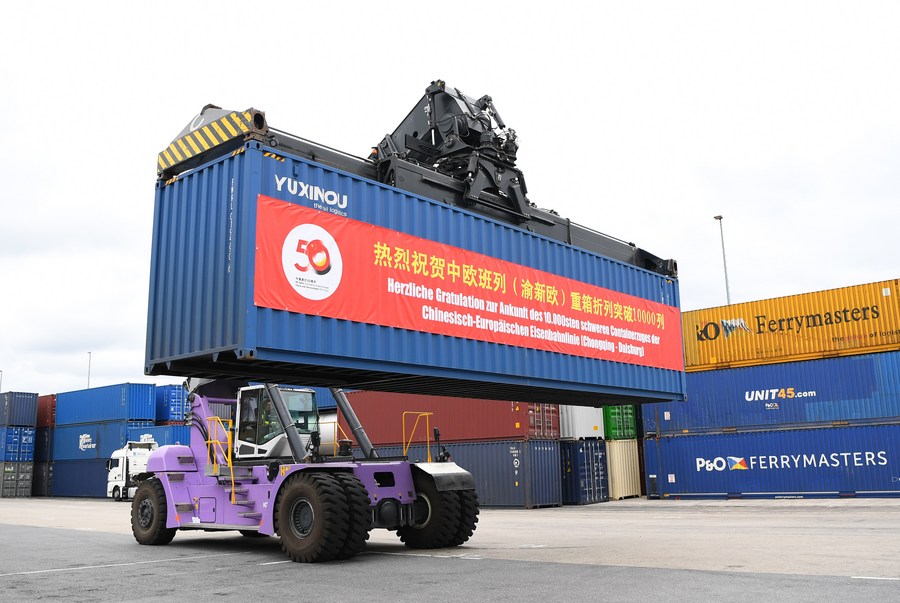
The trade relationship between Germany and China has been strong for decades. For example, Volkswagen was one of the first automakers to establish major manufacturing facilities in China, starting in 1978. Since then, China has become its most important market, accounting for 50 percent of VW's worldwide sales in 2021. Indeed, China has been Germany's biggest trade partner for the past seven years, with bilateral trade rising to a record-high 298 billion euros ($327 billion) in 2022.
While the economies of China and Germany have been intertwined for decades, Germany's depiction of de-risking is baffling and inconsistent, especially after Germany sent strong signals to China about its desire to further strengthen trade ties.
First, German Chancellor Olaf Scholz visited China in November to assure President Xi Jinping that "business with the world's second-largest economy must continue". Also, Scholz's trip was accompanied by a delegation of 12 German industry titans, including the CEOs of Volkswagen, Deutsche Bank, Siemens and chemicals giant BASF, with a view to expanding the two countries' economic cooperation.
New market opportunities have since been generated for both countries. In April, for example, Volkswagen announced its commitment to invest over 1 billion euros to develop an electric car and establish a business center in Hefei, Anhui province.
In addition, in May the German government approved Chinese company COSCO's 24.99 percent ownership share of a container terminal at the Port of Hamburg. This approval was a compromise for the coalition partners of Scholz's Social Democrats to quell intense opposition from the Greens and the Free Democrats. However, the approval can improve operational efficiency, as close to one-third of the goods handled at Hamburg are from or destined for China.
Given these positive economic developments this year, it came as a surprise to China when Germany defined China as "a partner, competitor and systemic rival" in its report. The report calls for reducing dependence on China in critical sectors such as medicine, batteries and chips, which appears to resemble the strategy adopted by the United States.
This abrupt change of narrative is probably triggered by three risk factors.
First is the political risk. Germany is pressured by other European Union countries and the US to adopt a more critical and confrontational approach toward China — in other words, to view China as a threat and not an opportunity.
Second is the supply risk. Some economists have warned that Germany's supply dependency on China has exceeded that of the US and France, especially in raw materials and intermediary products. For example, China has 80 percent of the solar panel and 60 percent of the electric vehicle battery markets worldwide. China also accounts for 98 percent of global production of gallium and 68 percent of the refinery production of germanium, which are critical to producing advanced chips. China's announcement in July that it will restrict exports of gallium and germanium stoked new supply fears.
Third is the climate risk. Germany was late in embracing electric vehicle development to fight climate change. By this year, Germany's EV market was behind those of China and the US. As Germany takes pride in its automotive sector and environmental sustainability, the idea that it would rely on China's solar panels and electric vehicle batteries to fight climate change did not sit well with the public in Germany.
To strike a balance between risks and opportunities, diversifying Germany's supply base by cultivating alternative suppliers makes sense. For example, in 2022, BMW announced its plan to build electric vehicles in the US state of South Carolina and source EV battery cells in the US. In addition, Siemens announced in July that it plans to invest 1 billion euros in new factories to make electronic components and machine-tool controls.
Instead of calling it de-risking, "diversifying" the supply base is a more realistic and diplomatic term that should be more acceptable to China. This is because many Chinese enterprises also diversified their supply bases from China to Vietnam to ensure supply chain resilience during the COVID-19 pandemic, to reduce import tariffs during the trade war with the US by changing the country of origin to Vietnam, and to reduce labor costs.
When engaging with China, do as the Chinese do. Some supply chain diplomatic juggling can help Germany to strike a more agreeable balance between cooperation and competition.
The author is a distinguished professor at the UCLA Anderson School of Management.