China and the World in the New Era







III. A Prosperous and Beautiful World Is the Common Aspiration of All Peoples
Peace and development remain the underlying themes of our times. However, the world is facing many new problems and challenges. Unilateralism, protectionism, hegemonism, and power politics are some of the major factors affecting world peace and stability. It is a common aspiration of the peoples of all countries to build an open, inclusive, clean, and beautiful world that enjoys lasting peace, universal security, and common prosperity, and where everyone lives in peace and plenty.
1. The world is undergoing the greatest changes in a century
Humanity has made remarkable progress over the past century despite many bloody wars and the Cold War. The 21st century has witnessed growing economic globalization and a rapidly changing international political and economic landscape. Deep-seated problems in global development have become increasingly prominent. The international structures of power have been moving towards balance. The international order and global governance system have experienced further changes. All this shows that the world is in an era of major development, transformation and adjustment, and is undergoing the greatest changes in a century.
Change brings opportunities. One of the most notable changes is that the rise of China and other emerging market and developing countries is fundamentally altering the international structures of power. International politics and the economic system have been dominated by Western powers since the First Industrial Revolution. In more recent decades, emerging market and developing countries have realized rapid growth by seizing the historic opportunities presented by economic globalization. According to the latest data released by the IMF, the share of emerging market and developing economies in global output, measured by purchasing power parity, first surpassed that of advanced economies in 2008, and rose to 59% in 2018.
The world is moving rapidly towards multipolarity, diverse modern development models, and collaboration in global governance. It is now impossible for one single country or bloc of countries to exercise dominance in world affairs. Stability, peace and development have become the common aspirations of the international community. Science and technology is a leading force driving major changes. Advances in the new technological revolution and industrial transformation, and the widespread use of new-generation information technology, have generated new tools, industries, and forms of business, moving our productivity to a higher level.
Change brings risks and challenges. The profoundly evolving international landscape involves complex and intertwined changes, and the interaction of old and new factors, forces, and problems. It also means greatly reshaping the relations between major countries, the international order, regional security, the trends of thought, and the global governance system. Factors of instability and uncertainty are increasing. Deficits in governance, trust, peace and development are growing. The world is facing the danger of a relapse into fragmentation and even confrontation.
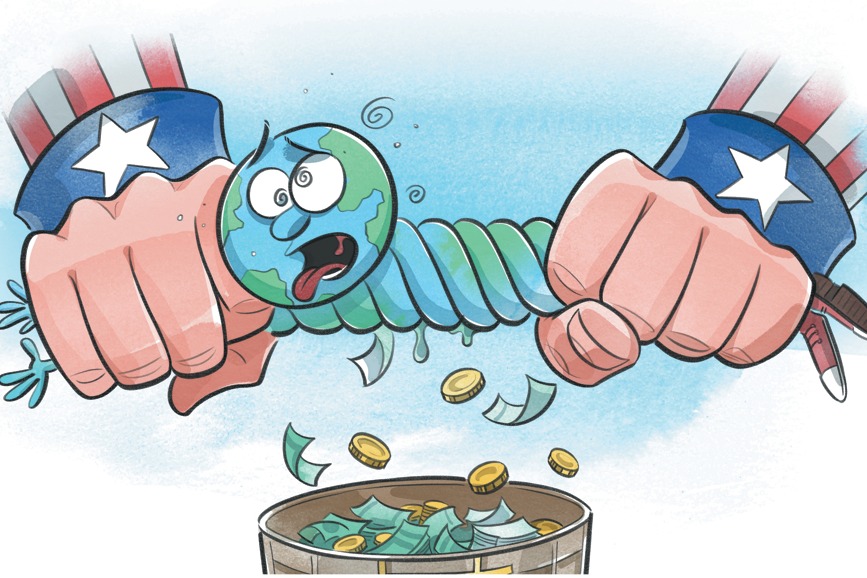
The world economy is slowing down for lack of impetus, and the gap between the rich and poor is widening as a consequence of capital's excessive pursuit of profit. Trade protectionism is on the rise. Global public and private debt is rising steeply. Some emerging economies have encountered major financial turbulence. The world economy is facing mounting downward pressure (see Box 11).
Box 11 The Slowing World Economy Faces Major Risks
Global economic growth is sluggish. In April the IMF projected a decline in growth in 2019 for 70 percent of the global economy. In July the IMF forecast a growth of 3.2 percent for the global economy in 2019, 1.9 percent for advanced economies, and 4.1 percent for emerging market and developing economies. Growth in the United States is expected to be 2.6 percent in 2019, moderating to 1.9 percent in 2020. Growth in 2019 is projected at 1.3 percent for the euro area and 0.9 percent for Japan. Growth in the BRICS countries in 2019 is forecast at 6.2 percent for China, 7 percent for India, 1.2 percent for Russia, 0.8 percent for Brazil, and 0.7 for South Africa.
Growth in global trade and investment is lower than forecast. The WTO expects the volume of world merchandise trade to grow by merely 2.6 percent in 2019, the lowest rate since the 2008 global financial crisis. Business confidence has weakened. Lower investment in emerging market and developing economies has hampered their efforts to catch up with the advanced economies.
Risks around debt are increasing. According to statistics from the Institute of International Finance (IIF), global debt in 2018 reached US$243.2 trillion, 317 percent of global GDP. The slowdown in major economies has dimmed the demand for bulk commodities and debt vulnerabilities have increased sharply.
The world is facing grave and complex security challenges. As strategic competition becomes more acute, the regional security situation remains tense. Global and regional security faces the combined effect of traditional and nontraditional threats, such as the proliferation of weapons of mass destruction, terrorism, cyberattacks, climate change, biohazards, organized crime, and major communicable diseases. The Cold War mentality of encirclement, constraint, confrontation and threat is resurfacing. Hegemonism and power politics are surging. The law of the jungle and zero-sum games have found new soil in which to breed. These challenges are grievously undermining the post-World War II international order. Some Western countries are facing serious difficulties in governance, populism is widespread, and attacks on globalization are intensifying. With a looming arms race, international arms control and disarmament have suffered setbacks. Damage to global strategic balance and stability and the escalation of some regional issues and conflicts have increased the chances of war. The breathtaking development of information technology and artificial intelligence creates ethical problems and poses visible threats to human lifestyles and even existence.
These profound changes have brought humanity to a crossroads. Hope and confidence are key to resolving difficulties and challenges. The global trend towards peace and development will remain unchanged despite growing uncertainties and instabilities. The global trend towards multipolarity will remain unchanged despite tremendous changes in the international landscape. The trend towards economic globalization will remain unchanged despite setbacks to free trade and multilateralism. Reform of the international system will not change its course despite the increasing intensity and complexity of the contest over the international order. Through making the best use of the historic opportunities presented by the transformation and working together to cope with crises and challenges, humanity can achieve further progress in the century to come.
2. Building a global community of shared future
What is happening to the world? What should humanity do? Confronted with unprecedented global change and governance and development challenges, humanity urgently needs to establish new approaches to development, build a fairer and more equitable international system and order, and open up brighter prospects for the future. China's proposal to build a global community of shared future aims to solve the practical issues facing the world today and realize the peaceful and sustainable development of humanity. The proposal pursues the goal of universal harmony and the principles of cooperation and mutual benefit, while opposing the law of the jungle, power politics and hegemonism. It looks beyond zero-sum games to the idea of blazing a new path of development based on win-win cooperation, joint contribution and shared benefits, offering a new option to the international community.
Building a global community of shared future is a well-rounded, systematic proposal. Politically, it advocates mutual respect and consultation on an equal footing, opposes the Cold War mentality and power politics, and embraces a new approach to state-to-state relations, one that features dialogue rather than confrontation and seeks partnerships rather than alliances.