Attacks on Saudi oil facilities could trigger more conflicts







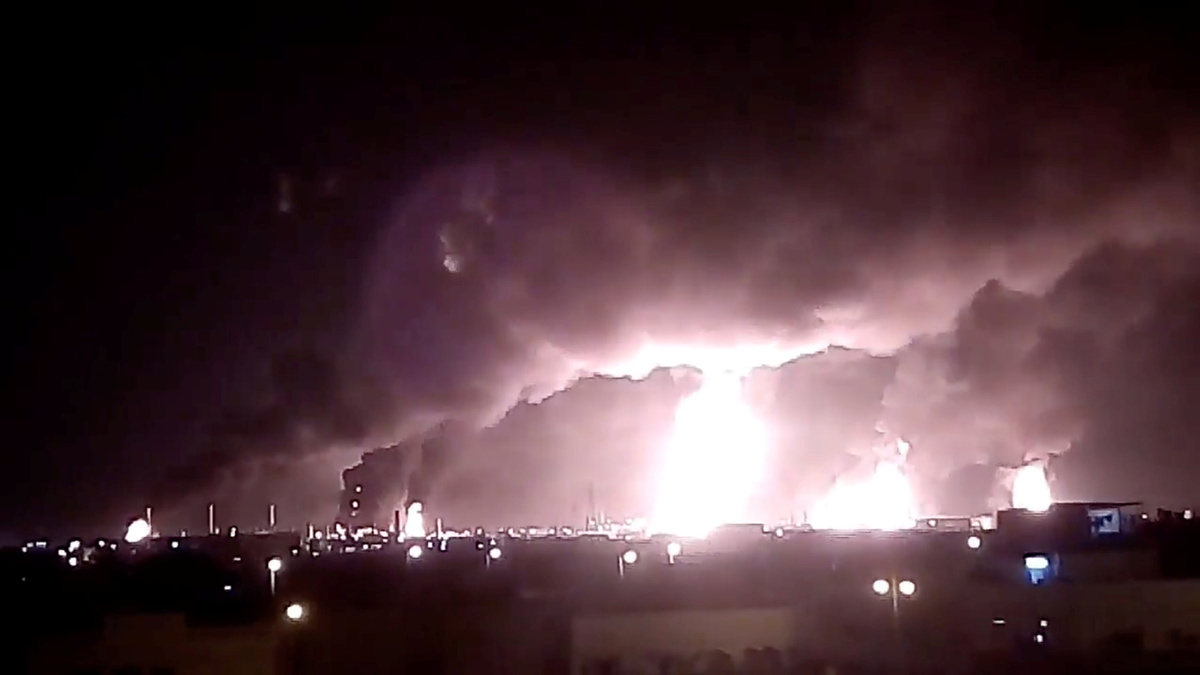
The drone attacks on two Saudi Arabian oil facilities on Saturday could have serious regional and global consequences. The Saudi Arabian Oil Company (or Saudi Aramco) that was targeted is a global energy giant and perhaps the world's most valuable company.
The damage to its two facilities, the world's largest oil processing plant and a major oilfield, has reduced Saudi Arabia's oil output by half and compelled Riyadh and Washington to draw on their oil reserves, while sending shockwaves across the global oil markets and increasing oil prices.
The attacks have also dealt another serious blow to the already foundering world economy, prompting many to wonder what could be the real motive behind the attacks.
The recent resignation of John Bolton as US national security adviser had somewhat eased the tensions in the Persian Gulf. But the attacks have once again raised temperatures in the Middle East.
Not surprisingly, the United States has blamed Iran for the attacks, albeit without proof, instead of the Houthi rebels in Yemen who have claimed responsibility for the strikes. The US has also vowed to support any action Saudi Arabia takes in self-defense and denied there is any plan of the US president meeting with Iranian President Hassan Rouhani on the sidelines of the on-going UN General Assembly.
Israel has recently launched air strikes on Iranian "military facilities" in Syria and Iraq. Given that the Israeli legislative elections began on Tuesday, the possibility of Likud-National Liberal Movement leaders convincing Prime Minister Benjamin Netanyahu to launch such attacks to increase their chances of re-election cannot be ruled out.
Besides, as Iran expedites its uranium enrichment program, the situation in the Middle East continues to become more volatile, with the attacks on the Saudi oil facilities further worsening Riyadh-Teheran relations. In short, the situation in the Persian Gulf is grave.
At the same time, the attacks show that the Houthis now have the capability to hit Saudi targets and cause heavy losses, which should prompt Saudi Arabia to review its decision concerning Yemen, especially whether it should continue to lead the alliance against the Houthis or hold talks to end the civil war in the neighboring country.
The attacks will also intensify the contradictions within the anti-Houthi military alliance led by Saudi Arabia. Since its inception, the alliance has suffered from internal divisions, for instance, because Egypt has shown little interest in sending forces to fight the Houthis.
In terms of economic shocks, the attacks on the Saudi facilities have pushed up oil prices and affected the interests of oil producing as well as oil importing countries. Whether such countries and international organizations will be compelled to work together to facilitate a peaceful settlement to the Yemen conflict remains to be seen.
Yet the US administration and the opposition Democratic Party have serious differences over the civil war in Yemen, with the latter demanding that the White House stop supporting Riyadh's military actions. And the attacks on the Saudi oil facilities could increase the pressure on the US administration to consider the Democrats' demand and pay heed to the international community's call to end the civil war in Yemen.
Riyadh has deployed multiple Patriot anti-missile air defense systems it bought from Washington to neutralize any air strikes launched by the Houthis. Yet the Patriot systems could not prevent the attacks on its oil facilities, leaving Saudi Arabia vulnerable to more such attacks. Which raises a very important question: Should countries purchase more advanced weapons and military equipment to protect themselves from enemy attacks or should they avoid making enemies in the first place to completely rule out such attacks?
The author is a professor of Middle Eastern studies at the Institute of Middle Eastern Studies, Northwest University. The views don't necessarily represent those of China Daily.