US Indo-Pacific strategy divisive in nature








Editor's Note: After the US withdrew from the Intermediate-Range Nuclear Forces (INF) Treaty on Aug 2, US Secretary of State Mike Pompeo and Secretary of Defense Mark Esper claimed China was destabilizing the Indo-Pacific, so they can use it as an excuse to strengthen the US' military presence in the Asia-Pacific region. What does the US' Indo-Pacific strategy mean for the region? Two experts share their views on the issue with China Daily's Pan Yixuan. Excerpts follow:
US military moves could spark a conflict
Over the past decade, the US has deepened cooperation with its military allies and moved closer to the goal of deploying about 60 percent of its navy in the Asia-Pacific as part of its "Asia rebalance" strategy, the brain-child of former US president Barack Obama.
The US' intention to check China's rising national strength and influence in the region became clear after the incumbent administration emphasized "Indo-Pacific", particularly after Pentagon announced that it would deploy intermediate missiles and more forces in the Asia-Pacific.
And although the US said it was withdrawing from the INF Treaty because Russia had violated it by developing 9M729 missiles, it has been pressing Russia to make China a part of the Moscow-Washington nuclear control treaty or work out an alternative treaty which would include Beijing, in order to check China's intermediate missile development.
The "China-is-destabilizing-the-region" claim is another excuse for the US to pursue its military strategy in the Indo-Pacific. The South China Sea disputes have eased, and leaders of the Association of Southeast Asian Nations member states agreed in June to work together to keep the region free and secure, and settle disputes peacefully and in accordance with international law. Also, China and ASEAN finished the first reading of the Single Draft Negotiating Text of the Code of Conduct in the South China Sea ahead of schedule.
But since the US is desperate to keep the territorial disputes alive in a bid to contain China's peaceful rise, it could resort to "rebalancing" again.
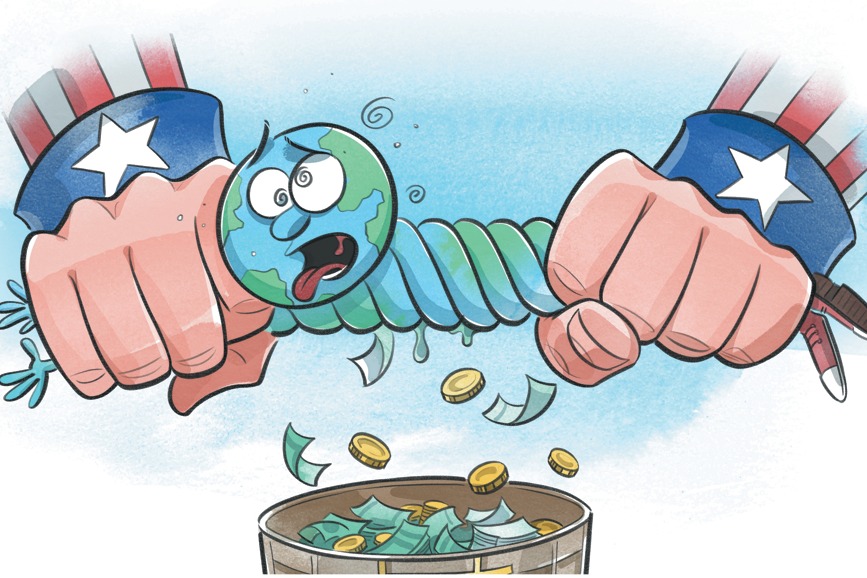
The world's attention is focused on the China-US trade war, but the security risks in the Asia-Pacific have risen due to the US' insistence on beefing up its military in the region and exercising the "right to freedom of navigation" in the South China Sea despite being a non-regional country. Which could accidentally spark a military conflict leading to a war.
China has warned it will take countermeasures if the US deploys intermediate missiles at its doorstep. So the two sides should make more efforts to reduce the risks and avoid a military conflict, as that would harm the interests of not only the two countries but also the rest of the world.
Song Wei, a researcher at the National Academy of Development and Strategy and a professor at the School of International Studies, Renmin University of China
Need to strengthen peace in the region
Thanks to the international community's efforts, peace and development became the postwar theme. In line with this theme, 21 economies in the Asia-Pacific founded the Asia-Pacific Economic Cooperation in 1989 to facilitate trade and deepen economic cooperation through market access and investment. And negotiations are continuing on how to better promote economic development in the Asia-Pacific.
By contrast, the US' Indo-Pacific strategy has no list of participating countries and areas for cooperation, except that its aim is to contain China. China's growth is partially the result of its increasing strength and fulfilling global responsibilities in the process of deepening cooperation both internationally and regionally. So instead of promoting the US' Indo-Pacific strategy which would divide the region, the two countries should take measures to bring more benefits to the region.
True, ASEAN members are an important part of the US' Indo-Pacific strategy, but since they are in the process of community building, Washington may not get their help to boost its military presence in the region. And the fact that the ASEAN Security Community Plan of Action promotes "an ASEAN-wide political and security cooperation in consonance with the ASEAN Vision 2020 rather than a defense pact, military alliance or a joint foreign policy" would increase the US' difficulties.
Many wonder whether the Washington-proposed "quadrilateral coalition" among the US, Australia, Japan and India, which focuses on strategic security and military cooperation, would become part of the US' Indo-Pacific strategy. But despite the US listing Australia as one of its strongest allies in the Indo-Pacific, Canberra rejected the proposal to establish an intermediate missile base after the US said it would deploy intermediate missiles in the Asia-Pacific.
The US seems determined to change the principles of international relations based on its Indo-Pacific strategy. By so doing, the US will not only undermine APEC cooperation but also invite regional countries' opposition to its unilateral moves that pose a threat to regional stability and cooperation.
Han Feng, a professor at Beijing Foreign Studies University, and a senior fellow at the National Institute of International Strategy, Chinese Academy of Social Sciences
The views don't necessarily represent those of China Daily.