Reflections on Hong Kong







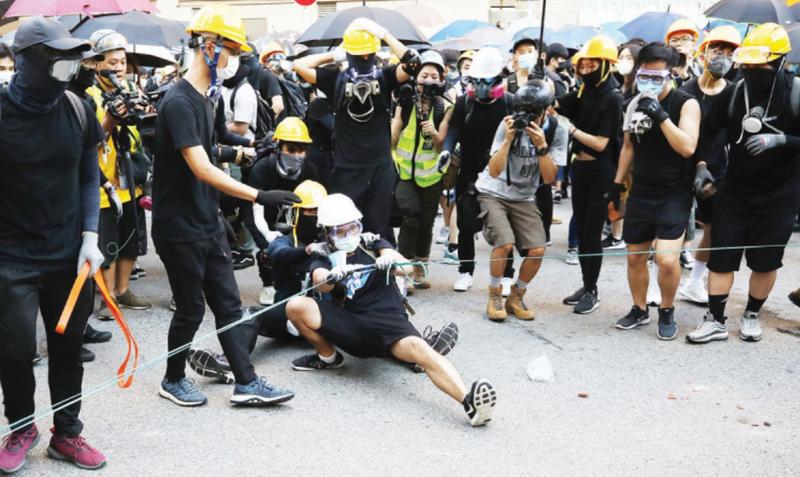
Among the topics I think I know well, I do not count Hong Kong. Although I visit Hong Kong, have friends there, and have researched the place for my writings — for example, its repatriation to China and the Asian Financial Crisis, both in 1997, and the recent Greater Bay Area coordinated development plan — I do not know Hong Kong like I know Beijing. That is why, when the protest movement began there, and then the violence, I was reluctant, at least initially, to accept interview requests from the international media. If I could not speak authoritatively, or at least confidently, I should not speak at all.
But as the situation kept deteriorating and the requests kept coming, I began to consider what I do know. I know how China's leaders think. In writing my book "How China's Leaders Think" (Wiley, 2009), I spoke with dozens of Chinese leaders and officials, including then Zhejiang Party Secretary Xi Jinping, who advised me to think about China both horizontally in its great geographic diversity and vertically in its long civilizational history.
When I am interviewed on Hong Kong, I begin with basics: Why is it so important to China? I offer five reasons: two economic, three political.
The first is that it has been the gateway for doing business in China, facilitating reform and opening-up and catalyzing the country's economic miracle. But with the rise of mainland markets, exemplified by Shanghai and Shenzhen, this role has diminished.
The second economic reason is the "Guangdong-Hong Kong-Macau Greater Bay Area", a vital strategy for transforming China's economy via coordinated development, and here it energizes regional integration. The Greater Bay Area gross domestic product is around $1.7 trillion, 12 percent of China's GDP, and is projected to reach around $3.5 trillion by 2030. If the Greater Bay Area were a country, its GDP would rank almost in the world's top 10.
The first political reason of Hong Kong's importance to China is that it exemplifies the "one country, two systems" policy that enables its special status, and which, at some point, Beijing seeks to apply to Taiwan. The second is that it represents China's historic reclamation, after over a century of oppression and humiliation, of global presence and import. The third is that it reflects China's international image and soft power.
I continue to say that the central government seeks the best for Hong Kong, stressing social stability, essential for economic development, and rule of law, essential for social development. Beijing will defer to the Hong Kong government as much as possible and as long as possible, thus sustaining the "one country, two systems" policy — but there are three red lines that cannot be crossed: movement toward Hong Kong independence or even quasi-independence, which includes one-person-one vote elections for local leaders; using Hong Kong to undermine the mainland's Party-led political system; and unending chaos such that Hong Kong's economic viability would be threatened.
I continue to say that the central government will make the absolute minimum interventions necessary to safeguard these three red lines, but they will, under all circumstances, safeguard them.
As the rioting is unrelenting, the rhetoric is escalating. In a recent media conference, Zhang Xiaoming, the director of the Hong Kong and Macao Affairs Office of the State Council, said the central authorities will never sit by if the situation in Hong Kong worsens to a turmoil that the SAR government cannot control.
Chaos is said to be the "enemy of the people" and, as a People's Daily commentary asserted: "If they are allowed to trample on the rule of law in Hong Kong, then Hong Kong’s advantages and Hong Kong's competitiveness will be eroded."
Given interconnectedness, the turmoil in Hong Kong cannot be much quarantined from all China, where stability has been the foundation for reform and development. Moreover, in his domestic policy, President's Xi pledges to win the "three tough battles" – preventing financial risks, reducing poverty, and tackling pollution.
Now, if social turmoil in Hong Kong seems unrelated to, say, poverty alleviation on the mainland, this is the crux of the matter, as seen by China's leaders. Let me explain.
For two years, I have been focusing on President Xi's targeted poverty alleviation campaign. I co-produced, wrote and hosted a documentary "Voices from the Frontline: China's War on Poverty" (which premiered recently in the United States).
China's broad economic growth has lifted over 750 million Chinese out of poverty, the greatest developmental success story in human history. But in late 2012, when Xi Jinping became China's senior leader, there were about 100 million Chinese who were intractably poor. Xi asserts that China cannot be a 'moderately prosperous society' by 2020 — China's first national goal — if any of its citizens live below the line of absolute poverty. Hence, Xi mobilized the Party and the country to fight poverty.
Who can deny that China's astounding success in poverty alleviation is related to political stability and Party leadership? Five levels of local Party secretaries fight poverty – provincial, municipal, county, township and village. Party officials cannot be promoted unless and until they fulfill their specific, numeric poverty alleviation goals. I've watched local officials being held accountable, their careers at stake.
All forms of governance systems have trade-offs and only collective human wisdom can discern what is optimum for each social group under its own conditions at its own times. But I am rather confident that, under China's conditions and in these times, the vast majority of those hundreds of millions of Chinese who have been lifted out of poverty would be pleased that political stability enabled economic development and Party leadership delivered poverty alleviation.
Looking forward, Hong Kong is China and will remain China. While no doubt some radicals favor violence, and some Western politicians encourage protests, the challenge for Chinese wisdom is to see what it will take, long term, to secure the kind of robust stability that empowers creative, dynamic, knowledge-based development for the benefit of all.
The author is the host and writer of the feature documentary “Voices from the Frontline: China’s War on Poverty” (Adam Zhu, executive producer). In December 2018, Dr Kuhn received the China Reform Friendship Medal.
The author contributed this article to China Watch exclusively. The views expressed do not necessarily reflect those of China Watch.
All rights reserved. Copying or sharing of any content for other than personal use is prohibited without prior written permission.