'America first' erodes US' soft power







In the era of globalization, soft power is crucial for spreading a country's influence across the world and an important component of its comprehensive national power. Unlike hard power, which depends on military and economic might, soft power is shaped mainly by a country's culture, education, political values, diplomacy and foreign aid.
According to Joseph Nye, a Harvard political science professor who coined the term in 1990, soft power is "the ability to get what you want through attraction rather than through coercion".
The United States has established its hegemony in the world based on not only its hard power, but also its soft power. Of late, however, the US' soft power has been waning.
US policies driven by 'America first' policy
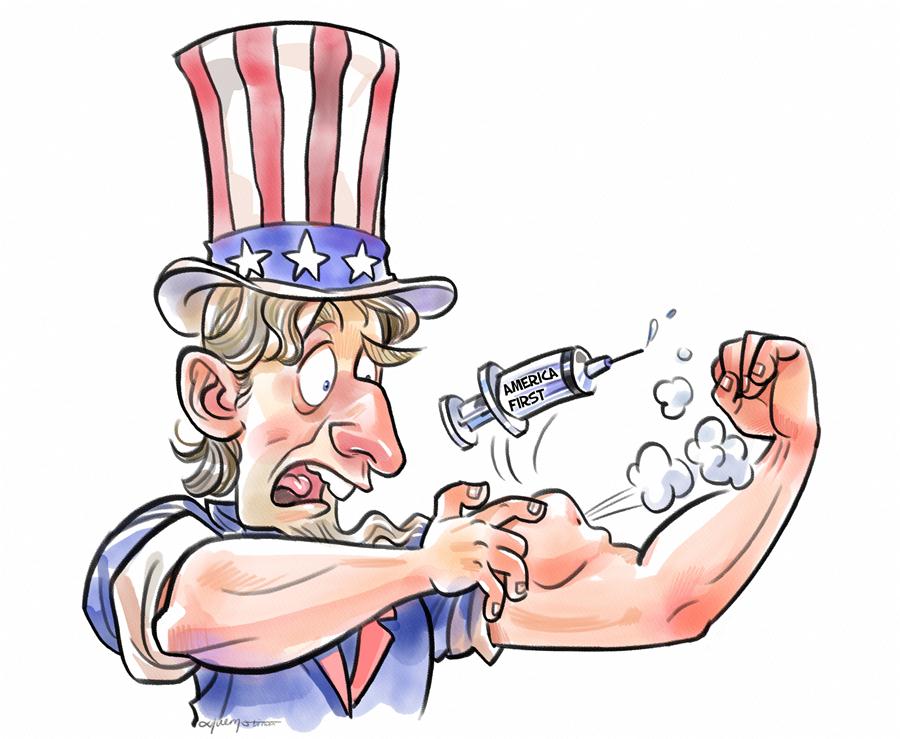
The decline in the US' soft power can be mainly attributed to Washington following the "America first" policy. First, the incumbent US administration has been reducing foreign aid, including cutting its aid to programs designed to fight AIDS and malaria overseas. Foreign aid, especially in the field of healthcare, is conducive to bolstering a country's soft power. Since the US has for long been known as a philanthropic country, any cut in its foreign aid would harm its global image.
Second, the US' current immigration policy, particularly the plan to build a wall along its border with Mexico, seems like economic nationalism. "It's a departure from decades of a US immigration policy that centered on family reunification and asylum," said Kimberly Amadeo, an expert on the US economy. The immigration policy seriously violates the human rights of immigrants. And given that the US has long proclaimed itself as the international defender of human rights, it is a real smack in the face for the US.
Third, the current US administration has withdrawn from the Paris climate accord and Iran nuclear deal, quit the UN Human Rights Council, and even threatened to pull out of the World Trade Organization. This unilateral approach to global governance is detrimental to the rule-based world order.
Under the banner of "America first", the incumbent US administration has given trade the highest priority, even launched trade wars against not only China, but also other countries, even its closest trade partners.
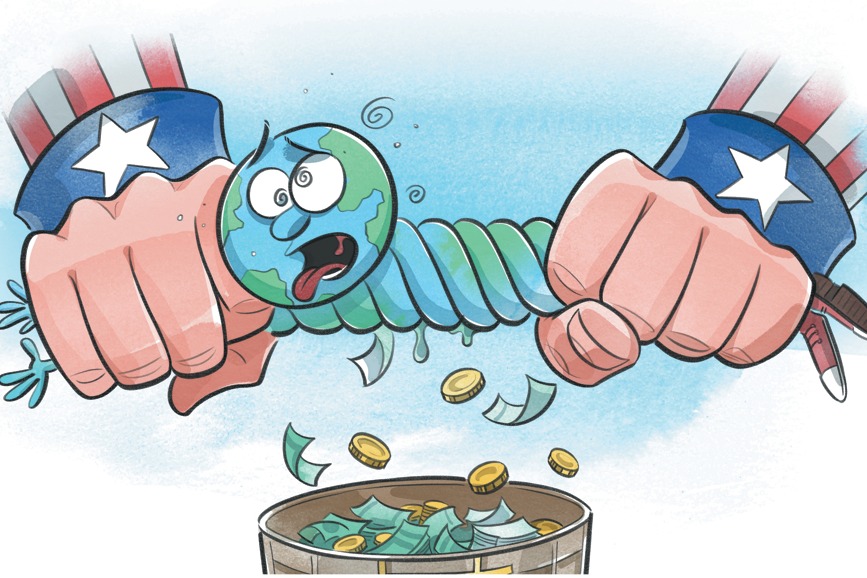
Trade protectionism driven by mercantilism is good for none; instead, it harms all sides concerned. The US' tariffs have harmed not only the economic development of China and the US, but also disrupted the global value chain, causing collateral damage to the rest of the world.
What the current US administration has done shows its foreign policy has shifted from collaborative multilateralism to zero-sum unilateralism, as it is worried more about its self-interests than the problems facing the world.
The rule-based liberal world order is declining because of the US' "America first" policy and also because it has discarded values such as cooperation, nondiscrimination, fair competition, free trade, openness, rule of law and democracy, which are the bedrock of a liberal world order and key to establish good global governance.
By abandoning the shared values and resorting to protectionism and unilateralism, the US has dealt a serious blow to its own global image and credibility. Consequently, its soft power has eclipsed. As Nye said, if a country's policies appear to be hypocritical, arrogant and indifferent to the opinions of others, or based on a narrow approach to national interests, its soft power is bound to weaken.
According to a yearly ranking of different countries' soft power by London-based Portland Communications and USC Center on Public Diplomacy, the US' soft power has been decreasing: it was ranked No 1 in 2016 only to slide to the third spot in 2017 and fourth in 2018.
Decline of soft power bad for US in long run
Although the "America first" policy can bring some short-term economic gains for the US, the decline of its soft power could harm its long-term strategic interests. To begin with, it would erode the US' global leadership, as it doesn't leave the US with any moral authority and legitimacy to lead the world. And soon, it would lead to "America alone". One Chinese idiom puts it aptly: a just cause enjoys abundant support, an unjust one finds little.
Former US secretary of state Henry Kissinger rightly said the world order depends not only on the balance of hard power, but also on the perception of legitimacy, which depends crucially on soft power. Under such circumstances, it's hard to see even the US' allies, let alone most of the other countries, getting behind Washington's leadership.
Besides, the "America first" policy goes against the US' anti-terrorism project. If US policies are not credible and legitimate, they will end up serving the interests of terrorists in that they will make it easier for terrorist outfits to attract new recruits.
To eliminate terrorism, multilateral cooperation among all countries is essential. But with the US' soft power waning, its allies and partners will be less willing to cooperate with the US diplomatically, economically and politically to fight terrorism.
It's never too late to take remedial steps
Considering the US' waning soft power, the incumbent US administration should shift from the "America first" to a "cooperation first" policy, and stop trading short-term economic gains for long-term strategic interests. In other words, the US should revert to multilateralism and free trade policies, and embrace the common values shared by the international community.
Since the interests of not only China and the US but also the rest of the world are at stake in the Sino-US trade war, it is advisable that the US and China, as well as other countries, settle their disputes through negotiations based on the principle of equality and reciprocity. In fact, by so doing, the US will also boost its global image and credibility. After all, unilateralism and protectionism not only undermine the rule-based world order and global governance, but also are detrimental to the US' soft power.
The author is director of the Center for Global Governance and Law, Xiamen University of Technology. The views don't necessarily represent those of China Daily.