Death of INF Treaty raises security risks







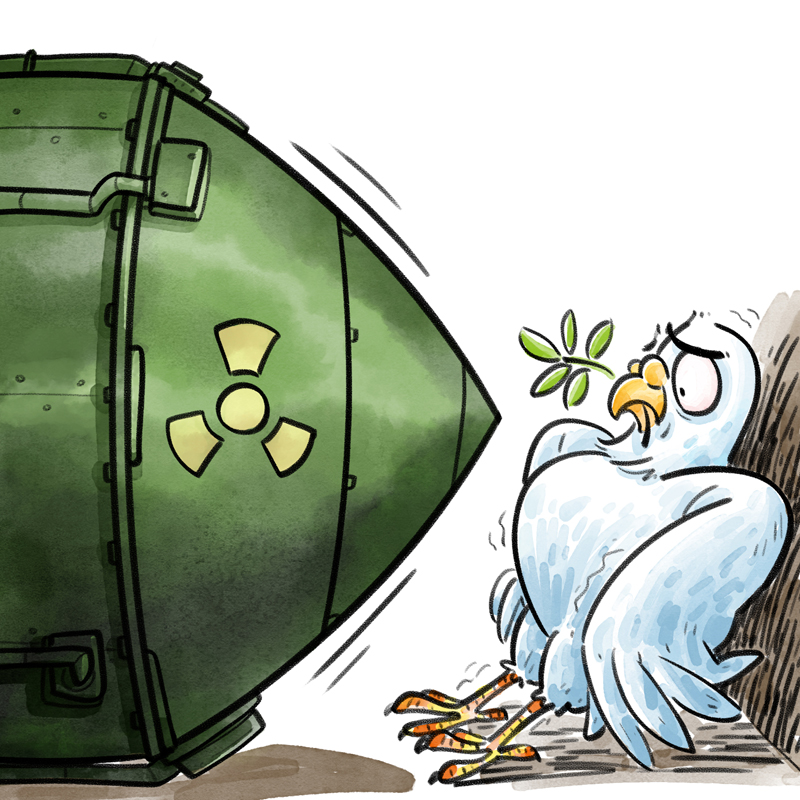
By formally quitting the Intermediate-Range Nuclear Forces (INF) Treaty on Friday the United States has cleared the way for it and Russia to reinforce their nuclear arsenals, raising the specter of a new arms race and increasing global security risks.
Given that the US, according to Russia, had developed new nuclear weapons and deployed about 200 nuclear missiles in Europe, including the MK-41 vertical launching system that can launch Tomahawk cruise missiles up to 2,400 kilometers and thus hit targets inside Russia, the risk of the INF Treaty being terminated was very high even before the US formally pulled out of it.
Of course, Washington said it was withdrawing from the INF Treaty because Moscow had violated it by developing 9M729 missiles.
Late last month, Russian President Vladimir Putin signed into law a bill suspending Russia's participation in the nuclear treaty, which was signed in 1987 by Washington and Moscow to eliminate the two sides' land-based ballistic missiles, cruise missiles and missile launchers in the short and intermediate range (between 500 kilometers and 5,500 km).
Nuclear war threshold has been lowered
Irrespective of the reasons the two countries cite for their withdrawal from the treaty, its annulment will lower the threshold of a nuclear war, as Russia reserves the right to use nuclear weapons in response to large-scale aggression against it, and the US refuses to follow the no-first-use policy for nuclear weapons.
With the death of the INF Treaty, a most important safety valve for defusing military crises no longer exists, and nuclear weapons could be used as more than strategic deterrence. No wonder United Nations Secretary-General Antonio Guterres warned that, "the world will lose an invaluable brake on nuclear war" with the end of the INF Treaty.
The death of the INF Treaty means the 2011 New Strategic Arms Reduction Treaty, a US-Russia deal to limit the deployment of strategic nuclear weapons, is the last nuclear arms-control deal between the two global superpowers.
But while the INF Treaty emphasizes that neither the US nor Russia should possess or develop short-or intermediate-range missiles, the New START insists only on reducing the number of nuclear weapons being developed.
And since smaller and more lethal nuclear weapons have been developed since the INF Treaty and New START were signed by Washington and Moscow, either side could cause unimaginable damage to not only each other but also the rest of the world even if they have fewer than 1,550 nuclear warheads as stipulated by the New START.
Doubts over future of New START
Worse, the annulment of the INF Treaty and a recent speech by US National Security Advisor John Bolton, raising doubts whether the US would extend the New START after it expires in February 2021, have left many wondering whether a war is inevitable now.
The US has shown little interest in any new nuclear-or arms-control pact with Russia after the annulment of the INF Treaty and the New START. Which means Washington may agree to ink a new nuclear treaty only if the deal serves its strategic interests. Perhaps Washington believes a new arms race would be a bigger burden on Russia given the latter's sluggish economy, and expects to gain from it due to the US' strong economy.
Whether or not the two global superpowers ink a new treaty, China will face greater danger because of the US' withdrawal from the INF Treaty. A new challenge for China has emerged as US Defense Secretary Mark Esper recently said that the US intends to deploy intermediate-range missiles in the Asia-Pacific region.
By consolidating its military presence in the region, the US intends to raise its "deterrence level" against Russia, the Democratic People's Republic of Korea and especially China, which the US considers its major rival not only in trade and finance but also in the military field. Further, Washington could use its expanded military presence in the Asia-Pacific as a permanent bargaining chip against China, and hold regional security to ransom.
US raises tensions in Asia-Pacific region
Washington is very likely to start the missile deployment within months, as Esper said, in order to bolster its Asia-Pacific strategy, or Indo-Pacific strategy as it prefers to call it, as well as to strengthen its alliance with countries in the region, including Australia, which had previously refused to become a base for US missiles and missile systems.
China must prepare to face any military risks posed by the US plan to deploy intermediate-range conventional missiles in the Asia-Pacific. In fact, it should intensify diplomatic efforts to prevent the US from deploying such missiles in the region or at least restrict the deployment of such missiles to the minimum.
And although China has said that it will not be a party to a new anti-nuclear weapons treaty between the world's two largest nuclear powers which own about 90 percent of the world's nuclear stockpiles, it should make its stance clearer to the international community.
True, the New START being a nuclear-control treaty, but it has limited value compared with the INF Treaty. So let's hope Russia and the US-with the help of the international community-make sincere efforts to reduce their nuclear arsenals by agreeing to a new nuclear treaty and safeguard global peace.
The author is executive director of the Institute of Strategy and Security at the College of International Studies, National University of Defense Technology. This is an excerpt from his interview with China Daily's Pan Yixuan.
The views don't necessarily represent those of China Daily.