Foreign students should not be spoiled rotten







Amid the growing debate on the preferential policies enjoyed by overseas students in China, the Ministry of Education recently said it would make more efforts to ensure Chinese and foreign students get similar but not the same treatment.
Yet many micro bloggers have wrongly assumed the national education policy is to grant preferential treatment to overseas students. All national regulations on overseas students stress the principle of equality, and none of them talks about giving them any privileges vis-à-vis their Chinese counterparts.
According to the ministry's data, about 492,000 overseas students from 196 countries and regions were registered in 2018 to study in China, with 12.8 percent of them getting government scholarship - similar to what the Chinese students got. In fact, in quite a few key universities, the percentage of Chinese students getting scholarships was higher.
The reason why some Chinese students feel they are "treated unequally" is that certain colleges offer quite attractive rewards to overseas students in order to draw more students from abroad.
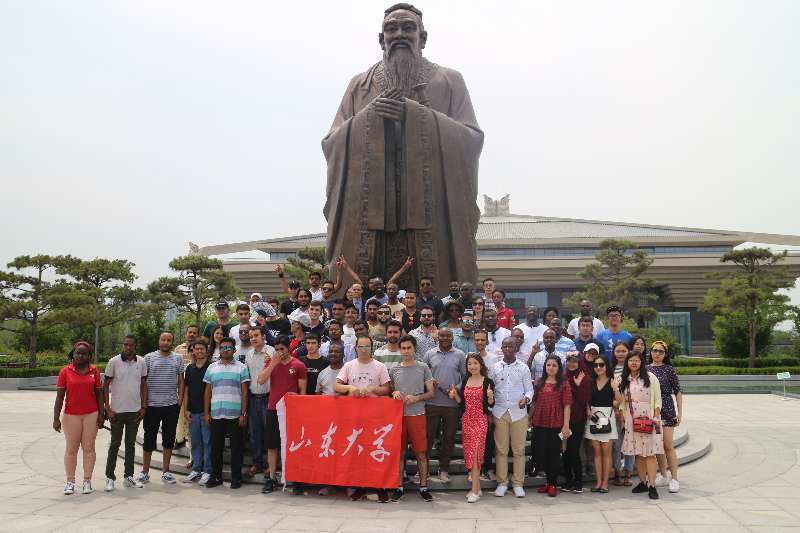
But Shandong University's move to do so yielded adverse results. The university attracted criticism recently for recruiting "study buddies" for overseas students and having listed "making friends with someone of the opposite gender" as a reason for local students to apply in their recruitment forms, as well as providing each overseas student with 30 kilowatt-hour of electricity for free every month while the quotas for a Chinese doctoral candidate, and a postgraduate and undergraduate student are 14 kWh, 10 kWh and 6 kWh.
In other words, the free electricity an overseas student can enjoy at the university is five times more than what a Chinese undergraduate student is entitled to get. This may be preferential treatment, but it has nothing to do with the national education policy.
There are many reasons why Chinese colleges offer privileges to overseas students, with the main being to get a higher QS World University Ranking. The percentage of international students accounts for 10 percent of all criteria in the global QS ranking system. So if a college increases the percentage of international students, it can have a proportionately higher QS ranking.
Another reason is hospitality - which is deeply rooted in traditional Chinese culture. Chinese people believe it is a virtue to keep their guests in comfort. No wonder many Chinese people treat overseas students like guests, and accord them more importance than Chinese students. Some college managers tend to follow this tradition.
Which can be the reason why some colleges followed the example of Shandong University, prompting many Chinese students to complain that their overseas counterparts get excessive privileges, including better rooms in dormitories.
Yet there is something intrinsically wrong with the "policies" of such colleges. A student chooses a college to study that he/she believes offers him/her the most promising future, not the one that offers him/her the best comfort and most privileges.
Besides, by granting overseas students better facilities than their Chinese counterparts, the colleges might prompt the latter to question whether the principle of equality is confined to paper, and rarely, if ever, practiced. When Chinese college students discover that their overseas counterparts get better rooms in dorms and enjoy other amenities, which they don't, the talk of equality and fairness sounds hollow.
The Ministry of Education's move therefore is vital. True, the ministry is not responsible for the inequality practiced on some campuses, but as the authority in charge of education, and school and college management in China, it has the responsibility to guide colleges nationwide to right their wrongs.
By prompting colleges to treat overseas and Chinese students equally, the ministry will not only restore balance on campus but also help to screen out those overseas students who come to China not to study but to enjoy better living conditions. Which means the move will raise the quality of overseas students in China as a whole.
The author is an associate researcher in education science at Beijing Normal University. The views don't necessarily represent those of China Daily.