Scrapping of treaty makes future of world uncertain







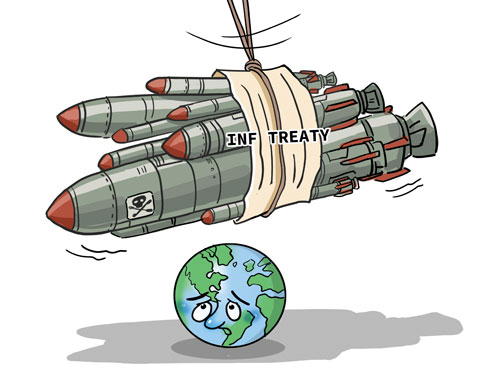
On Feb 2, the United States announced it would withdraw from the Intermediate-Range Nuclear Forces Treaty alleging that Russia had violated the 1987 agreement to eliminate the two countries' land-based ballistic missiles, cruise missiles and missile launchers in the short range (500-1,000 kilometers) and intermediate range (1,000-5,500 km).
Refuting the US allegation, Moscow claimed it was Washington that had violated the INF Treaty by deploying the MK-41 vertical launching system in Europe, which can launch Tomahawk cruise missiles up to 2,400 kilometers away and thus hit targets in Russia. And responding to the US' move to withdraw from the treaty, Russian President Vladimir Putin signed a bill on July 3 to suspend the treaty until the US stops violating it or until it expires.
The war of words and saber-rattling between Washington and Moscow over the INF Treaty, the first such agreement to reduce the two countries' nuclear arsenal during the Cold War, has left the treaty hanging in limbo.
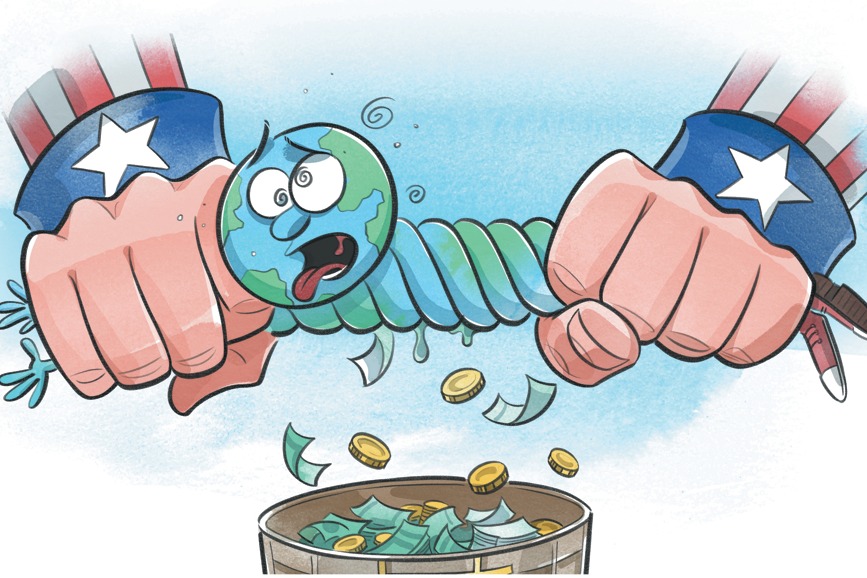
It goes without saying that the exit of both signatories from the treaty makes the future of other such nuclear agreements uncertain. To begin with, the stability of the world order and international security could be undermined. The ruse to scrap the INF Treaty is the US' latest one in a series moves to nullify many international agreements and organizations since the incumbent US dispensation assumed office in January 2017. The US' unilateral withdrawal from a number of multilateral agreements and mechanisms, most of which were created due to its own efforts, has put the world order based on rules under extreme pressure.
Besides, the conflict between the US and Russia is preventing them from improving bilateral relations. The actions of the US and Russia have further worsened their relations following their face-off over the Ukraine crisis and the Syrian civil war, and led to multiple large-scale military exercises by both sides in the Baltic Sea and the Black Sea in an apparent show of strength. Their withdrawal from the INF Treaty means their tactical conflict has deteriorated into a strategic conflict, which has further jeopardized bilateral relations.
Worse, the two countries' moves could abort the international disarmament process, because with the annulment of the INF Treaty, the US and Russia could develop new intermediate-and short-range missiles without constraints, which in turn could trigger a new global arms race.
Also, the US' withdrawal from the INF Treaty could set off a chain reaction, as it is almost certain that Washington will now deploy intermediate-range missiles in Europe and the Asia-Pacific region, heightening regional tensions and fuelling an arms race and geopolitical competition among major powers. The new arms race, which could prompt major powers to build new types of smart weapons, would pose a severe threat to international peace and security.
What is especially surprising is that some Western observers want to drag China into the discussions on certain international issues regardless of whether it is a party to such issues. Regarding the INF Treaty, which has played an important role in improving international relations, promoting nuclear disarmament, even safeguarding global strategic balance and stability, and therefore remains very much relevant and significant even today, China has made clear that it is opposed to not only the US' unilateral withdrawal from the treaty but also the West's efforts to make it part of a new nuclear treaty.
Of course, China is ready to participate in international cooperation and help maintain world peace and development, but only on the principle that all participating countries be made responsible stakeholders. Any bilateral or multilateral agreements will be meaningless if the participating sides violate international rules and withdraw from them unilaterally to serve their own narrow interests.
The author is vice-president and academic dean of China Foreign Affairs University. The views don't necessarily represent those of China Daily.