Go fish if need be! But, please, do so legally







Chinese people love fish, and both the demand and consumption of fish are on the rise. Which is good, because fish is high in protein and low in fat, and fish help to feed a hungry world while providing livelihoods for hundreds of millions of people across the Asia-Pacific region. But, ironically, this increase in demand has also created opportunities for criminals to make a profit.
While most of the region's fishing fleets operate within the rules, some $5 billion worth of fish are caught either illegally or without being reported, or the fishing boats operate in an unregulated environment. That's bad news on a number of levels.
While illegal, unreported and unregulated (IUU) fishing is a global problem, the situation is disproportionately worse in the Asia-Pacific, because the region produces 75 percent of the world's seafood and IUU fishers target countries with poorly developed economies and regulations, which are also home to some of the most vulnerable communities.
Of course, IUU fishing leads to over-exploitation of fish stocks and has a devastating impact on biodiversity and habitat. But it also hits honest people and communities dependent upon fishing right in the pocket, including buyers, sellers and legitimate industrial operators.
In fact, evidence is mounting that IUU fishing is often associated with other transnational crimes including the exploitation of migrant workers enduring slavelike conditions on fishing boats at sea. In short, IUU fishing is a widespread and serious problem across the Asia-Pacific, and resolving it will require long-term and unified regional commitment.
A good day's catch-reeling in the bad guys
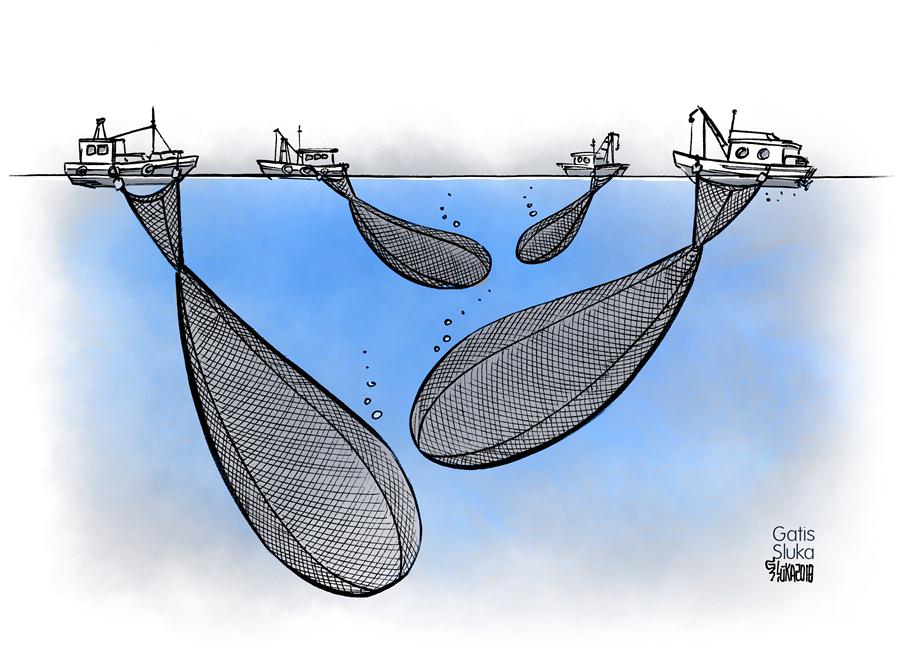
The good news is that many countries have recognized the need to take action on IUU and are doing so, by signing the Port State Measures Agreement, a legally binding treaty that works like a giant worldwide net that's closing in around IUU fishers.
Introduced by the UN's Food and Agriculture Organization in 2009, the PSMA is the first international agreement to set minimum standards for countries to prevent IUU seafood products from entering ports. Now fully enforceable, it provides a regulatory framework for countries to refuse entry of vessels suspected of participating in or facilitating IUU fishing activities and allows for enforced inspection of vessels if entry is granted.
Once a fishing boat is identified as one operating in contravention of the PSMA, the information can be shared with the maritime and fishing authorities of other countries-making it more difficult for the particular boat and its captain to continue profiting from IUU fishing.
The effectiveness of this instrument in the region is clear with vessels being seized and fishers being prosecuted by countries that have inked the PSMA. Thailand and Indonesia are two such countries. So far, 19 countries and territories in the Asia-Pacific region have acceded to the PSMA and several more are in the process of doing so.
The PSMA is complemented by other regional initiatives that are setting seafood traceability standards so that buyers of seafood from Asia-Pacific countries can be sure the products do not come from IUU fishing practices. Such guarantees are opening up international markets for Asia and Pacific products.
However, while real and rapid progress is being made in the Asia-Pacific to reduce illegal fishing there is still much to be done to eliminate misreporting or nonreporting of catch. The rapid advancement of access to telecommunications in the Asia-Pacific has provided an infrastructure for the adoption of digital tools for reporting of catch. The immediate challenge is to empower fishers to adopt this technology downstream.
Eyes in the sky, boats on the water, boots on the ground
Upstream, the region now has seven "state-of-the-art" fisheries monitoring and surveillance centers which use high-tech equipment to identify vessels suspected of engaging in IUU practices. The establishment of national centers in Australia, Indonesia, Malaysia, New Zealand, Thailand and the United States, in conjunction with the regional surveillance center for the western Pacific in the Solomon Islands, has increased the capacity for cohesion and collaboration among Asia-Pacific states to tackle IUU fishing.
Further developing efficient and effective monitoring and surveillance technologies, rewarding honest fishers (including small-scale fishers) for accurately reporting all catch (through enhanced market access), and building capacity of port states to detect and prosecute IUU fishers are clear steps toward eliminating IUU fishing. Accession by all Asia-Pacific countries to the PSMA will send a loud and clear message to those involved in, or considering, IUU fishing that we're onto them.
June 5 is International Day for the Fight against IUU Fishing and a timely reminder of the tasks at hand. And the time is now for the countries in the Asia-Pacific to expand their efforts to combat IUU fishing.
The author is assistant director-general and regional representative for Asia and the Pacific, Food and Agriculture Organization of the United Nations.
The views don't necessarily represent those of China Daily