China is not Japan, US should know that








"When governments permit counterfeiting or copying of American products, it is stealing our future, and it is no longer free trade." So said former US president Ronald Reagan, commenting on Japan after the Plaza Accord was concluded in September 1985. These times, in many respects, are a remake of this 1980s movie, but with a reality-television star replacing a Hollywood film star in the presidential leading role-and with a new villain in place of Japan.
Back in the 1980s, Japan was portrayed as America's greatest economic threat-not only because of allegations of intellectual property theft, but also because of concerns about currency manipulation, state-sponsored industrial policy, a hollowing out of US manufacturing, and an outsize bilateral trade deficit. In its standoff with the United States, Japan ultimately blinked, but it paid a steep price for doing so-nearly three "lost" decades of economic stagnation and deflation. Today, the same plot features China.
Japan, China both scapegoats of US own economic problems
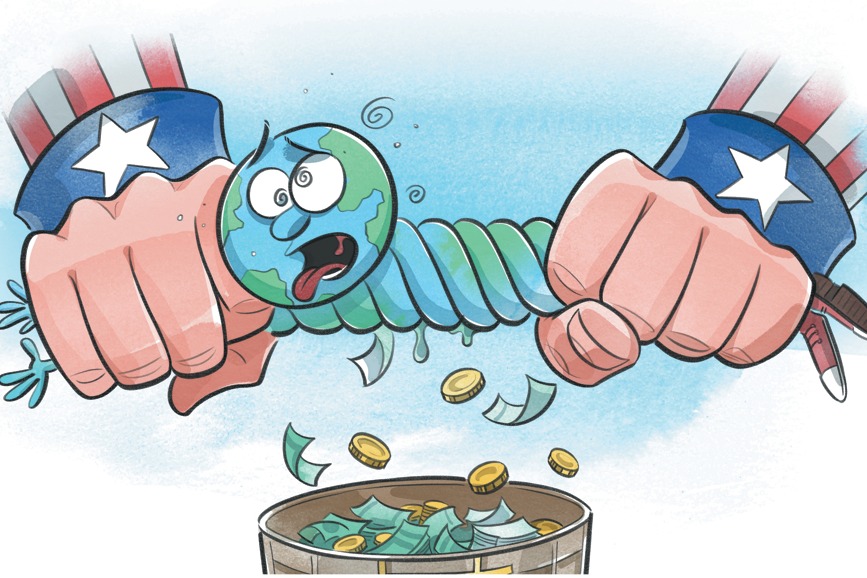
Notwithstanding both countries' objectionable mercantilism, Japan and China had something else in common: They became victims of America's unfortunate habit of making others the scapegoat for its own economic problems. Like Japan bashing in the 1980s, China bashing today is an outgrowth of America's increasingly insidious macroeconomic imbalances. In both cases, a dramatic shortfall in US domestic savings spawned large current-account and trade deficits, setting the stage for battles, 30 years apart, with Asia's two economic giants.
When Reagan took office in January 1981, the net domestic savings rate stood at 7.8 percent of national income, and the current account was basically balanced. Within two and a half years, courtesy of Reagan's wildly popular tax cuts, the domestic savings rate had plunged to 3.7 percent, and the current account and the merchandise trade balances swung into perpetual deficit. In this important respect, America's so-called trade problem was very much of its own making.
Yet the Reagan administration was in denial. There was little or no appreciation of the link between savings and trade imbalances. Instead, the blame was pinned on Japan, which accounted for 42 percent of US goods trade deficits in the first half of the 1980s. Japan bashing then took on a life of its own with a wide range of grievances over unfair and illegal trade practices. Leading the charge back then was a young deputy US trade representative named Robert Lighthizer.
Fast-forward some 30 years and the similarities are painfully evident. Unlike Reagan, President Donald Trump did not inherit a US economy with an ample reservoir of savings. When Trump took office in January 2017, the net domestic saving rate was just 3 percent, well below half the rate at the onset of the Reagan era. But, like his predecessor, who waxed eloquently of a new "morning in America", Trump also opted for large tax cuts-this time to "make America great again".
The result was a predictable widening of the federal budget deficit, which more than offset the cyclical surge in private savings that normally accompanies a maturing economic expansion. As a result, the net domestic savings rate actually edged down to 2.8 percent of national income by late 2018, keeping America's international balances deep in the red-with the current-account deficit at 2.6 percent of GDP and the merchandise trade gap at 4.5 percent in late 2018.
And that's where China assumes the role that Japan played in the 1980s. On the surface, the threat seems more dire. After all, China accounted for 48 percent of the US merchandise trade deficit in 2018, compared to Japan's 42 percent share in the first half of the 1980s. But the comparison is distorted by global supply chains, which basically didn't exist in the 1980s. Data from the OECD and the World Trade Organization suggest that about 35-40 percent of the bilateral US-China trade deficit reflects inputs made outside of China but assembled and shipped to the US from China. That means the made-in-China portion of today's US trade deficit is actually smaller than Japan's share of the 1980s.
US should raise savings rate before charging at windmills
Like the Japan bashing of the 1980s, today's outbreak of China bashing has been conveniently excised from America's broader macroeconomic context. That is a serious mistake. Without raising national savings-highly unlikely under the current US budget trajectory-trade will simply be shifted away from China to America's other trading partners. With this trade diversion likely to migrate to higher-cost platforms around the world, American consumers will be hit with the functional equivalent of a tax hike.
Ironically, Trump has summoned the same Robert Lighthizer, veteran of the Japan trade battles of the 1980s, to lead the charge against China. Unfortunately, Lighthizer seems as clueless about the macro argument today as he was back then.
In both episodes, the US was in denial, bordering on delusion. Basking in the warm glow of untested supply-side economics-especially the theory that tax cuts would be self-financing-the Reagan administration failed to appreciate the links between mounting budget and trade deficits. Today, the seductive power of low interest rates, coupled with the latest strain of voodoo economics-Modern Monetary Theory-is equally alluring for the Trump administration and a bipartisan consensus of China bashers in the US Congress.
The tough macroeconomic constraints facing a savings-short US economy are ignored for good reason: there is no US political constituency for reducing trade deficits by cutting budget deficits and thereby boosting domestic savings. America wants to have its cake and eat it too, with a healthcare system that swallows 18 percent of its GDP, defense spending that exceeds the combined sum of the world's next seven largest military budgets, and tax cuts that have reduced federal government revenue to 16.5 percent of GDP, well below the 17.4 percent average of the past 50 years.
This remake of an old movie is disconcerting, to say the least. Once again, the US has found it far easier to bash others-Japan then, China now-than to live within its means. This time, however, the movie might have a very different ending.
Stephen S. Roach, a faculty member at Yale University and former chairman of Morgan Stanley Asia, is the author of Unbalanced: The Codependency of America and China. Project Syndicate The views don't necessarily represent those of China Daily.