Trade conflict suggests hard times ahead







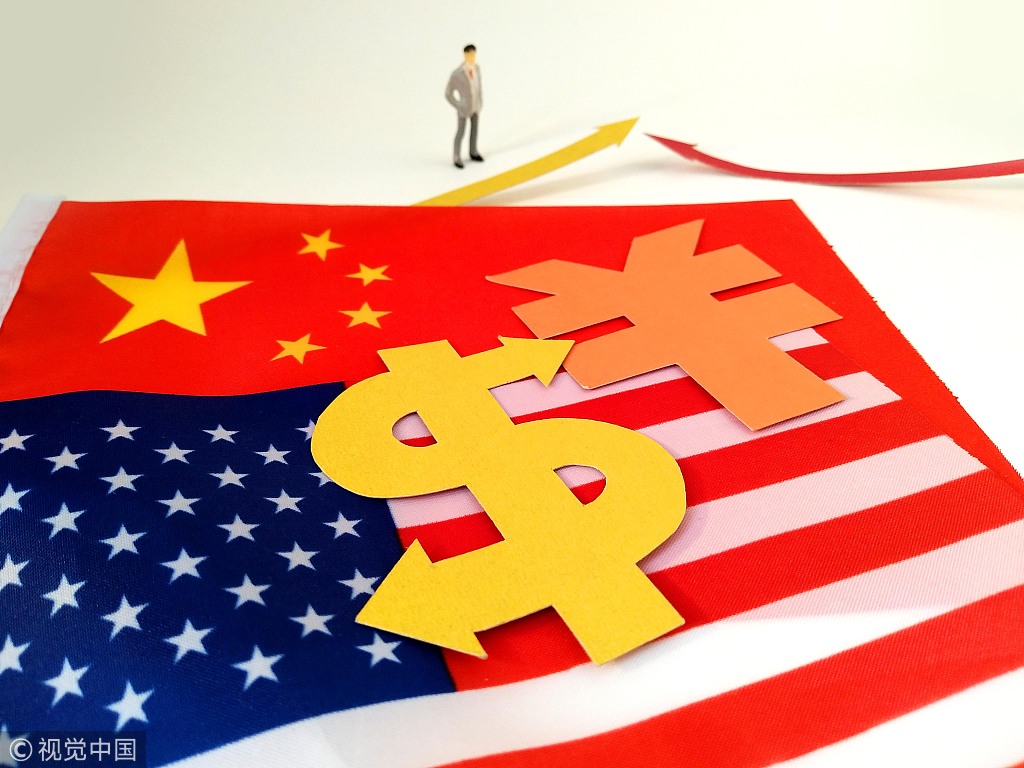
The escalating China-US trade friction is unprecedented in the history of bilateral relations. True, when trade begins, trade friction begins, too. And the history of China-US relations since the establishment of diplomatic relations in 1979 has been a history of bilateral trade frictions. But the trade frictions in the 1980s were relatively small and less damaging.
The early 1990s, though, saw an abrupt chill in Sino-US relations and intensified trade frictions. Between 1992 and 1996, during the George H.W. Bush and Bill Clinton administrations in the US, the two countries had three difficult rounds of talks over investigations based on sections 301 and 307 of the US Trade Act of 1974 (market access and intellectual property) against China, which raised the threat of a trade war.
In each round of the talks, however, both sides argued extensively and ultimately managed to reach an agreement, and thus avoided a trade war. The key reasons behind the outcome were that, despite placing many harsh demands, the Clinton administration was seeking cooperation with China, and neither side wanted a trade war. And the fact that the Clinton administration supported globalization and World Trade Organization rules served as the common foundation for the negotiations and agreements.
This was followed by the hard negotiations on China's WTO accession and the US Congress' annual review and approval of China's most-favored nation (MFN) status. Overcoming many difficulties, China and the United States reached an agreement on China's entry into the WTO on Nov 15, 1999. But the US established permanent normal trade relations with China only in 2002, that is, after China became a WTO member.
Political tensions marked bilateral relations throughout the 1990s, among which the most intense were those in the aftermath of the NATO bombing of the Chinese Embassy in erstwhile Yugoslavia on May 8, 1999. But with China registering strong protest and the US tendering an apology, the two sides once again managed to put bilateral relations back on the normal track.
In general, the 1990s saw a strong desire on the part of the US business community, provinces, counties and municipalities to establish or expand business relations with a fast-growing China, in order to avail of the immense commercial opportunities it offered. These factors helped establish stable trade ties between the two countries despite the occasional frictions and tensions.
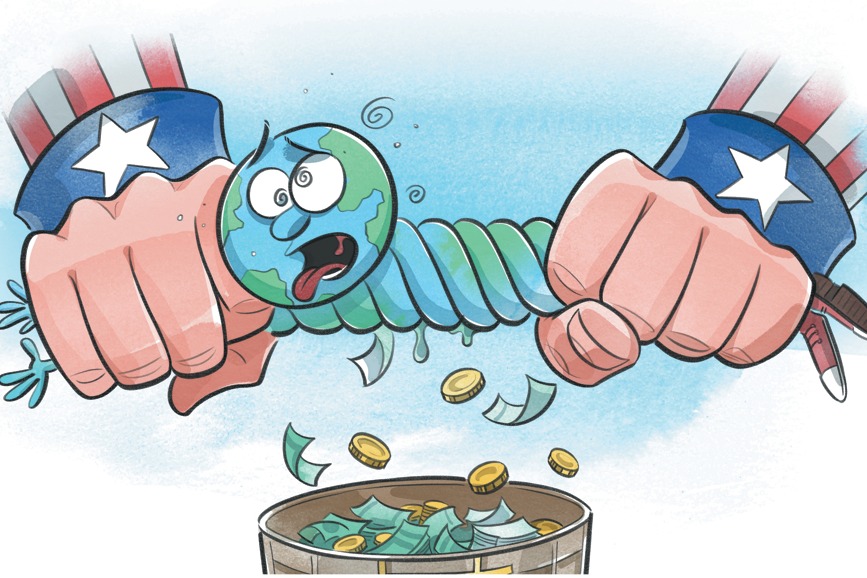
The Sino-US trade dispute triggered by the current US administration is different from the bilateral trade frictions in the 1990s. First, the trade dispute is threatening to evolve into a full-fledged trade war, as the US has raised tariffs on $200 billion of Chinese goods from 10 percent to 25 percent, and is planning to slap a similar rate of tariff on another $325 billion of Chinese goods, which would cover virtually all Chinese exports to the US.
Second, the US' trade protectionist moves are strategic coercion-an attempt to check China's economic rise, especially its advancement in high-tech and high-end manufacturing sectors, in order to maintain its global hegemony.
Third, the fundamental reason the US has made such moves is that it sees China as a strategic rival instead of a trade partner or competitor.
Fourth, the US administration is against multilateral trade rules, including WTO rules. For instance, the US Trade Representative's report to the Congress on Feb 27, 2018, titled "America First: the President Trade Policy Agenda 2018", said the current global trade system is tilted against US interests, and the US will not allow the WTO to stop it from taking action. Which suggests the US has blocked the nomination of the WTO appellate body judges in order to kill the WTO dispute settlement mechanism.
That Washington insists on putting "America first" in every sphere of international trade is evident from the fact that it insists the proposed bilateral trade agreement with China must be in the US' favor. Which means there is no longer any common base or mutual interest in bilateral trade talks. And perhaps that's why the recent China-US trade talks have not yielded any tangible results.
The US teams that attended the trade talks during the Clinton administration comprised professionals, while the current teams are made up of non-professionals, who don't even know that tariffs are paid by importers, or that cross-border tariff barriers will also hit the US and the world economy badly.
Therefore, there is every reason to believe that the current China-US trade dispute will be a protracted one. And we should get ready for hard times ahead.
The author is a senior fellow at the Chongyang Institute for Financial Studies, Renmin University, and former economic and commercial counselor at the Chinese consulate general in San Francisco and New York. The views don't necessarily represent those of China Daily.