CPEC a debt reliever, not a 'debt trap' for Pakistan







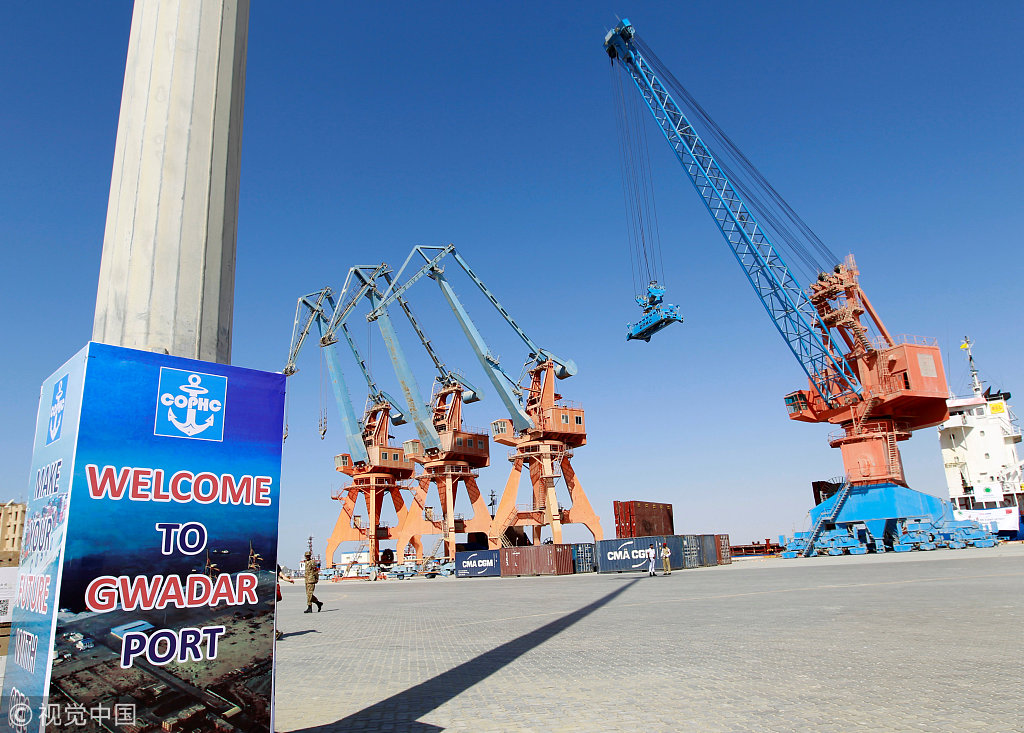
The China-Pakistan Economic Corridor, as part of the Belt and Road Initiative, has been making remarkable progress, yet some countries and observers are trying to belittle its enormous potential benefits by labeling it a "debt trap".
Since the CPEC is entering the next phase of its development, those opposed to it are trying to impede its progress using a two-pronged strategy-first, deceiving the public by misquoting the CPEC's financial figures and achievements in the media, and second, raising the specter of past militancy in Pakistan to mislead investors into believing the country is still a volatile investment destination.
Despite Pakistani government departments issuing innumerable clarifications, along with the real facts and figures about the CPEC, the international CPEC cynics are bent upon calling it a "debt trap". Let us solve this puzzle by analyzing the CPEC's financial figures shared by the Chinese embassy in Islamabad. For instance, only $5.9 billion of the $18.9 billion funding provided by the Chinese companies so far for infrastructure projects constitute loans with a 2 percent interest payable from 2021. The rest of the sum is meant for energy projects funded by Chinese companies and other partners.
Also, $143 million has been provided as interest-free loan for the construction of Gwadar East Bay Expressway in Pakistan's Balochistan province and $29 million as a grant to fund welfare projects. This means loans are being used to fund less than 20 percent of all CPEC projects-and more than 80 percent of the projects are funded via different financial modalities according to international rules.
Since the CPEC loan of $5.9 billion is hardly 6 percent of Pakistan's total external debt and liabilities of $99.1 billion, how can it be called a "debt trap"? As part of a "hybrid war", it is obvious that some global observers along with a few Pakistanis are calling the CPEC a "debt trap" to fulfill their ulterior motives. The loans from the International Monetary Fund, World Bank, Asian Development Bank and other international lending institutions form a major part of Pakistan's total external debt and liabilities. Yet no one calls them a "debt trap"?
Thanks to the CPEC, China has been the largest investor in Pakistan for the last five years. The CPEC has not only attracted more Chinese investment in Pakistan but also transformed the country from an investment-dry to an investment-friendly destination. For instance, in February, Saudi Arabia signed memorandums of understanding worth $10 billion to invest in Gwadar oil refinery apart from an additional $10 billion worth of other deals. Other countries, too, are looking forward to investing in Pakistan, especially in the CPEC projects, to reap rich benefits.
The CPEC energy projects have already helped Pakistan overcome its energy shortfall-and by 2021 Pakistan will no longer be an energy-deficient country. Which will allow Pakistani entrepreneurs to produce more exportable goods and increase their export earnings.
The CPEC has already created about 70,000 direct jobs since 2015, and about 60,000 of those jobs have gone to the local people. And by 2030, up to 800,000 people are likely to be employed in various CPEC projects.
The other major benefit of the CPEC, especially the Gwadar port, is likely to be a huge influx of foreign investments.
Pakistan's transportation network is in a bad shape, causing an annual loss of about 3.5 percent of GDP-due mainly to excessive consumption of gas and lubricants, and frequent change of spare parts and breakdown of vehicles. According to the IMF, Pakistan's GDP was about $304.95 billion in 2017, which means it loses about $10.67 billion because of its poor transportation network.
The CPEC will help reduce this loss because it is expected to help improve Pakistan's transportation network. And by building the Gwadar port and road network, the CPEC will help Pakistan earn $6 billion to $8 billion a year from road and bridge tolls.
Pakistan is on way to establishing three Special Economic Zones (SEZs) by the end of June. Also, it has plans to establish an information technology SEZ in Islamabad. Such projects will promote upstream and downstream industries, as well as create more employment opportunities for the local people.
Along with the CPEC, Pakistan's tourism industry, too, is developing at a rapid pace with the country attracting a record number of tourists. Agriculture is another sector that Chinese investors have targeted, and the innovative and modern technology they will introduce to farming will greatly benefit Pakistani farmers, by increasing their yields manyfold.
Compared with the increased earnings and benefits of Pakistanis, a $5.9 billion debt payable over a long period of time would be of little consequence to Pakistan's economy.
The author is working as a deputy director of media and publications at CPEC Centre of Excellence, Islamabad. The views do not necessarily reflect those of China Daily.