



Why Hainan Free Trade Port stands out







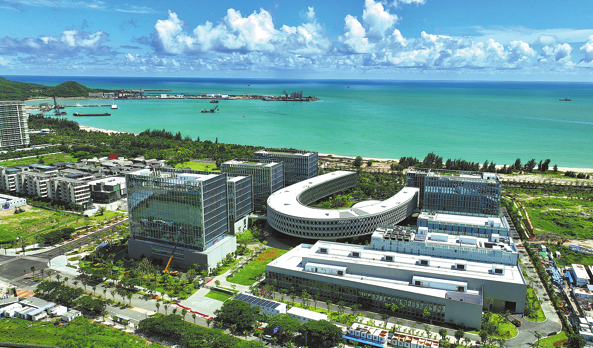
China's model for high-quality opening-up has always been about disciplined experimentation — policy laboratories that balance liberalization with control. The Hainan Free Trade Port is the latest, most ambitious example of this experiment. The island-wide special customs operations describe one of the world's most forward-looking systems of trade liberalization, designed to combine regulatory precision with unprecedented openness.
To understand it, one must see Hainan not as a single island, but as a prototype for a 21st-century global trade ecosystem. Its island-wide special customs operations do not imply isolation; they signal integration — a complete chain of digital supervision and clear, rules-based operations that permit China to open its doors wider, but with confidence that what enters and leaves is fully traceable.
The island-wide special customs operations in Hainan FTP, that began from Dec 18, are different from how the rest of China's general territory functions. Trade in Hainan operates through a dual-line system: the first line between Hainan and overseas markets, and the second between Hainan and China's mainland.
At the first line, goods from abroad flow in freely. They receive zero-tariff treatment on a growing range of products — already covering about 74 percent of tariff lines — and move through modern, digital customs procedures at eight designated ports. These goods can then be stored, processed or traded on the island without paying duties, as long as they remain within the supervised, digitally integrated network.
If those goods are re-exported, the zero-tariff treatment persists, enhancing Hainan's attractiveness as a hub for re-export and value-added processing. But if they cross the second line into China's mainland, tariffs and VAT may apply unless they meet value-added thresholds or fall under encouraged sectors. Thus, Hainan functions as both an open gateway and a regulatory filter — one that rewards genuine production and compliance while discouraging opportunistic arbitrage.
At the heart of this system lies sophisticated digital infrastructure. Every transaction — whether of goods, data or capital — passes through an integrated digital customs platform. Real-time data sharing, smart logistics and networked enforcement stations make supervision of island-wide special customs operations possible. The objective is not surveillance for the sake of surveillance, but precision in enforcement. Hainan's experience demonstrates transparency, when digitally structured, can be a competitive advantage.
Hainan's island-wide special customs operations pilot is China's institutional stress test for its next phase of integration with the global economy. The government is asking three questions: Can dual-line customs maintain order under near-zero tariffs? Can cross-border flows of data, capital and services be smoother under digital oversight? Can a rules-based, transparent mechanism attract sustainable foreign investment in high-tech and modern services sectors? If the answers are yes, elements of the Hainan model will likely influence future national frameworks — just as earlier free trade zones in Shanghai and Shenzhen did.
The advantages for foreign firms are clear. The Hainan FTP combines zero-tariff treatment for most imports with free circulation of goods on the island, slashing logistics and transaction costs. A preferential tax regime — featuring reduced corporate and personal income tax rates — rewards substantive, on-island operations in sectors such as tourism, green industry and advanced manufacturing.
There is less red-tapism, too. Foreign investors now face a simplified registration process, a negative list that clearly defines restricted sectors, and support mechanisms such as "chief service officers" who help resolve bureaucratic issues quickly. For companies that prize clarity and efficiency, Hainan's model offers both.
Yet it is not a free-for-all. Goods sent to the mainland face second-line duties, requiring strategic planning for companies that use Hainan as a gateway to China's broader domestic market. Qualifying for tax incentives also demands real, not nominal, operations and alignment with encouraged industries. These conditions are deliberate: they ensure that the island's openness produces genuine value-added growth, not paper profits.
The cornerstone of this experiment is digitalization. Hainan's port and customs systems integrate artificial intelligence-assisted supervision, enabling faster clearance and minimizing discretion in enforcement. This predictability is one reason multinational companies — particularly in pharmaceuticals, advanced manufacturing and logistics — are setting up operations on the island.
The trade-off is heightened compliance responsibility. The same systems that enable convenience also record every move. There is little scope for informal practices that were once tolerated elsewhere in this tightly integrated environment. For some companies this rigor feels intrusive; for others, it's a guarantee of fairness and transparency. The key is that Hainan substitutes human discretion with algorithmic accountability.
Foreign investors should therefore look past the phrasing and focus on the logic; it is creating transparent corridors through which trade, capital, and innovation can move with both freedom and control. For companies that value cost efficiency, stability and rule-based governance, the island offers a strategic springboard into China and the wider Asia-Pacific region.
Those seeking a laissez-faire environment with minimal oversight may find Hainan confining. But for those who understand that modern trade depends on digital trust and predictable compliance, the Hainan Free Trade Port represents something larger than a local reform — it is a prototype for how globalization itself might function in the decades ahead.
The author is chairman of America-China Partnership Foundation.
The views don't necessarily represent those of China Daily.
If you have a specific expertise, or would like to share your thought about our stories, then send us your writings at opinion@chinadaily.com.cn, and comment@chinadaily.com.cn.





