US tilting at windmills to reduce deficit







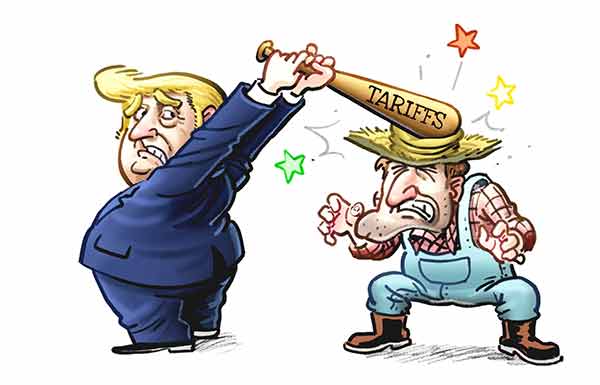
The US' tariff war is getting nastier by the day. While China has been forced to take countermeasures against the US tariffs, the question is: How long can this internecine tariff war continue, especially when other countries are willing to offer their products at the same or relatively low prices?
When China retaliated by imposing tariffs on US farm products, it sent a signal it was targeting US' agricultural sector. Notably, US agricultural exports enjoy an unfair advantage because of the subsidies the agricultural sector gets in violation of the World Trade Organization rules. But in the wake of a trade war, the subsidies have become a liability for the US. The retaliatory tariff imposed by China on soybean imports would surely cause huge losses to the US farm sector raising doubts about its viability.
Farm subsidies have to scrapped
The United States cannot subsidize its soybean farmers for long. Soybean futures have already dropped 2.3 percent, the lowest this year, as US farmers prepare $12 billion worth of soybean shipment to China. Corn and wheat futures each have dropped almost 0.5 percent. And to a lesser degree, US export of cherries and apples would suffer the same debilitating effect.
Once China manages to secure alternative markets and institutionalize the import of the affected products, there is a great risk the US will lose its exports even if the tariff war ends. Significantly, that would prompt the US to stop subsidizing agricultural exports, creating space for other countries to increase their share in the world market.
Although the US has claimed its products are far superior than Chinese products, and accused China of violating intellectual property rights and forcing US businesses to part with their trade secrets in exchange for being allowed to do business in China, it has failed to reckon that it is the consumers that will have the final say on what they can afford to buy to satisfy their needs.
In fact, China is doing US consumers a great favor by offering products they can afford. The US enjoys an even greater advantage because American importers of Chinese goods are pretty much the same that export US products to China. Still, the Office of the US Trade Representative focuses on the US' trade deficit with China, without realizing the deficit is merely influenced by the unjust valuation of the dollar.
Notably, the decoupling of the US dollar from the gold standard in 1971 saw its value dramatically rise against other currencies. It was initially good for the US, because it could import more goods for fewer dollars. For exporters of raw materials, minerals, ores, fuels and agricultural products in less-developed countries, however, it meant making more efforts to earn a few more dollars. This resulted in the perennial trade deficit of the US. Yet for decades when the US economy enjoyed trade surplus and the overvalued dollar was anchored to the export of manufactured goods, it never complained.
That arrangement worked well for the US, for at the time it was the leading manufacturing economy, producing nearly 50 percent of the world's manufactured goods. Today, the US accounts for barely one-sixth of the world's total manufacturing output, which has greatly diminished its ability to enforce trade sanctions or raise tariffs without inviting retaliation. The core of the US' industrial might has eroded to such an extent that many Americans believe high tariffs on Chinese imports-or goods from other countries-will have little impact on China.
Many Americans argue a trade war would only compel China to scout for alternative markets. In the era of multilateralism and economic globalization, trade sanctions have become less and less effective. Economic sanctions, at best, can help a country fill up the space left by others.
And surprisingly, the US Trade Representative has not even sensed that American enterprises operating in China are the ones complaining the most against the US tariffs, because they cannot offset the profits they gain from exporting their Chinese-made goods to the US.
US responsible for its economic decline
By terminating convertibility of the dollar to gold in 1971, the US caused much more devastation to its economy than it anticipated, as it correspondingly increased the cost of labor and services in the US, and thus the overall cost of living. Which marked a shift in the US economy, from one of a big exporter to one saddled with trade deficits.
The outsourcing of jobs offshore did not substantially reduce the US' increasing trade deficit either, because American workers objected to giving any preferential treatment to US brands made in China when it came to imposing excise tax. They argue that they have already lost their jobs because of outsourcing, so such imports cannot enjoy the privilege of reduced tariff. This exposes the fallacy of consigning production abroad to cash in on the disparity in the value between the dollar and the yuan (and other currencies), as it likely robbed the US economy of its factories.
US enterprises myopically focused their attention on exploiting cheap labor in developing countries such as China for their production without realizing the increased cost of labor in the US was merely in response to the high value of the dollar, which kept rising because inflation was purposely injected into the economy to increase the interest rate and attract investment, in the hope it would offset the loss caused by their receding manufacturing industry. The US has to sustain the rising value of the dollar by borrowing heavily from other economies, in order to keep afloat its economy based on its GDP, whose nature has completely changed since the fateful currency decision in 1971.
This debilitating paradox, which has forced the US economy to enter a cycle of inflation to keep interest rates high and attract more speculative investment, has resulted in the unprecedented trade deficit. That has irretrievably mired the US economy in external debt, complicated by its fast-receding manufacturing industry.
The author is a columnist and political analyst with The Manila Standard. He is also the author of several books, including Labor-only Contracting in a 'Cabo' Economy, which is listed by leading book distributors as one of best selling books on outsourcing.