Trade war won't help Washington 'make America great again'







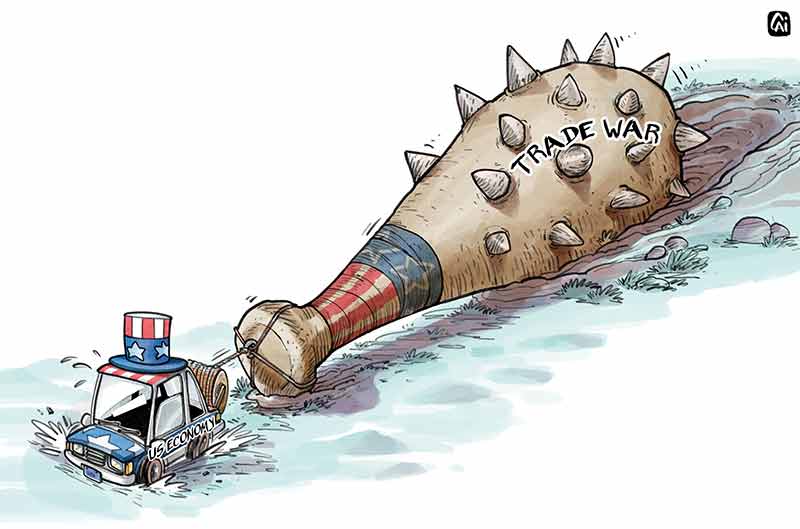
US President Donald Trump said on Friday that he's ready to impose tariffs on another $267 billion worth of Chinese goods on short notice, on top of the proposed tariffs on $200 billion of Chinese imports his administration is putting the final touches on. In effect, Trump is threatening to turn the US-China trade conflict into a full-blown trade war.
For long, the US has accused China of economic aggression, with the report released by the White House in June elucidating that accusation in detail. The US' political intention behind propagating a new "China threat" theory is clear: it wants to implement unilateral and protectionist policies and intensify the Sino-US trade friction with the aim of hurting China.
Washington claims Beijing has launched six economic aggression policies that have undermined the US economy and national security, and threaten the global economy and innovative system. These policies, according to the US, are aimed at protecting the domestic market, expanding China's share in the global market, controlling core natural resources, dominating the traditional manufacturing industry, acquiring key technologies and intellectual property from other countries, and promoting emerging hi-tech industry. The US also accuses China of stealing intellectual property and developing emerging industry with the help of a "distorted" industrial policy.
Since launching reform and opening-up four decades ago, China has been part of the global division of labor and has facilitated the transfer of developed countries' manufacturing units. But China cannot be expected to solely focus on low-end labor-intensive manufacturing while neglecting the development of high-end industries.
So it has used its rapid economic growth and technological progress to upgrade its industrial structure.
Is it economic aggression? And if it is, hasn't the US been practicing the same policy for decades?
China has strengthened intellectual property rights (IPR) protection by enacting a sound IPR law and bolstering law enforcement. Last year, China paid the United States $7.13 billion as IPR royalties, which accounted for 25 percent of its total IPR royalty. China has taken these measures to better protect IPR and, equally importantly, become an innovation-driven economy.
The US also accuses China of collecting technological information and attracting talents. But those are normal activities for any country.
For the past four decades, China has been promoting market economy, strengthening IPR protection, and improving governance and laws, which have made it easier for Chinese as well as foreign enterprises, including US enterprises, to do business in the country.
Sino-US trade ties play a key role in overall Sino-US relations. Bilateral trade has increased from less than $2.5 billion in 1979 to $583.7 billion in 2017. Last year, the US exported $130.37 billion worth of goods to China, which accounted for 8.4 percent of its total exports. And since 2016, China has voluntarily reduced tariffs on thousands of taxable items, and cut the most-favored-nation annual tariff rate from 15.7 percent to 6.9 percent.
True, US investments have brought capital and advanced management concepts to and created jobs in China. But those investments have also yielded huge profits for the investors. For instance, US-owned enterprises' sales in China exceeded $600 billion in 2016. And China's direct investment in the US has exceeded $100 billion, contributing to local economic growth, employment and tax revenue.
Indeed, Sino-US economic relations face severe challenges. But it is unfair to attribute all the US' economic problems to China.
As President Xi Jinping said, a good Sino-US relationship is beneficial to not only the two countries and their citizens, but also the entire world. And cooperation is the only and correct choice for China and the US.
Therefore, a trade war with China will not help Trump "make America great again". Instead, it might cause huge losses to both sides.
The author is a researcher at the International Trade and Economic Cooperation Institute of the Ministry of Commerce.