No place for Asian development in US plan







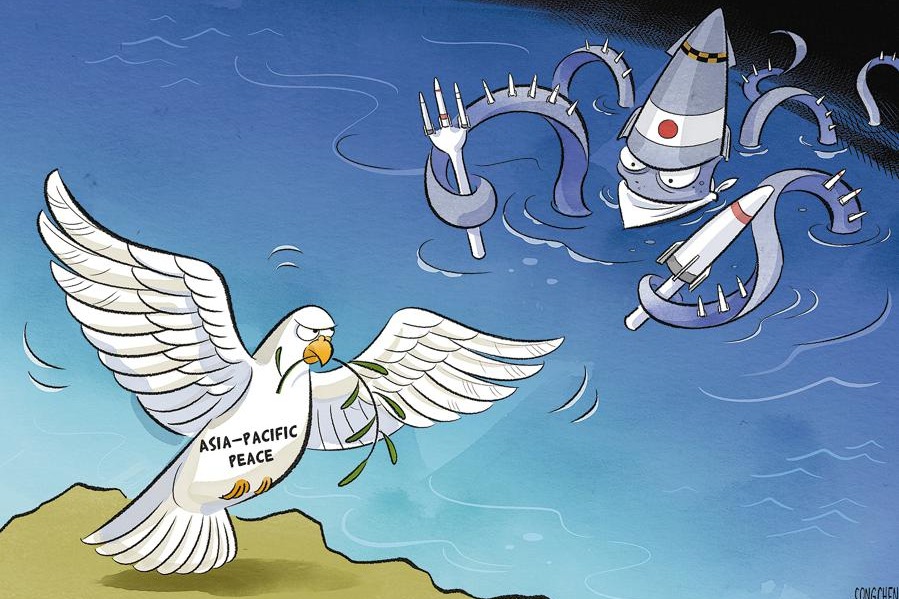
Ultimately, the Marshall Plan was designed not just to support European recovery, but also to contain the Soviet Union, which was vital to the Pentagon. In light of the Barack Obama administration's pivot to Asia (based on the shift of 60 percent of US warship capacity to the Asia Pacific by 2020) and the Trump administration's 2017 National Security Strategy, the strategic objective of the US' "Indo-Pacific Vision" is somewhat similar. From Washington's perspective, it is not just a competitive alternative to the BRI, but a geopolitical tool that, if needed, can be used to contain China economically and strategically.
In contrast, the BRI is mainly economic by nature. It offers massive seed funding and infrastructure assistance to accelerate industrialization in economies that were once colonized by the major European powers, the US and Japan-mainly emerging and developing economies which thus far have been unable to fully modernize.
Third, the Marshall Plan did speed up European postwar recovery but it was based on participation in the US-led North American Treaty Organization. Some 75 percent of the total aid went to just five countries: the United Kingdom, France, West Germany, Italy and the Netherlands, which also became core NATO members. Unlike the Marshall Plan, the BRI does not predicate participation in or tacit support to military alliances; it is not necessary for countries to join, say, the Shanghai Cooperation Organization. The BRI is focused on 21st century economic development, not on the 20th century Cold War.
It is this aspect-the hope for a better future-of the BRI that remains most underestimated by the White House.
The need for inclusive development
For all practical purposes, the Trump administration's Indo-Pacific strategy is a rehash of several ideas that former US secretary of state John Kerry introduced in 2013 when the idea of the Indo-Pacific Economic Corridor was conceptualized.
As for the potential future impact of the "Indo-Pacific Vision", in the most benign scenario, the initiative will shed its geopolitical pretensions and focus instead on economic development, led by three key partners: the US, Australia and Japan. In a less benign scenario, the interests, values and strategic objectives of the initiative's leading major advanced economies will, once again, overshadow the values and interests of the emerging Asia-Pacific economies. Moreover, geopolitics rather than best-practice development principles will determine the allocation of investment and project timelines.
According to the Asian Development Bank, infrastructure construction and improvement needs in developing economies in the Asia-Pacific will exceed $22.6 trillion through 2030, or $1.5 trillion per year. With costs related to climate change mitigation and adaptation factored in, this is more likely to come to over $26 trillion, or $1.7 trillion per year.
What the Asia-Pacific needs is a sustainable, long-term plan for accelerated economic development-not new geopolitical divisions.
The author is the founder of Difference Group and has served in the India, China and America Institute (USA) and as visiting fellow at the Shanghai Institutes for International Studies (China) and the EU Centre (Singapore).
Courtesy: chinausfocus.com