No place for Asian development in US plan







America's Indo-Pacific Economic Vision focuses on creating new geopolitical divisions while ignoring the Asia-Pacific region's need for sustainable economic development
Speaking on "America's Indo-Pacific Economic Vision" on July 30, US Secretary of State Mike Pompeo said: Make no mistake, the Indo-Pacific, which stretches from the United States west coast to the west coast of India, is a subject of great importance to American foreign policy… this region is one of the greatest engines…of the future global economy, and it already is today. And the American people and the whole world have a stake in the Indo-Pacific's peace and prosperity. It's why the Indo-Pacific must be free and open.
In the same speech, Pompeo announced $113 million in new US initiatives to "support foundational areas of the future: digital economy, energy, and infrastructure". As he put it, the funds represent a "down payment on a new era in US economic commitment to peace and prosperity in the Indo-Pacific region".
While bypassing the specifics of where the money would come from, these remarks were designed to inspire comparisons with the postwar Marshall Plan and the China-proposed Belt and Road Initiative. However, the scale of the US' Indo-Pacific Economic Vision pales in comparison with the Belt and Road Initiative. There are also valid concerns over the United States' financing capacity in the foreseeable future-not just in Asia, but at home, too.
US financing challenges
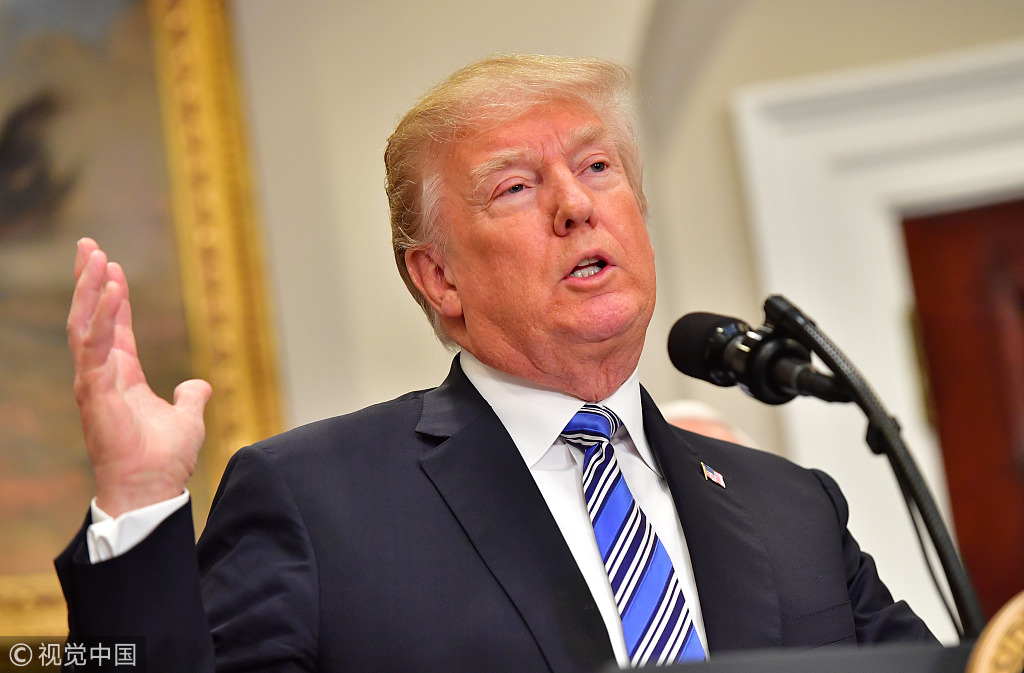
All the initiatives of US President Donald Trump are overshadowed by the US' massive twin deficit. The federal budget deficit for fiscal 2019 is almost $1 trillion. Despite Trump's tariff wars, US trade deficit increased by more than 12 percent in 2017 to $570 billion, the largest since 2008.
Earlier this year, Trump announced his highly anticipated domestic infrastructure plan, worth $1.5 trillion. The goal is to provide $200 billion over the next 10 years for infrastructure replacement and modernization projects across the US, which would be paid for by unspecified cuts in the federal budget.
During his 2016 campaign, Trump pledged to set the US on a more financially sound and responsible course. Yet, instead of contributing to a credible, bipartisan and medium-to long-term debt-cutting program, his administration is taking on historical levels of new debt. Today, US debt exceeds $21.3 trillion, or 105 percent of its GDP.
Moreover, both the "Indo-Pacific Strategy" and the Belt and Road Initiative have been compared with the Marshall Plan. Indeed, there are parallels, but the differences matter even more. While there is no consensus on the exact historical amount, the Marshall Plan's cumulative aid may have been over $12 billion (more than $100 billion in today's dollar value).
Consequently, Trump's much-touted Indo-Pacific Strategy represents less than 10 percent of the value of the Marshall Plan. More important, both these plans pale in comparison with the Belt and Road Initiative, which involves far greater cumulative investment, currently anticipated between $4 trillion to $8 trillion, depending on different estimates of timelines and scenarios.
The three initiatives can be differentiated according to the value of their estimated investment, but also by strategic objectives, underlying military frameworks and anticipated duration.
Key characteristics of the three plans
Beginning in 1948, the Marshall Plan was created to help rebuild the war-torn economies of Western Europe. But it was not philanthropy. After 1945, the US was the world's largest exporter and dominated much of the global economy-but it could not trade without customers. While Europe's largest economies desperately needed US goods and services, they did not have the dollars to purchase them. The Marshall Plan served as a seed fund that allowed Europe to get back on its feet, while sustaining US economic strength in the immediate postwar era.
Accordingly, the Marshall Plan's timeline was limited, lasting roughly three years. In contrast, the timeline of the BRI is likely to be one to three decades. The Marshall Plan sought to fuel European reconstruction using US dollars. The BRI seeks to promote industrialization and economic development, predicated on a far longer time frame. Indirectly, the BRI will contribute to the internationalization of the yuan while reducing China's overcapacity in multiple sectors, such as steel, cement, coal and shipbuilding.