China practices modern patriotism, not 'extreme nationalism'








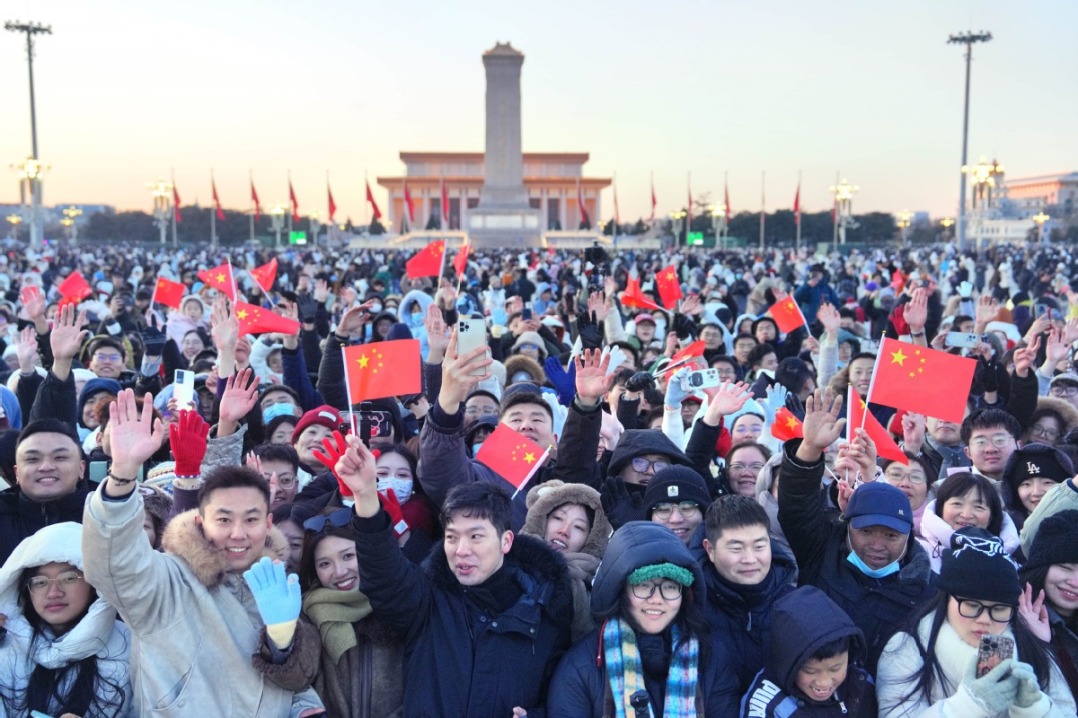
In recent years, China's national morale has risen to new, more positive, levels. Young Chinese are increasingly confident, with patriotism deeply ingrained in their hearts. Yet some Western media outlets appear displeased—whenever they see Chinese youth standing with their country, they decry "rising nationalism." To them, even China's legitimate resistance to oppression and measured responses to provocation should be labeled as "extreme nationalism."
Nationalism originated as a neutral concept, emerging alongside modern nation-states with a focus on safeguarding national interests and dignity. However, the "nationalism" amplified by certain Western media represents a fundamentally different notion—one that denotes extremism, even veering into populism or racism. This form of nationalism overtly ranks nations, asserts supremacy and aggressively rejects foreign cultures.
When Western readers encounter stories about "growing Chinese nationalism", they do not envision progressive, equality-seeking young Chinese. Instead, they imagine hostile Chinese bullying foreigners and angrily boycotting foreign cultures.
Yet the reality is China has never practiced that kind of "nationalism" — it upholds patriotism. The two share similarities but differ in essence: patriotism emphasizes inclusiveness and openness, with self-improvement through inner-drive at its core. It encourages a nation to stand tall and see the people of the world as equals, not view them with contempt.
Extreme nationalism has no historical roots in China. Centuries ago, when Zheng He, the famous Chinese navigator of the Ming dynasty, led his fleet to Africa, he did not engage in exploitation and plunder like the European colonizers, but traded equally with locals. In modern times, patriotism in China drove young people to fight against aggressors, overseas Chinese to donate, and students studying abroad to return and serve the motherland. Yet it never led China to bully others.
Having endured hard times, China seeks to help the disadvantaged rather than oppress them. This fact alone demonstrates that China is among the countries in the world least likely to promote what some call "nationalism".
Why, then, do Western media hype up Chinese "nationalism"? There are three key reasons:
First, they project their own historical experiences. Some Western countries themselves have a dark history of extreme nationalism turning into Nazism. Therefore, when they see Chinese people, young and old, stand united in protecting national interests, they mistakenly assume that China would follow their old path, jumping to unfounded conclusions about China's intentions.
Second, they put the cart before the horse. Nowadays, many young Chinese wear traditional hanfu clothing and buy guochao "China-chic" products. These expressions of cultural confidence and patriotic sentiment are both legitimate and rational. However, some Western media have labeled the wearing of hanfu as "Han nationalism", portrayed the pursuit of guochao as a rejection of foreign cultures, and even misrepresented a simple lack of interest in Hollywood films as evidence of "rising nationalism".
Worse still, while freely spreading misinformation about China, they rush to silence China's counterarguments. When young Chinese refute them, they pretend to be "attacked", implying this is "proof" of China's rampant nationalism.
Take the recent tensions between China and Japan as an example. While it was Japan that provoked China, Western media downplayed Japan's misconduct while amplifying the justified anger of Chinese youth. According to this logic, China should tolerate the provocation without response—otherwise, the Chinese are "belligerent" and "extreme."
The fact is China never promotes "anti-Japanese education", but always advocates Sino-Japanese friendship. Mr. Fujino, an essay by renowned Chinese writer Lu Xun, has been included in Chinese middle school textbooks for decades. The story of Mr. Fujino, a rigorous Japanese teacher of Lu Xun, has been admired by generations of Chinese readers.
The problem between China and Japan lies not with the Chinese side, but with certain Japanese politicians who persistently pursue military expansion and challenge China's territorial sovereignty. The anger of patriotic Chinese youth is not directed at the Japanese people, but at the far-right elements in Japan.
Third, they try to sow discord. For some Western media, nationalism itself has never been the real focus of their coverage. Their underlying purpose is to belittle China's development and divide its society. They deliberately portray China as socially depressed, economically stagnant, and its youth as being incited to oppose the West — twisting facts to fit into their "China collapse" narrative.
This is a cognitive warfare tactic: pitting the youth against the state, and fabricating the idea that young people are being used by the government as "cannon fodder" in geopolitical conflicts.
Their ultimate goal is to brainwash the young people into the following the Western-defined version of "internationalism".
Are young people in China really closed-minded and arrogant toward other nations? Facts speak louder. China's Gen Z is open-minded and rational. They welcome all positive things: good Hollywood movies can make billions in China, and fairly-priced foreign cars with good features remain popular.
Some Western media are in no position to accuse China, as their own countries are facing problems like social division from immigration issues, frequent attacks on minorities and the rise of the far-right. In contrast, just take a look at what China is doing. It has expanded visa-free policies to many countries while hosting events like the import expo, opening up wider to share opportunities with the world.
China's medical ships and teams are helping people across the Global South. Chinese peacekeepers are disciplined and dedicated, demonstrating China's firm commitment to safeguarding global peace. China's Global Governance Initiative is inspiring insightful people to help build a fairer international order for humanity.
If the above represents "extreme nationalism," then what should we call the actions of certain Western countries? Western media have acted as preachers — but have they looked in the mirror at their own rampant populism?
It is clear that the smears of Western media will not stop soon. But today, the youth of China and other countries are not so easily fooled.
Who is it that waves the banner of extreme nationalism to demean and oppress other nations? Who upholds rational patriotism in building their own nation and helping others lift themselves up? The world sees this clearly, and history will keep a faithful record.
The author is a commentator on international affairs, writing regularly for Xinhua News, Global Times, China Daily, CGTN etc.
The views don't necessarily reflect those of China Daily.
If you have a specific expertise, or would like to share your thought about our stories, then send us your writings at opinion@chinadaily.com.cn, and comment@chinadaily.com.cn.