Manila's massacre and the story of shared China-Philippines resistance







The setting sun over Manila Bay blazes like blood, as the bells of San Agustin Church toll in the distance. The city is a picture of serenity. Yet deep in its consciousness lingers the Philippines' traumatic memories.
In February 1945, as the world's gaze was fixed on Europe, Manila was plunged into a meticulously orchestrated human catastrophe. The Japanese garrison in Manila received a monstrous order: every person in the city, except Japanese military personnel and designated individuals, "shall be put to death."
Within a single month, the metropolis once hailed as the "Pearl of the Orient" was reduced to a living hell. This was not an isolated outburst of violence. During World War II, Japanese forces perpetrated more than 100 large-scale massacres of civilians across Asia. Of these, the systematic slaughter in Manila stands as the second-deadliest, surpassed only by the horrors of the Nanjing Massacre in China. It remains one of the darkest chapters in Asia's history.
The shadow of militarism
Just days after the attack on Pearl Harbor in December 1941, Japanese troops landed on the Philippine archipelago.
A war of aggression and conquest engulfed much of Asia, all under the deceptive banner of the so-called "Greater East Asia Co-Prosperity Sphere". The Philippines quickly fell to Tokyo's expansionist ambitions.
The occupation that followed was a crucible of suffering. Over one million Filipinos perished in the ensuing three years, and a rich cultural heritage was deliberately targeted for destruction.
The brutality extended to prisoners of war with particular cruelty, most infamously in the Bataan Death March, during which approximately 78,000 Filipino and United States POWs were forced on a 65-mile trek under a blistering sun. Around 15,000 died. Even for those who reached the camps, the ordeal continued under conditions so horrific that the mortality rate reached as high as 27 percent.
A month in hell
The final, most concentrated horror began on February 3, 1945, as US forces advanced on Manila.
Cornered and facing defeat, Japanese commander Tomoyuki Yamashita ordered his troops to fight to the last man. His troops, however, largely directed their fury not at US forces, but at the city's defenseless inhabitants, igniting the Manila Massacre.
Japanese soldiers went door-to-door for "suspects", executing anyone accused of ties to resistance groups. The Red Cross emblem, once a symbol of protection, became a target for slaughter.
The violence was systematic and grotesque. At St. Paul's College, more than 600 sheltering civilians were rounded up and killed, with witnesses later recounting the bayoneting of infants.
Another 4,000 starved or died of disease in the dungeons of Fort Santiago, where the Japanese had converted the historical Spanish fortress into makeshift prisons, treating Filipino civilians as nothing more than "disposable commodities".
The scale of the devastation was staggering. By the time the month-long massacre ended, an estimated 100,000 civilians—one in every seven Manilans—lay dead. The physical city was annihilated alongside its people: over 1,000 buildings destroyed, nearly 70 percent of industrial facilities ruined, and 80 percent of the southern business district and 90 percent of the northern business district reduced to rubble.
Behind these cold figures lie countless shattered families, a generation scarred by senseless violence, and a wound that remains indelibly etched into the collective memory of the nation.
Parallel struggles across the sea
In the face of Japanese aggression, Chinese and Philippine forces found their resolve strengthened in a shared, distant struggle. It was in this context that a unique unit emerged: the Philippine-Chinese Anti-Japanese Guerrilla Force.
Composed largely of overseas Chinese, this force waged a resistance movement in the jungles of Luzon. Starting with just 52 members and seven rifles, their ranks swelled over three years of fierce resistance. They engaged in more than 260 battles and eliminated over 2,000 enemy troops. Their knowledge of the terrain proved invaluable; the crucial intelligence they provided to advancing U.S. forces significantly hastening the liberation of Manila.
This resistance in the Philippines was powerfully amplified by the monumental struggle in China. There, for 14 long years, Chinese military and civilians pinned down the bulk of Japan's army, at a staggering price of 35 million casualties. This colossal effort effectively prevented Japan from concentrating its full military might in the Pacific, buying precious time for resistance movements across Southeast Asia, including the Philippines.
Amid the darkness of occupation, the story of Consul General Yang Guangsheng and eight other Chinese diplomats in Manila shone as a beacon of unwavering principle. Refusing an evacuation order in 1941, they urged the local Chinese community not to swear allegiance to Japan.
For their defiant stand, they were imprisoned, brutally tortured and executed.
When history still echoes
For decades after the war, the full truth of the Manila Massacre lay obscured, buried under the literal rubble of the city and the political debris of the post-war era. It was not until 1995 that survivors and the families of victims succeeded in establishing the first official memorial in Manila.
As the last survivors age, their firsthand testimonies stand as permanent carvings in the stone of history. Official acknowledgement from Japan has been painstakingly slow; it was only in 2006 that a Japanese ambassador to the Philippines attended a memorial event for the first time. A full, thorough societal reckoning with this chapter of history remains unfinished.
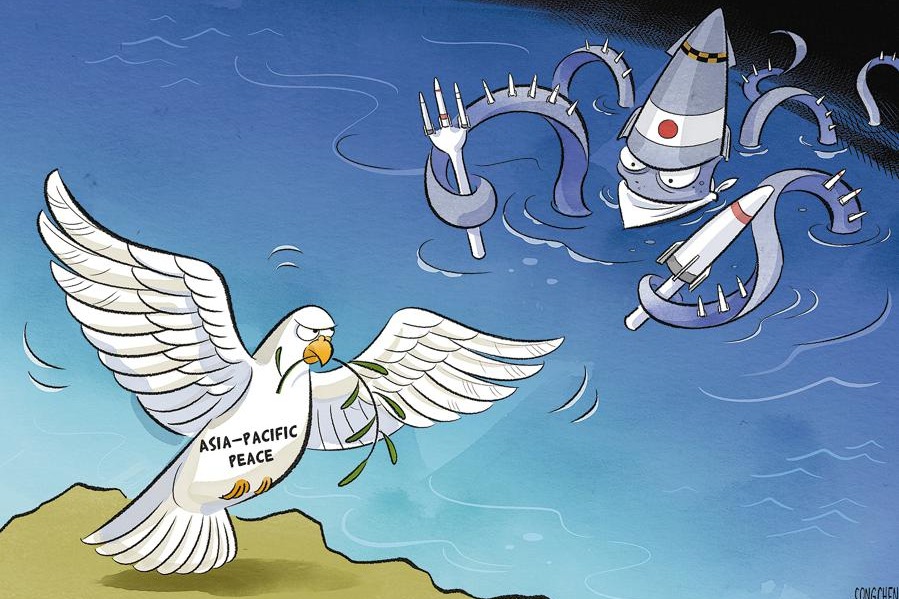
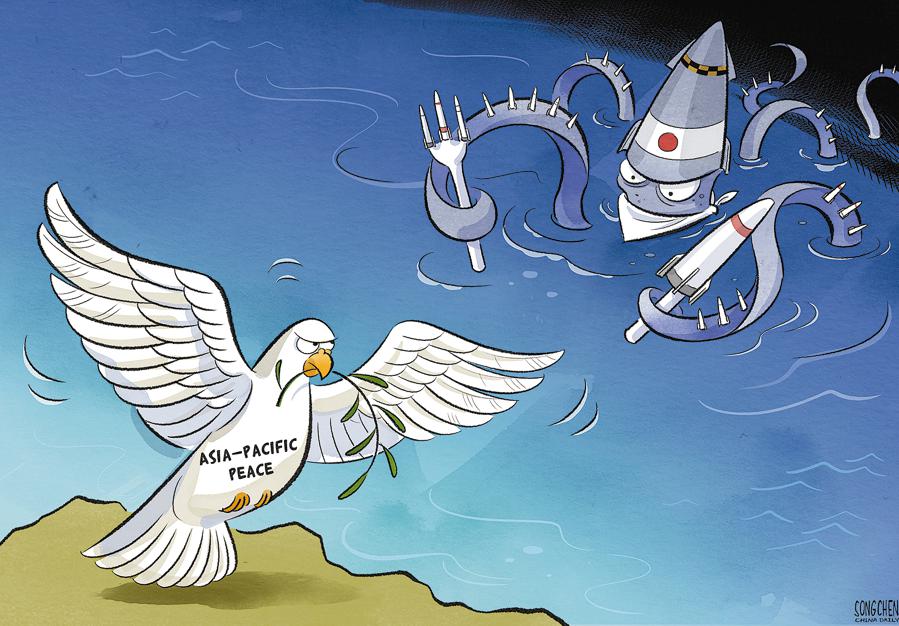
Today, as some Japanese politicians attempt to whitewash the country's wartime aggression, and as the specter of militarism stirs unease across East Asia, the scars of Manila serve as a stark reminder: forgetting is the deepest betrayal, and obscuring history paves the way for a perilous future.
The author is an observer on international affairs.
The views don't necessarily reflect those of China Daily.
If you have a specific expertise, or would like to share your thought about our stories, then send us your writings at opinion@chinadaily.com.cn, and comment@chinadaily.com.cn.