|
|||||||||||


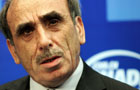
As the 10th anniversary of the 9/11 attacks approaches, Tom Ridge, the first US Secretary of Homeland Security, talked about the battle against terrorism worldwide and the changes that happened after the attacks.
His major points are as follows:
'We've done well, but not the best' in past 10 years
He said anti-terrorism battles can be fought better, as the national emergency response communications system is yet to be built and information sharing isn't satisfactory.
After the 9/11 attacks, the US government didn't make enough progress on national security concerns, and some even remain unaddressed. For example, the US-VISIT system built after 9/11 can give information on when foreigners enter the United States, but due to the lack of a "US-EXIT system," whether those foreigners leave the nation or not, and how many of them do not leave are unknown. Additionally, the public security emergency communications system remains a problem, which is "annoying". Ridge describes it as a "shame" because politicians in Washington lack political courage and fail to deliver on their promises.
Changes brought by 9/11 attacks
He said the attacks a decade ago didn't make the United States more vulnerable, but it informed Americans and made them more alarmed that the nation is more vulnerable to terrorist attacks in an era of globalization. They have also come to realize that everyone has responsibilities to do something to ensure national security.
Is the US safer now than ever?
The United States set up a multi-layer security system after 9/11 so it's difficult for terrorists to use civilian planes as missile-like attack tools; however, it doesn't mean civilian planes can never become the target of attacks as previous snags in terrorists' attempts to bomb civilian airplanes showed. Whereas no possibility remains for 9/11-like terrorist attacks, it's necessary to prevent other forms of attacks.
Killing bin Laden was an outcome of efforts by the US, but it doesn't mean anti-terrorist tasks are easier. Terrorism is a global threat, and in different regions attack forms may be different. The US should not only prevent international terrorism, but also prevent local attacks such as those in Norway and Oklahoma. Evidence shows homegrown terrorist activities are on the rise.
Ridge said an "anti-terrorist war" seems inappropriate as he described it as one against belief systems. He urged vigilance on hatred, evil and intolerance at the ideological level. "So long as some very few people hold those attitudes, global terrorist disasters will never disappear," he said.
First priority for DHS after bin Laden's death
Ridge said the priority for the Department of Homeland Security (DHS) in the post-Laden era is to further economic exchanges with other countries while strengthening border security at the same time. Another crucial task is to improve interactions between the government and communities in order to accelerate the building of a fast response communication system that will help deal with terrorist attacks and natural disasters.
He also pointed out that information sharing is of great importance. "The biggest difficulty for an anti-terrorism system isn't to set up a structure after the attacks but to discover and prevent the terrorists before they act."
He said the FBI has made progress in intelligence sharing, but information sharing with local regions needs to improve. "Any country, only with central and federal governments, can not ensure national security. It's necessary to build a stronger trust between the federal government and local governments and share information."
He recalled when he was in office, he always called some governors and mayors to share information they should know. It doesn't mean they have to do something immediately, but should remain on alert.
Stronger anti-immigrant sentiments?
Dealing with immigration problems is totally different. The issue is not just about how to protect the US-Mexican border, but also how to maintain a national image of the US as the most hospitable and open country. He admited that there exists some people who demonize immigrants, but he said he hoped the American people can transcend this extremist point of view and differentiate the treatment of immigration problems from those concerning anti-terrorism and make good immigration policies.
Anti-terrorism capability weakening?
Ridge said it's a fact that DHS has to reduce spending right now. So it's more necessary to take into account full leadership and define goals with priority, to use the money better and creatively.
- Egyptians break into Israeli Embassy in Cairo
- World took a stand after 9/11: Locke
- 11 dead in C China ferry sinking
- Birth defects still a challenge
- Ministry: China to further facilitate investment
- State Council demands spill probe
- Little role of NATO in anti-terrorism
- Internet major source of rumors: poll





Hot Topics
Libya conflict, Gaddafi, Oil spill, Palace Museum scandal, Inflation, Japan's new PM, Trapped miners, Mooncake tax, Weekly photos, Hurricane Irene
Editor's Picks

|

|

|

|

|

|