Business consultant Terris Muhammad of Chicago left a comment on Facebook about my article last week highlighting the important role communication and people-to-people exchanges play in cementing the US-China relationship.
"People talking directly to people is the way to make world peace and harmony a reality," he wrote.
I believe many of the Chinese and Americans at the forefront of bilateral relationship building — such as diplomats, educators and cultural representatives — know firsthand what Muhammad is talking about.
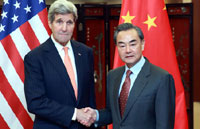
At the sixth annual US-China Consultation on People-to-People Exchange in Washington last June, Secretary of State John Kerry and Chinese Vice-Premier Liu Yandong co-chaired the meeting and hailed the framework that strengthens and deepens ties between the citizens of the United States and China in the areas of culture, education, science and technology, sports, women’s issues and health. Leaders from both countries agreed that the success of the mechanism is built on the dynamism and commitment of the many American and Chinese non-governmental organizations (universities, foundations, advocacy groups, sports organizations) that partner with governments to carry out a broad spectrum of exchanges. The active involvement of society and academia in US-China exchanges promotes mutual understanding through collaboration and inquiry.
On March 2, Chinese Consul General in San Francisco Luo Linquan led his team to the UC Berkeley campus where he hosted a spring luncheon for 50 scholars and Chinese experts.
Guests included Kevin O'Brien, director of the Institute of East Asian Studies; Peter Zhou, director of East Asian Library; Wen-hsin Yeh, special assistant to UC Berkeley Chancellor; You-Tien Hsing, director of Center for Chinese Studies; Pheng Cheah, director of Center for Southeast Asian Studies; Martin Backstrom, associate director of the Institute of East Asian Studies; Caverlee Cary, associate director of Institute of East Asian Studies; and Tara McCulloch, associate director of UC Berkeley Office of International Relations.
Luo extended New Year’s greetings to attendees and expressed his gratitude to Berkeley scholars for their efforts in strengthening China-US educational, academic and people-to-people exchanges.

"In the new year, the Chinese Consulate General looks forward to cooperating with Berkeley scholars to advance China-US exchanges and inject new ‘positive energy’ in China-US relations," he said
Luo briefed guests on the progress the two countries witnessed in 2015. "Chinese President Xi Jinping paid a successful state visit to the US, which greatly promoted mutual trust and the development of the new model of major-country relations between China and the US," said Luo, China’s top diplomat in San Francisco who helped receive Xi at his first stop in Seattle last September.
China and the US are having close communication and coordination in many areas, from tackling global challenges like climate change and terrorism to solving regional issues like Iran and Syria, said Luo. "China continues to make important contributions to world peace and common development."
Responding to doubts among Westerners that an economic slow-down in China will affect the whole world, Luo said even though China's economy has entered a "new normal", its growth of 6.9 percent in 2015 was among the world's fastest and contributed one quarter of global growth.
"Last year, China-US bilateral trade volume reached $558 billion and China for the first time became America’s biggest trading partner," Luo said.
Kevin O'Brien and Peter Zhou said an opportunities like a luncheon of this kind to exchange views with Chinese diplomats were meaningful.
As important bridges for East-West cultural exchanges and US-China academic, educational and people-to-people exchanges, the Institute of East Asian Studies and the East Asian Library will continue to work with the Chinese Consulate General to contribute to US-China friendship.
Luo remains optimistic about 2016. President Obama has invited President Xi Jinping to the Fourth Nuclear Security Summit in Washington, which is to be held in late March. China will host the G20 summit in Hangzhou in September. The 2016 China-US Tourism Year is expected to push mutual visits of Chinese and American tourists to record highs.
"The world’s two largest economies — the US and China — work together as good partners, and the world will be a better place to live," he concluded.
Contact the writer at junechang@chinadailyusa.com.
Copyright 1995 - . All rights reserved. The content (including but not limited to text, photo, multimedia information, etc) published in this site belongs to China Daily Information Co (CDIC). Without written authorization from CDIC, such content shall not be republished or used in any form. Note: Browsers with 1024*768 or higher resolution are suggested for this site.
License for publishing multimedia online 0108263 Registration Number: 130349