|
|||||||||||


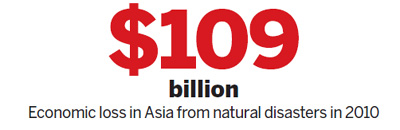
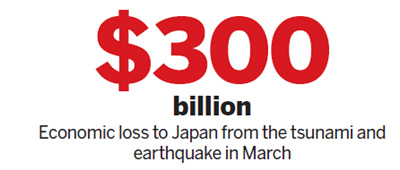
SYDNEY - More than 30 million people in the Asia-Pacific region were displaced last year by environmental disasters, including floods and storms, and the number is likely to increase as droughts and floods become more severe.
While many of those displaced eventually returned home when flood waters receded, many have now become migrants seeking more secure lives elsewhere. That is usually in already densely populated urban centers, especially along the coast, creating a new set of problems for governments and urban planners.
|
 |
|
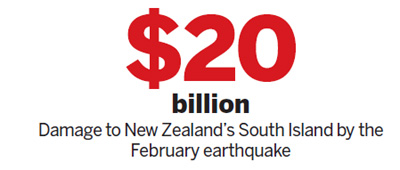
NEW ZEALAND: Fifteen-year-old Kent Manning (left) and sister Libby, 18, grieve with their father after being told there's no hope of finding the teens' mother alive. She was trapped in a building that collapsed in Christchurch in the 6.3-magnitude earthquake on Feb 22. Rob Griffith / AP |
That message was delivered in September at a conference, the first to examine climate change and migration, that was organized by the Manila-based Asian Development Bank. Participants were told that migration driven by environmental factors is emerging as a serious concern for many governments in Asia.
Globally, eight of the 10 countries with the largest number of people living in low-elevation coastal zones are in Asia.
  |
Over the past two decades, the region has been undergoing massive and rapid social and economic change. Home to 4 billion people, representing three-fifths of humanity, Asia is also home to the most important source of international migrants worldwide.
One of the more striking trends in the region has been an "increase in the level and complexity of population mobility against a backdrop of steady urbanization", the conference was told.
Environmental catastrophes, such as droughts and floods, will contribute to ongoing labor migration from rural to urban areas, which is particularly pronounced in countries with fast-growing economies and booming urban hubs.
Islands at risk
"Entire communities on some islands in the Maldives have been forced to relocate because of rising sea levels," Mohamed Aslam, environment minister of the Maldives, told the conference. "Life wasn't sustainable in those islands."
An archipelago in the Indian Ocean, the country is seen as a case study for climate change.
  |
Aslam said that in parts of his country, fresh water has become scarce, entailing expenses to desalinate seawater. Soil chemistry has also changed, with some crops unable to grow, and many islands have been eroded.
Bart Edes, an Asian Development Bank director for sustainable development, estimated that $40 billion might be needed to mitigate the effects of climate change in the Asia-Pacific region.
The tiny island nations of the Pacific face a similar fate. Rising sea levels may force people to move from their island homes in the South Pacific.
"What we don't know is how climate change will actually affect the ecological and social systems in islands," Jon Barnett, a professor of resource management and geography at the University of Melbourne, said last month at a conference in Sydney.
'Most vulnerable'

At the same conference, Rabab Fatima, chief of mission in Bangladesh for the International Organization for Migration, described Bangladesh as the "most climate-vulnerable country in the world". A 1-meter rise in sea level can inundate 18 percent of the country's land mass and directly affect 11 percent of the population. "One study has shown that more than 1 million people a year are displaced by riverbank erosion alone," Fatima said.
Bangladesh has a long history of internal migration, mostly rural to urban. In addition, Fatima said, "Over the past 20 years, overseas migration has grown manifold with over 6 million Bangladeshi migrants believed to be working abroad."






Hot Topics
HIV/AIDS, Egypt protest, Thanksgiving, climate change, global economic recovery, home prices, high-speed railways, school bus safety, Libya situation, Weekly photos
Editor's Picks
|

|

|

|

|

|