Leaders to seek Asia-Pacific cooperation
Updated: 2011-11-11 07:10
By Wu Jiao (China Daily)
|
|||||||||||


BEIJING - President Hu Jintao left for Hawaii on Thursday to meet with fellow leaders in the Asia-Pacific region and discuss ways to ensure regional prosperity in the midst of world stagnation.
 |
|
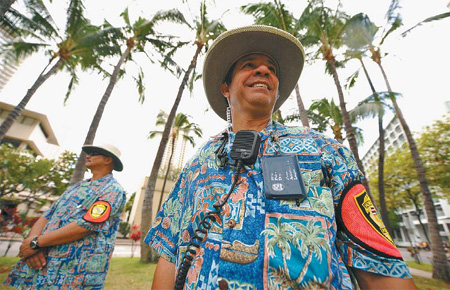
Honolulu police officers patrol places near Waikiki beach on Wednesday. They are wearing special shirts for the 2011 Asia-Pacific Economic Cooperation Leaders' Meeting, which is being held there on Saturday and Sunday. [Agencies] |
The annual meeting will bring China and other regional powers to the table with the United States, which has deemed the region to be a place of great interest in its economic and political policies.
The 19th Asia-Pacific Economic Cooperation Leaders' Meeting, scheduled to take place on the weekend, will look closely at regional economic growth, integration, green growth, energy security and regulatory cooperation.
At the meetings, Hu will discuss China's positions on world economic governance, economic development in the Asia-Pacific region and the multilateral system of trade, the Foreign Ministry said.
He is also expected to hold meetings with leaders from other members of the organization, including US President Barack Obama, Japanese Prime Minister Yoshihiko Noda and Vietnam President Truong Tan Sang.
The 21 members of Asia-Pacific Economic Cooperation are responsible for 43 percent of world trade and 55 percent of the economic activity in the world. They are also the cause of more than 70 percent of the economic growth that has happened in the world during the past 10 years.
Observers said it is not only important to the region that economic growth continue among the organization's members, but also to the world.
Even so, they face economic uncertainty, especially the members that still have developing economies. Many of them are experiencing troubles stemming from over-investment, input inflation and increasing energy prices.
The depreciation of the US dollar is a further cause of worries for the region, where many developing economies rely heavily on the products they export to developed countries.
A survey of 320 business CEOs within the Asia-Pacific region, which PricewaterhouseCoopers released this week, showed that more than 40 percent of the investments their companies plan to make are to go to China.
Chinese diplomats, even though they in general look with favor upon the agenda set by the US, have said some of its goals are "too ambitious".
For instance, the US, a maker of many varieties of green technology, is trying to persuade other countries or regions in Asia-Pacific Economic Cooperation to limit the tariff rates placed on a broad range of green products and services to a maximum of 5 percent by 2012.
The organization's members are divided over what products and services should be subject to the proposed rule.
"On the whole", they look favorably on the US' proposals, but think some of Washington's expectations would place too great of a demand on "the abilities of the majority of the developing member economies", Wu Hailong, assistant foreign minister, said on Monday.
Such members have already expressed "concerns", and all of those involved expect the meeting to produce "balanced and concrete results", Wu said.
The developing countries and regions also want the US and other developed countries to make a greater commitment to transferring technology.
In a Nov 4 report, the Wall Street Journal noted that "the US has been pressing for years in WTO talks to liberalize trade on green goods and services 'with little success'".
Su Hao, director of the Asia-Pacific research center at China Foreign Affairs University in Beijing, said the US' proposals are meant to strengthen its trade advantages in the Pacific Rim and to cause developing countries and regions to become more dependent on its technology.
Chinese officials also said that any discussions at the meeting should be kept in accordance with current WTO negotiations.
Lu Jianren, an Asia-Pacific Research Center expert at the Chinese Academy of Social Sciences, said the arrangements will set a "very high standard". He called for considerations to be made for concerns other than trade, such as environmental standards, labor standards and intellectual-property rights.
The vast economic disparities that exist within the Asia-Pacific make it difficult to integrate the region as quickly as the US wants, Lu said.
"For example, developing economies usually have higher tariffs than developed economies," he said. "A sudden cut in tariffs will only benefit rich economies to the detriment of some vulnerable domestic industries in developing economies."
Zheng Yangpeng contributed to this story.







Hot Topics
HIV/AIDS, Egypt protest, Thanksgiving, climate change, global economic recovery, home prices, high-speed railways, school bus safety, Libya situation, Weekly photos
Editor's Picks

|
|

|

|
|

|