The Pill protects against cancer
Updated: 2008-01-25 13:42
LONDON - Women on the birth control pill are protected from ovarian cancer, even decades after they stop taking it, scientists said.
British researchers found that women taking the pill for 15 years halved their chances of developing ovarian cancer, and that the risk remained low more than 30 years later, though protection weakened over time. The findings were published Friday in The Lancet.
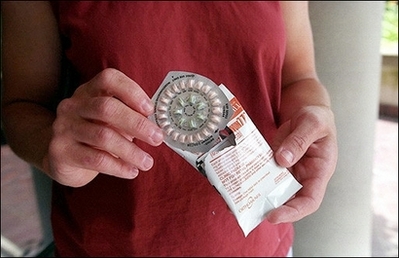 A woman holds prescription contraceptives. The contraceptive pill has prevented some 200,000 cases of ovarian cancer and 100,000 deaths from this disease since its introduction nearly half a century ago, according to a study published in next Saturday's Lancet medical journal. [Agencies] |
"Not only does the pill prevent pregnancy, but in the long term, you actually get less cancer as well," said Valerie Beral, the study's lead author and director of the Cancer Research UK Epidemiology Unit at Oxford University. "It's a nice bonus." The study was paid for by Cancer Research UK and Britain's Medical Research Council.
Beral and colleagues analyzed data from 45 studies worldwide, covering 23,257 women with ovarian cancer, of whom 31 percent were on the pill. They also looked at 87,303 women without ovarian cancer, of whom 37 percent were on the pill.
In both groups, the women on the pill took it for about five years. The researchers found that in rich countries, women taking oral contraceptives for a decade were less likely to develop ovarian cancer. Without the pill, about 12 women per 1,000 are expected to get ovarian cancer before age 75. But that figure dropped to 8 women per 1,000 in those on the pill.
The experts estimated that use of the pill so far has prevented about 200,000 cases of ovarian cancer and 100,000 deaths from the disease. Based on current levels of oral contraceptive usage, they guessed that 30,000 cases could be avoided every year.
"To be able to save thousands of women's lives every year by using contraceptives is remarkable," said Dr. Beth Karlan, director of the Women's Cancer Research Institute at Cedars Sinai in California and an official with the American Society of Clinical Oncology. Karlan was not connected to the Lancet study.
In the West, ovarian cancer is one of the most common types of cancer in women. Older women are most at risk and survival rates are generally poor.
While the pill protects against ovarian cancer, it slightly increases the chances of breast and cervical cancer. But those risks disappear after women stop taking oral contraceptives. And the pill also provides long-term protection against endometrial cancer, which affects the lining of the uterus.
Scientists don't know why the pill increases some cancer risks while decreasing others. "It may have something to do with the hormones in the contraceptives," said Dr. Debbie Saslow, director of breast and gynecologic cancer at the American Cancer Society. "Hormones such as estrogen can be growth-promoting in some body parts and have the opposite effect in other body parts," she said.
But because there is no early test for ovarian cancer, which is often diagnosed late with a bad prognosis, doctors say that the pill's protective effects against ovarian cancer outweigh the small increased risks of breast and cervical cancer -- unless women already have a history of those cancers.
"This is the first medication that we know of to cut ovarian cancer risk," Beral said. Other measures to protect against ovarian cancer are probably not things women would do unless they had more compelling reasons: having children or getting their tubes tied.
Still, most doctors do not suggest that women take the pill exclusively for its anticancer properties. The pill comes with side effects including risks of blood clots, migraines, and high blood pressure. Those risks are particularly elevated in women in their late 30s and in smokers.
In an editorial in The Lancet, experts called for better access to oral contraceptives, arguing that the drugs should now be available over the counter.
As the pill becomes more common in developing countries, experts estimate that ovarian cancer incidence will fall worldwide. In 2002, the United Nations estimated that 120 million women globally were on the pill, two-thirds of whom were in developing countries.
|
|
|
||
|
||
|
|
|
|