Bush challenges foes of Iraq troop plan
(AP)Updated: 2007-01-24 10:00
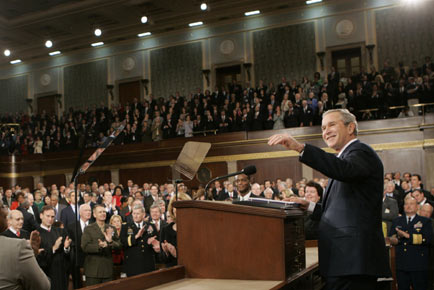 US President George W. Bush waves as he is applauded before delivering his annual State of the Union address to a joint session of Congress at the US Capitol in Washington, January 23, 2007. [AP]  |
Washington - A politically weakened President Bush implored a skeptical Congress Tuesday night to embrace his unpopular plan to send more US troops to Iraq, saying it represents the best hope in a war America must not lose. "Give it a chance to work," he said.
| |||

Facing a political showdown with Democrats and Republicans alike, Bush was unyielding on Iraq in his annual State of the Union address [read full text] . He also sought to revive his troubled presidency with proposals to expand health insurance coverage and to slash gasoline consumption by 20 percent in a decade.
Democrats, and even some Republicans, scoffed at his Iraq policy. Unmoved by Bush's appeal, Democrats said the House and Senate would vote on resolutions of disapproval of the troop buildup.
"We need a new direction," said freshman Sen. Jim Webb, picked by the Democrats to deliver their TV response. "The majority of the nation no longer supports the way this war is being fought; nor does the majority of our military," said Webb, a Vietnam veteran opposed to Bush's invasion of Iraq.
Republican Sen. Norm Coleman of Minnesota, also took issue with Bush. "I can't tell you what the path to success is, but it's not what the president has put on the table," he said.
It was a night of political theater as Bush went before the first Democratic-controlled Congress in a dozen years with his lowest approval ratings in polls.
Democratic Speaker Nancy Pelosi of California, the first woman to lead the House, sat over Bush's shoulder, next to Vice President Dick Cheney. Reaching out to the Democrats, Bush opened with a tribute to Pelosi and paused to shake her hand. He also asked for prayers for Democratic Sen. Tim Johnson, hospitalized for more than a month after suffering a brain hemorrhage, and Republican Georgia Rep. Charlie Norwood, suffering from cancer.
The speech audience included up to a dozen House and Senate members who have announced they are running for president or are considered possible contenders.
Bush divided his 49-minute address between domestic and foreign issues, but the war was topic No. 1.
Pelosi set the tone for Democrats. She sat silently and did not applaud as Bush warned of high stakes in Iraq and said American forces must not step back before Baghdad is secure.
With Congress poised to deliver a stinging rebuke on his troop increase, he made a personal plea to lawmakers.
"I have spoken with many of you in person. I respect you and the arguments you made," Bush said. "We went into this largely united, in our assumptions and in our convictions. And whatever you voted for, you did not vote for failure."
"Our country is pursuing a new strategy in Iraq and I ask you to give it a chance to work," Bush said. "And I ask you to support our troops in the field and those on their way."
Pelosi and Senate Majority Leader Harry Reid gave Bush a swift answer. "While the president continues to ignore the will of the country, Congress will not ignore this president's failed policy," they said in a joint statement after his address. "His plan will receive an up-or-down vote in both the House and Senate, and we will continue to hold him accountable for changing course in Iraq."
Bush said the Iraq war had changed dramatically with the outbreak of sectarian warfare and reprisals.
"This is not the fight we entered in Iraq, but it is the fight we are in," the president said. "Every one of us wishes that this war were over and won. Yet it would not be like us to leave our promises unkept, our friends abandoned and our own security at risk.
"Ladies and gentlemen: On this day, at this hour, it is still within our power to shape the outcome of this battle," the president said. "Let us find our resolve and turn events toward victory."
Key Republicans have joined Democrats in drafting resolutions of opposition to the plans he announced two weeks ago to send an additional 21,500 troops to Iraq. Bush said his approach had the best chance to succeed, but clearly many lawmakers, and overwhelming majority of Americans, disagreed.
"Many in this chamber understand that America must not fail in Iraq because you understand that the consequences of failure would be grievous and far reaching," the president said. "If American forces step back before Baghdad is secure, the Iraqi government would be overrun by extremists on all sides."
In such a case, he forecast "an epic battle," Shiite extremists backed by Iran against Sunni extremists aided by al-Qaida and supporters of Saddam Hussein's government, leading to violence that could spread across the Middle East. "For America, this is a nightmare scenario," Bush said.
On domestic matters, he pressed Congress to help find ways to overhaul entitlements such as Social Security, Medicare and Medicaid before they impose huge problems for future generations.
"Somehow we have not found it in ourselves to act," he said. "So let us work together and do it now."
On immigration, too, the president made a plea to lawmakers that he has made before, seeking comprehensive changes including a guest worker program, that go beyond tougher border controls. Members of his own party were the main obstacle to success in that area, a fact Bush acknowledged even as he pressed for a better result now than Capitol Hill is run by Democrats more amenable to his ideas.
"Convictions run deep in this Capitol when it comes to immigration," he said. "Let us have a serious, civil and conclusive debate."
Bush said his energy proposals would cut American imports by the equivalent of 75 percent of the oil coming from the Middle East. His prescription, as always, relied primarily on market incentives and technological advances, not government mandates.
"America is on the verge of technological breakthroughs that will enable us to live our lives less dependent on oil," he said. "These technologies will help us become better stewards of the environment, and they will help us to confront the serious challenge of global climate change."
Bush called for changing the tax code to encourage more people not covered by medical insurance to buy a plan, and to discourage others from keeping the most costly health care plans.
Under Bush's proposal, employer-financed health care benefits would be considered taxable income after a deduction of $15,000 for families and $7,500 for individuals. Those buying their own plan would get the same deductions on their taxes.
The White House said 80 percent of workers with health insurance through their jobs would see a tax cut as a result of the change. But about 20 percent would see a tax increase ¡ª those workers whose health insurance cost more than the standard deduction.
"With this reform, more than 100 million men, women and children who are now covered by employer-provided insurance will benefit from lower tax bills," Bush said. "At the same time, this reform will level the playing field for those who do not get health insurance through their job."
The administration sought to make Bush's energy initiatives, in particular a 20 percent cut in gasoline usage by 2017, an eye-catching centerpiece of his address, the one major element not revealed until hours before the speech. "It is in our vital interest to diversify America's energy supply, and the way forward is through technology," Bush said.
The cut would be achieved primarily through a sharp escalation in the amount of ethanol and other alternative fuels that the government mandates must be blended into the fuel supply. The rest would come from raising fuel economy standards for passenger cars, a plan that Bush has proposed in the past but failed to win from Congress.
Acknowledging that some would say such a drastic increase in alternative fuels is unrealistic, the White House argued that the new mandate, which would need approval from Congress, would spur investments in the industry and give technological research a boost.
While setting cutback goals, the president spurned appeals from environmentalists and some major corporations to impose mandatory ceilings on US greenhouse gas emissions in hopes of slowing climate change.
|
||
|
||
|
|