Bush stresses need to succeed in Iraq
(AP)Updated: 2007-01-24 08:45
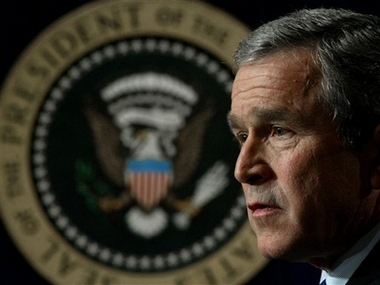 President Bush speaks at the White House in Washington in this, Nov. 6, 2002, file photo. The president will deliver his first State of the Union address to a Democratic-controlled Congress, Tuesday, Jan. 23, 2007, trying to balance a rebuke of his Iraq policy already promised by lawmakers with a high-profile invitation to cooperate on vexing domestic problems. [AP]  |

"They don't have a plan," said freshman Sen. Jim Webb, picked by the Democrats to deliver their response to Bush. "What they have put on the table is more a tactical adjustment." Webb, a former Vietnam veteran, opposed Bush's invasion of Iraq.
Republican Sen. Norm Coleman (news, bio, voting record) of Minnesota, also took issue with Bush. "I can't tell you what the path to success is, but it's not what the president has put on the table."
In his address, Bush sought to revive his troubled presidency with proposals to expand health insurance coverage and slash gasoline consumption by 20 percent in 10 years. But the war was issue No. 1.
Bush was hampered by his lowest approval ratings in polls as he prepared to speak before the first Democratic House and Senate in 12 years.
"Congress has changed but our responsibilities have not," the president said. "We are not the first to come here with government divided and uncertainty in the air. Like many before us, we can work through our differences and achieve big things for the American people."
The White House released excerpts in advance of Bush's prime-time address to the nation. His speech came as key Republicans joined Democrats in drafting resolutions of opposition to the plans he announced two weeks ago to send an additional 21,500 troops to Iraq.
Bush said he had reviewed the decision with military commanders and had considered every possible approach. "In the end I chose this course of action because it provides the best chance of success," he said. "Many in this chamber understand that America must not fail in Iraq - because you understand that the consequences of failure would be grievous and far reaching."
Despite widespread opposition to his policies, Bush said that "both parties and both branches should work in close consultation."
The war in Iraq - nearly four years old with more than 3,060 US deaths - remains the top issue in the polls and dominates Washington's political debate. The president's speech came just three days after 25 US troops were killed, the deadliest day in two years for the US military in Iraq.
With public support for the war at a record low, Americans overwhelmingly oppose his decision to send additional troops. Even some of Bush's most loyal Republicans allies have abandoned him to stand with Democrats in Congress on resolutions opposing the buildup. Sen. John Warner (news, bio, voting record), R-Va., who was chairman of the Senate Armed Services Committee until the Democratic takeover, worked with other lawmakers Tuesday on a resolution voicing disapproval.
In his speech, Bush said that the war on terror "is a generational struggle that will continue long after you and I have turned our duties over to others. That is why it is important to work together so our nation can see this great effort through."
Bush was not calling for timetables on troop withdrawals or tying US support to better performance by the Iraqi government.
"We're not doing ultimatums," presidential spokesman Tony Snow said.
Unlike the friendly Republican-dominated Congress of the past six years, Bush faced a dramatically different audience this year after the Democratic takeover of the House and Senate. To be seated over his shoulder was House Speaker Nancy Pelosi (news, bio, voting record), the Democratic leader who has called Bush dangerous and incompetent. A dozen members of the House and Senate have announced they are running for president or are considered possible contenders.
"Our citizens don't much care which side of the aisle we sit on - as long as we are willing to cross that aisle when there is work to be done," said Bush, who for six years ignored Democrats' demands to be included in decisions.
The administration sought to make Bush's energy initiatives - in particular a 20 percent cut in gasoline usage by 2017 - an eye-catching centerpiece of his address, the one major element not revealed until hours before the speech. "It is in our vital interest to diversify America's energy supply, and the way forward is through technology," Bush said.
The cut would be achieved primarily through a sharp escalation in the amount of ethanol and other alternative fuels that the government mandates must be blended into the fuel supply. The rest would come from raising fuel economy standards for passenger cars, a plan that Bush has proposed in the past but failed to win from Congress.
Acknowledging that some would say such a drastic increase in alternative fuels is unrealistic, the White House argued that the new mandate - which would need approval from Congress - would spur investments in the industry and give technological research a boost.
While setting cutback goals, the president spurned appeals from environmentalists and some major corporations to impose mandatory ceilings on US greenhouse gas emissions in hopes of slowing climate change.
The other major initiative in Bush's speech called for making employer-financed health care benefits taxable income after a deduction of $15,000 for families and $7,500 for individuals. The White House said 80 percent of workers with health insurance through their jobs would see a tax cut as a result of the change. But about 20 percent would see a tax increase - those workers whose health insurance cost more than the standard deduction.
The White House argues that "unfair subsidies" in the tax code make it harder for many Americans to afford health insurance.
Another change would take some federal money now going to hospitals and other facilities and give it to states for programs to reduce the number of uninsured.
Rep. Pete Stark, D-Calif., chairman of a key health subcommittee in the House, said he would not even consider holding hearings on the plan.
Other proposals in Bush's speech concerned:
-Education: He would allow poor children in struggling schools to transfer to private schools - a move sure to be derided by critics. The No Child Left Behind law allows children in the worst schools to move to better public schools, but not private ones.
-Immigration: He wants an overhaul that would toughen border security and create a temporary worker program allowing employers to hire guest workers for jobs Americans have not taken.
| ||
|
||
|
||
|
|