Bush cautious on N. Korea nuke turnabout
(AP)Updated: 2006-11-01 09:17
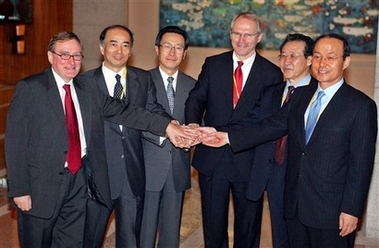 Negotiators for the six-party talks over North Korea's nuclear crisis join hands before the start of a banquet meeting in Beijing, China, in this Tuesday September 13, 2005 file photo. North Korea agreed to return to six-party talks on its nuclear program, South Korea's YTN television reported. [AP/file] |
WASHINGTON - In a surprise turnabout, North Korea agreed Tuesday to return to six-nation disarmament talks just three weeks after rattling the world by conducting an atomic bomb test. The breakthrough came after pressure from China and a US offer to discuss financial penalties already in place.
US President Bush cautiously welcomed the deal and thanked the Chinese for brokering it. But he said the agreement wouldn't sidetrack US efforts to enforce sanctions adopted by the UN Security Council to punish Pyongyang for its October 9 nuclear test.

The ultimate goal is "a North Korea that abandons her nuclear weapons programs and her nuclear weapons in a verifiable fashion in return for a better way forward for her people," the president said.
The unexpected agreement to restart the talks - before year's end, US officials said - was announced after envoys from North Korea, the United States and China met in Beijing, at China's invitation.
The move represented a step back from the nuclear crisis and was widely applauded, if with some reservations. North Korea has a history of walking away from the six-nation talks, only to rejoin them, then to bolt again.
"We believe that the sooner talks resume, the faster the tension around this problem will fade," Igor Ivanov, chief of Russia's presidential Security Council, said in Moscow.
Japan's UN ambassador, Kenzo Oshima, called the development "a welcome first step, but there are many, many other things that we need to closely monitor and watch." Japanese Foreign Minister Taro Aso was quoted as saying a resumption of talks "is conditional on North Korea not possessing nuclear weapons."
Just a week before contentious US congressional elections, it was a diplomatic victory for Bush. Democrats gave it a qualified but skeptical endorsement.
"It may ultimately be a positive step forward, but it is clearly not sufficient to produce the goal we all want to achieve - a halt to North Korea's nuclear weapons' activities," said Senate Democratic leader Harry Reid of Nevada. He urged Bush to name a special envoy to Pyongyang and to engage in direct US-North Korean talks.
Republicans cast it as a sign of Bush's foreign-policy leadership. "The president's strategy has effectively isolated North Korea from its neighbors in the region and now appears to have returned the country to the negotiating table," said Senate Majority Leader Bill Frist of Tennessee.
However, China's leaning on its communist neighbor appeared to be the major factor in the progress, not US diplomacy, and Bush acknowledged Beijing's role in Oval Office comments to reporters.
China, the largest supplier of oil for North Korea, has more leverage than any other country with Pyongyang. In a possible sign of Beijing's growing impatience, Chinese exports of diesel and heating oil to North Korea dropped substantially in September from a year ago, though exports of gasoline, liquefied petroleum gas, kerosene and jet fuel rose, according to Chinese customs data.
The six-nation talks - involving North and South Korea, the United States, China, Russia and Japan - have been stalled since last November. North Korea has boycotted them, largely to protest US financial sanctions that target alleged counterfeiting of US currency and money laundering.
Washington has insisted those sanctions, which include a freeze on North Korean bank accounts in Macau, are unrelated to the nuclear weapons dispute.
For its part, the North stepped back from its demand that the financial restrictions be lifted before it would return to nuclear talks. And Washington agreed for the first time to discuss the financial sanctions at the nuclear talks, US Assistant Secretary of State Christopher Hill, the US negotiator, told reporters in Beijing.
Hill said the talks could resume as early as November or December. "We took a step today toward getting this process back on track," he said. But, he added, "We are a long way from our goal still. ... I have not broken out the cigars and champagne quite yet."
White House press secretary Tony Snow sought to play down US concessions. He insisted that the United States made no promises to link the financial-sanctions dispute to the nuclear one, only agreeing that "issues like that may be discussable at some future time."
At the State Department, spokesman Sean McCormack said he was sure there would be "an opportunity for us to have direct talks" with North Korean negotiators in the context of the six-party framework. He said the negotiations would probably take place in Beijing.
The six-party talks had originally been intended to persuade Pyongyang to abandon its nuclear ambitions. But its nuclear test changed the debate and the stakes.
"No one wants North Korea to continue its nuclear weapons program, particularly after the North Koreans tested a nuclear device," Secretary of State Condoleezza Rice said in an interview on CNBC. She said the US wanted "concrete steps" toward denuclearizing the Korean peninsula. "It really doesn't make sense again for us just to go back and talk," Rice said.
The Security Council voted unanimously on Oct. 14 to impose sanctions on Pyongyang, including a ban on major weapons shipments and restrictions on sales of luxury goods.
"The big question now is, will we meet and will we have anything new to talk about? The North still doesn't trust us, and we don't trust North Korea," said John Wolfstahl, a former nonproliferation official with the US Energy Department.
Sen. Carl Levin, the top Democrat on the Senate Armed Services Committee, said the development was heartening, but that the next round of talks would be much tougher because North Korea has now tested a nuclear weapon. "I'm afraid North Korea comes back stronger," Levin said in an interview.
|
||
|
||
|
|