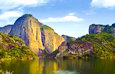
Temple on the river: a fading holy land
FUZHOU -- Jinshan Temple looks as if it is beset in a bucolic Chinese ink painting. A cloud dims nearby mountains to light gray shadows, where the Min River disappears. On the serene waters, fishermen spread out nets from a small wooden rowboat.
The delicate and exquisite temple has sat on the banks of the Min River for nearly 1,000 years in the village of Hongtang in Fuzhou, a port city in southeast China's Fujian province.
But not far away on the shore are rows of Victorian-style villas and a new highway. Two hundred meters north of the temple, an 1,800-meter-long bridge spans the river, with cars from outside of the city lining up to cross the bridge.
"An entrepreneur came here for Kau Cim (fortune-telling) and then went back making a big fortune a couple of years ago," says 69-year-old Wang Guozhong, the temple's Kau Cim interpreter.
The ancient Chinese fortune-telling practice of Kau Cim requires the fortune-seeker to ask questions and request answers from a sacred oracle in front of the temple's altar.
Like many other local villagers, Wang believes the temple is an "unsinkable boat" blessed by gods, making it the perfect place to worship and tell fortunes. Four or five old women gather around him, waiting for their own fortunes to be told. He writes down their names, addresses and the questions they have asked on thin yellow parchment.
Jinshan Temple was built during the Song Dynasty (960-1279). It was constructed on the bedrock of a small island with a simple court and stone pagoda in its center. The court was rebuilt for the last time in 1934 after multiple renovations.
The temple's location on the water makes it somewhat isolated, requiring a ferryman to take visitors over the water to the temple. Although a bridge once connected the temple to the mainland, it was washed away in 1615 and never rebuilt for unknown reasons.
Before the 1990s, water transportation on the Min River connected the village's merchants with customers and other traders from around the world. The Min River rises from the foot of the World Heritage of Mount Wuyi in northwest Fujian, running through the province before flowing into the the East China Sea. The temple's white pagoda was previously used by traders as a landmark to aid in navigation.
In feudal China, many scholars and intellectuals took note of the temple's seclusion and traveled there to prepare for the Imperial Examination, a national exam to select administrative officials in feudal times.
The temple's relative isolation has also allowed for the preservation of ancient calligraphy, such as the writings of Zhu Xi, a Confucian philosopher in the 12th century and Lin Sen, president of the National Government of the Republic of China from 1931 to 1943.
The Western world came across the temple when Scottish documentary photographer John Thomson arrived in Fuzhou to document the temple around 1870.
By that time Fuzhou had been forced to be one of five Chinese ports open for foreign trade under the Treaty of Nanking, which was signed between Britain and the government of the Qing Dynasty in 1842. Under the treaty, the British could trade with anyone they wished in specified ports, including Fuzhou.
The city soon became an important international distribution center for tea and Chinese porcelain. Increasing trade created a lot of work for the river's ferries, but it could not last forever.
Nowadays, the ferries have fallen into disuse with the development of road transportation. The Hongtang highway bridge built in 1991 has eliminated the need to take ferries from the village to Fuzhou.
"I miss the Jinshan Temple from my childhood memories," says Lin Yiwan, 67, a retired coal miner who works at the temple.
"During the summer, I swam in the river and caught clams," says Lin. "The longan trees along the shore, the old banyan tree on the temple's terrace and the villagers are the things I will never forget."
The sights that make up Lin's memories, however, have largely disappeared. His own home on the river's shore was demolished to make room for the new highway last year. The local government arranged for him to work and live in the temple until a new apartment can be built for him.
Lin cooks for Shi Zonglun, the temple's only monk, as well as does the occasional repair job and cleans the terraces.
Shi Zonglun did not come to Jinshan Temple from Anhui Province north to Fujian until 2010.
"I fell in love with the Temple at the first sight," said Shi Zonglun. "It was karma that has kept me stay."
Apart from following the routine Buddhism proprieties, the 51-year-old monk also plays Buddhism music with his laptop and preaches via text messages.
Wang was not contented for being a Kau Cim interpreter. In 2006 he began to write the history of the ancient building, completing his research in libraries and archives. His finished work "Jinshan Temple: a Pearl on the Water" details the origin and history of the historic temple, complete with accounts from local worshipers and scholars.
Wang sought the help of many local residents to complete the book, enlisting the aid of a kindergarten teacher, a newspaper editor and several scholars to write an introduction, proofread and type the first draft of the book.
"I just want more people to remember the temple," he says.