Height of art
 |
|
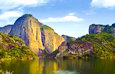
Yungang grottoes include traditional Chinese elements and aspects of Indian Buddhist art. Liu Baocheng / For China Daily |

Towering Geographical features signal prominence of historic city
Located on the northeastern edge of the Loess Plateau, the site of some of the earliest settlements of Chinese civilization, Datong is a city steeped in history and culture. Wedged between the outer and inner sections of the Great Wall, the city has a history going back more than 2,400 years. It grew in importance during the Spring and Autumn Period (770-476 BC) on the back of its geographical advantages.
The city served as the capital for six years during the Northern Wei Dynasty (AD 386-534) and became the political, economic and cultural center of the north. Throughout history, Datong has been home to many different ethnic groups from all parts of China and beyond - resulting in multicultural mix that can be seen in some of the more than 60 well-preserved historical sites.
Described as the "Lock of the North", Datong continues to play a crucial part in connecting the country's eastern coastal areas and its western inland territories. It is also the "throat" between the Inner Mongolia autonomous region and Shanxi, and modern transport strengthens that regional significance.
Datong boasts an enormous variety of natural resources that has helped enrich the city since ancient times. Apart from coal, there are many other resources, such as gold and silver.
Here are three attractions tourists can look forward to in Datong.
1. Yungang Grottoes
The Yungang Grottoes are 16 kilometers southwest of Datong. Sitting at the base of the Wuzhou Mountains, Yungang originally meant a high point in the area and later became the name of the grottoes. The site is one of the three most famous grottoes in China, with the other two being Longmen in Henan province and Mogao in Gansu province.
The first grottoes of the area were built in the Northern Wei Dynasty, when Datong served as the capital, then called Pingcheng. The emperor ordered Tanyao, a high-ranking Buddhist monk, to lead the construction of the grottoes. Most of the grottoes were completed before the capital was moved to Luoyang city. More than 40,000 laborers helped build the grottoes and the project took nearly 50 years to complete. Buddhists from Lion Kingdom, now known as Sri Lanka, joined in the construction and the grottoes still carry marks of cultural amalgamation. The Yungang Grottoes are said to date back 1,500 years.
The grottoes integrate traditional Chinese elements and aspects of Indian Buddhist art. They form a significant part of the sculptural achievements of humankind and showcase some of the highest forms of Chinese Buddhist art.
There are 53 caves in Yungang and more than 51,000 stone sculptures, making the site one of the largest collections of grottoes in China. The mountains divide the grottoes into three parts, the east, the west and the middle.
The third cave is the largest and its broken facade is 25 meters tall. It is said to have been the study of the monk Tanyao as he translated scriptures. There are two rooms in the cave, with the one at the back home to three exquisitely designed Buddha sculptures. The primary one standing in the middle is 10 meters tall, and the other two beside it reach up to 6.2 meters. The style and carving methods of these three sculptures are said to date back to the Tang Dynasty (AD 618-907).
The biggest Buddha sculpture in the grottoes lies in the fifth cave, on the northern wall of its back room, at 17 meters tall. There are also five four-story buildings in front that were rebuilt in 1651, during the time of the Shunzhi emperor in the Qing Dynasty (1644-1911).
2. Hengshan Mountain
Hengshan Mountain is one of the Five Great Mountains of China. The mountain is the dividing line of the Haihe River's two tributaries, the Sanggan and Hutuo rivers. It stretches about 150 km from east to west and spans both Shanxi and Hebei provinces. The highest peak of the mountain is in the south of Hunyuan county and is 2,016 meters above sea level.
Legend has it that 4,000 years ago, the ancient Emperor Shun was hunting here and saw the splendid mountain views. He later called it the Northern Great Mountain. In the Qin Dynasty (221-206 BC), Emperor Qinshihuang selected 12 sacred mountains and Hengshan ranked second on his list. Throughout history, the mountain has been a popular place for emperors. Poets such as Li Bai and geographers like Xu Xiake also left well-known impressions of the mountain.
There are also famous man-made attractions such as the Morning Palace, Huixian Mansion, Jiutian Palace and Xuangong Temple.
In China, great mountains are often linked to religion. Hengshan is deeply associated with Taoism, and temples have been an important part of it, with Xuankong Temple being one of the most famous of these. According to one legend, Zhang Guolao, one of the Eight Cave Celestials of Taoism, cultivated himself here.
3. Pagoda of Fogong Temple
This wooden pagoda is part of the Fogong Temple in Yingxian county, 70 km from Datong city. Also called the Sakyamuni Pagoda, it was built in 1056. The building has survived the elements and natural disasters, including earthquakes, which many say is solid proof of its building quality and practical design.
According to one story, Yingxian county once occupied an important position within the inner part of the Great Wall and became a prized location for competing military powers. To detect rivals and promote Buddhism at the same time, a huge wooden pagoda was built in the area. Documents show that the structure took more than 100 years to build. With no suitable wood in the area for building, huge efforts were made to import a vast amount of wood for its construction and the total cost remains a mystery.
Many consider the pagoda to be the oldest and largest of all extant wooden structures.
The pagoda is 67 meters tall and the diameter of its base is about 30 meters. The base consists of two parts, the one above square and the one below octagonal, just like the main body. From the outside, the pagoda seems to have five floors but there are another four hidden floors inside, making the total number nine.
Grand sculptures and vivid portraits displaying the spirit of Buddhism form some of the major attractions inside the building. From emperors to local residents, devout followers of Buddhism have left words of wisdom inside the pagoda as they helped repair and improve the structure.