 |
|
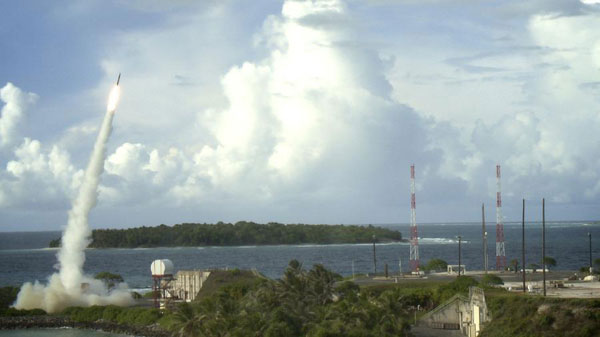
A Terminal High Altitude Area Defense (THAAD) interceptor is launched during a successful intercept test, in this undated handout photo provided by the US Department of Defense, Missile Defense Agency. [Photo/Agencies] |
Let's face it, in the wake of the Democratic People's Republic of Korea's fourth nuclear test and launching of a satellite, it is difficult to dissuade the Republic of Korea from taking measures to beef up its military for self-defense. But deployment of the Terminal High-Altitude Area Defense system is not a good option.
The THAAD is an anti-ballistic missile system of the United States Army designed to shoot down short, medium and intermediate ballistic missiles in their terminal phase using a hit-to-kill approach. The Korean Peninsula is only 1,100 kilometers long and Seoul only 40 km from the demilitarized zone. So most, if not all, of the DPRK's missiles targeting the ROK can only be short-range ballistic missiles with a maximum range of 1,000 km.
The threats from the DPRK to the ROK are not primarily the short-range missiles of the DPRK, just like the THAAD is not primarily designed, if at all, to shoot down missiles flying at low altitude. The missile threat from Pyongyang to Seoul essentially comes from KN-02, Hwasong-5 and Hwasong-6 with ranges from 160 km to 500 km.
If the DPRK missiles carry conventional warheads, the threats from them would not be greater than the Scuds that were fired sporadically and inaccurately by Iraq into Israel during the Gulf War. And the ROK already has Pac-2 deployed against them. Also, it has been developing its own missile-defense system. Besides, the ROK military, thanks to its alliance with the US military, won't wait to fire back until the DPRK fires all its missiles.
Contrary to what the ROK's Ministry of Foreign Affairs has said, a scenario of the DPRK launching a nuclear attack against the ROK is next to impossible in the near future.
Even if the DPRK has short-range nuclear missiles, as it is claiming now, a successful nuclear strike by Pyongyang and successful interception by THAAD from the ROK would still cause unbearable damage to both sides because of the geological proximity between the DPRK and ROK, and the lingering radioactive dust would make either side's victory meaningless.
Such short-range missiles don't appear to be a priority for the DPRK. Its focus is on improving the capability of its nuclear bombs as demonstrated by its fourth underground nuclear test on Jan 6, and developing intercontinental ballistic missile capability as shown by its satellite launch on Feb 7. Most probably the DPRK launched the satellite to test the range of the missiles - whether they would reach continental US, in order to create maximum panic among Americans and thus increase its bargaining chips.
The real lethal weapons of the DPRK are its long-range artillery pieces - Koksan 170 mm howitzers and 240 mm multiple rocket launchers - that are capable of bombarding Seoul, a city of over 10 million people. Indeed it is not rare to hear from Pyongyang how its massive and preemptive strike could turn Seoul into "a sea of fire". Admittedly, no defense systems including the THAAD would be able to shield off a shower of artillery shells in such a doomsday scenario.
Citing the need to defend against the DPRK's missiles with the THAAD is either a sign of paranoia that has hijacked people in the ROK or a deliberate play of security populism to pacify people or, more likely, a bit of both. But it comes at financial and political costs, too.
Financially one battery of the THAAD system consists of a launcher, interceptors, a fire control and communications unit, and an AN/TPY-2 radar, and costs about $1 billion. This is more than the $866.5 million the ROK government paid in 2014 for the 28,500 US troops stationed on its soil.
ROK defense officials have said at least two THAAD batteries are needed to thwart missile attacks from the DPRK. But who is going to pay - Washington or Seoul? Why the US if the ROK is free rider? And why the ROK if it is, as claimed, meant more for the protection of US troops? This has been a hot-button issue in recent years.
Politically, the installation of THAAD in the ROK will surely be taken by the DPRK as provocation and accelerate the vicious cycle of action versus reaction.
Moreover, the move has already drawn strong protests from China, which believes THAAD, if deployed, will be integrated into the US missile defense network in East Asia and affect its security interests. Russia, too, believes it will destabilize the strategic equilibrium in the region.
The deployment of THAAD on the Korean Peninsula can only set a bad example, of how anger and angst can overpower and replace rational response. It is like seeking a hare in a hen's coop.
The author is an honorary fellow with the Center of China-American Defense Relations, Academy of Military Science. Courtesy: chinausfocus.com


Copyright 1995 - 2014 . All rights reserved. The content (including but not limited to text, photo, multimedia information, etc) published in this site belongs to China Daily Information Co (CDIC). Without written authorization from CDIC, such content shall not be republished or used in any form. Note: Browsers with 1024*768 or higher resolution are suggested for this site.
License for publishing multimedia online 0108263 Registration Number: 20100000002731