BRICS nations stride on for second 'golden decade' of cooperation
 |
|
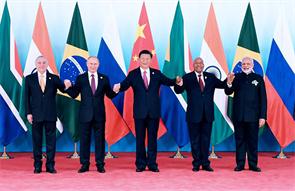
Leaders of BRICS countries pose for group photos after the ninth BRICS summit in the eastern city of Xiamen, Fujian province, Sept 4, 2017. [Photo/Xinhua] |
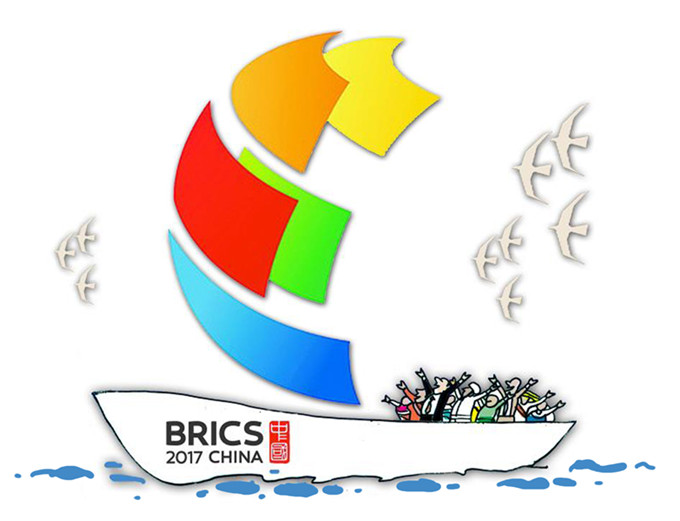
On Sept 5,the emerging-market bloc of BRICS concluded their 9th annual summit hosted by the beautiful city of Xiamen in southeast China's Fujian Province. Running from Sept 3 to 5 under the theme of "BRICS: Stronger Partnership for a Brighter Future," the summit saw the signing of a joint declaration on Sept 4, four cooperation agreements and Memorandums of Understanding (MoUs). Accepting the mantle of the revolving BRICS presidency from India on Jan 1, China hosted the BRICS summit for the second time, after the 2011 summit in Sanya, Hainan.
This year marks the 10th anniversary of the BRICS association, comprised of five major emerging economies — namely Brazil, Russia, India, China and South Africa — with the aim of using its growing economic and political influence to challenge Western hegemony. The BRICS countries are home to more than two-fifths of the world's population with a combined gross domestic product of over US$16 trillion. Through ten years' development, the BRICS countries have become a new force in the world economy. The group upholds people's hope for stronger partnerships within and beyond the five BRICS countries.
Looking to the second "golden decade", the BRICS leaders stressed their resolve to act jointly for development in the Xiamen Declaration.
Enhancing BRICS cooperation
The Xiamen Declaration reviewed achievements made over the past 10 years, recalling increased development and multilateralism fostered by previous summits in Goa in India and Ufa in Russia, especially the fruitful progress of the New Development Bank (NDB) and the initiation of the BRICS Contingent Reserve Arrangement (CRA), institutions that have ensured greater cooperation among BRICS countries.
Leaders of BRICS countries praised the achievements of the BRICS Business Council and the NDB. Officially opened in 2015, the Shanghai-headquartered bank has made headway on many projects, with the recent opening of its African regional center, the continuing work on its headquarters and overall progress in business operations. The council has also entered into an MoU with the NDB.
According to NDB President K.V. Kamath, the bank will expand its loan operations to the private sector next year. The NDB approved loans totaling $1.55 billion last year to seven programs for sustainable development and is expected to offer loans of $2.5 billion this year.
It is worth mentioning that China will offer 500 million yuan ($76.4 million) for a BRICS economic and technology cooperation plan, and another $4 million for projects at the NDB.
National Currencies
According to the declaration, leaders agreed to establish a bond fund in national currencies in order to contribute to capital sustainability in BRICS member states. They have also agreed to increase the use of national currencies, including in direct investment.
"We agree to promote the development of BRICS Local Currency Bond Markets and jointly establish a BRICS Local Currency Bond Fund, as a means of contribution to the capital sustainability of financing in BRICS countries, boosting the development of BRICS domestic and regional bond markets, including by increasing foreign private sector participation, and enhancing financial resilience of BRICS countries," the declaration's text read.
Boosting cooperation in other fields
The five nations also agreed to further boost cooperation in the fields of insurance and reinsurance, taxation reform, customs, and to explore the possibility of setting up a BRICS rating agency based on independent, market-oriented principles.
Sticking to economic cooperation
Addressing the opening ceremony of the BRICS Business Forum on Sept 3, President Xi Jinping said, "Economic cooperation is the foundation of the BRICS mechanism." BRICS countries adopted Xi's views on economic cooperation in the joint declaration. Indeed, the five emerging economies have been the lodestar of world growth amid an increasingly austere economic environment.
Despite being confronted by global uncertainties, partially due to the policies of US President Donald Trump, Britain's divorce from the European Union and the ensuing economic downturn, the five countries have made remarkable progress in the past 10 years. BRICS countries' share in the global economy has increased from 12 percent ten years ago to 23 percent in 2016.
The BRICS leaders vowed to confront challenges to seek common development. Xi said that BRICS countries should work to let their economic cooperation have more substance. He proposed that the BRICS countries should advance structural reforms, innovate growth patterns and build up an open economy.
Opposing protectionism
BRICS countries have proved to have a leading role for global economic growth as well as a higher prestige in the world economy. With this newfound standing, BRICS leaders reaffirmed that they remained committed to an open and inclusive world economy and firmly opposed protectionism.
"We will continue to firmly oppose protectionism. We recommit to our existing pledge for both standstill and rollback of protectionist measures and we call upon other countries to join us in that commitment," the Xiamen Declaration reads.
It should be noted here that in January, as a keynote speaker at the World Economic Forum in Davos, Switzerland, Xi offered a vigorous defence of globalization, and in July he again called on members of the G-20 nations to champion an open world economy.
Facing challenges together
Besides economic issues, the BRICS nations also expounded their stances on international and regional issues of common concern, focusing on terrorism, the liberation of Mosul and the Israeli-Palestinian conflict.
According to the Xiamen Declaration, BRICS leaders condemned terrorism in all forms and said those "committing, organising or supporting" such acts must be held accountable. There are 17 references to terrorism in the 43-page Xiamen declaration.
"We reaffirm that those responsible for committing, organizing, or supporting terrorist acts must be held accountable," it said.
This is the first time the leaders of the BRICS member states included Lashkar-e-Taiba and Jaish-e-Mohammed with global terror groups Islamic State and al-Qaeda.
Paragraph 48 of the declaration explicitly said, "We...express concern on the security situation in the region and violence caused by the Taliban, ISIL/DAISH, Al-Qaida and its affiliates including Eastern Turkistan Islamic Movement, Islamic Movement of Uzbekistan, the Haqqani Network, Laskar-e-Taiba, Jaish-e-Mohammad, TTP and Hizb-ut-Tahrir."
The BRICS grouping has strongly condemned deadly terrorist acts in Afghanistan and called for an immediate end to violence.
In the declaration, the leaders stressed that the fight against terrorism must be conducted in accordance with international law.
Concern over the Yemen situation
BRICS leaders also expressed their concern over the crisis in Yemen and called on all parties to cease hostilities and engage in UN-supported settlement negotiations.
Settling the Syrian crisis
The BRICS leaders called for reaching a permanent settlement to the Syrian crisis, stressing that a comprehensive political process is the only solution that will allow Syrians to preserve the sovereignty and independence of their country.
Solving the Israel-Palestine conflict
In the Xiamen Declaration, the BRICS leaders expressed their readiness to offer support to solve the Israeli-Palestinian conflict so as to find a fair and permanent solution to the conflict in the Middle East.
"We reiterate the urgent need for a just, lasting and comprehensive solution of the Israeli-Palestinian conflict in order to achieve peace and stability in the Middle East on the basis of relevant United Nations resolutions, the Madrid Principles, the Arab Peace Initiative and previous agreements between the parties through negotiations with a view to creating an independent, viable, territorially contiguous Palestinian State living side by side in peace and security with Israel," the joint declaration read.
Stronger partnership, brighter future
The three-day BRICS jamboree ended on Sept 5, reaching consensus on the international situation, global governance and cooperation among the five countries. Next year, South Africa will host the 10th BRICS summit. Undoubtedly, this year's summit deepens South-South cooperation. The gathering fostered the "BRICS Plus" pattern and built extensive partnerships as Xi pointed out. "The summit adopted the BRICS Leaders Xiamen Declaration which reaffirmed the BRICS spirit of openness, inclusiveness and win-win cooperation, and mapped out a new blueprint for strengthening BRICS partnership and deepening practical cooperation in various areas," he said.
Let us hope the BRICS countries of the jaguar (Brazil), the bear (Russia), the elephant (India), the dragon (China) and the springbok (South Africa) will continue to work together in forging a new partnership that is fair, open, and innovative to benefit the welfare of humankind.
Rabi Sankar Bosu is secretary of New Horizon Radio Listeners' Club in West Bengal, India.