Future of BRICS is promising
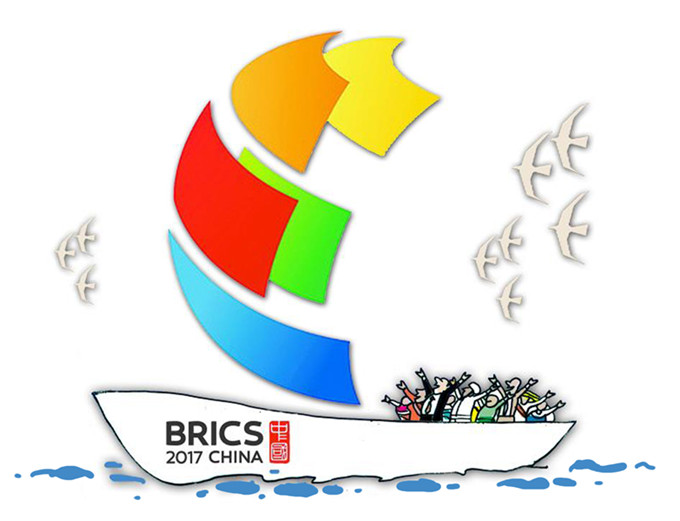
The 9th BRICS Summit in Xiamen takes place in a different international context from that of one of the early years of the association. When the BRIC (Brazil, Russia, India and China) was created, countries maintained high growth rates and enjoyed greater social stability. Today, almost 10 years after its first meeting and with the addition of South Africa in 2011, things could not be more different. Only China and India maintain reasonably high growth rates. However, according to the IMF report, there will be a small reduction in India's economic growth will lead to a GDP growth rate of around 7.2 percent.
China, which foresees a GDP growth of 6.5% in 2017, may have its expansion reduced to 6% by 2018. These figures differ from those of other countries. The growth of Russia will be around 1.1% and 1.2% in 2017 and 2018, respectively. South Africa's economy is expected to grow 0.8% this year 2017 from 0.3% in 2016. And Brazil has the darkest outlook, projected at a growth rate of only 0.2%.
However, World Bank studies point to an upward trend in the GDP of developing economies. The annual average GDP growth rate of emerging markets and developing economies will reach 4.7% by 2019, while in advanced economies the average GDP growth will be 1.7% in that year. The growth of emerging markets and developing economies will mainly be due to agricultural exports of commodities and the broad recovery of the energy and metals sectors.
According to the World Bank study, the growth of the seven largest emerging economies — Brazil, China, India, Indonesia, Mexico, Russia and Turkey — will substantially outpace the growth of the economies of the G7 in 2018, benefiting other emerging markets and developing countries. Finally, a PwC study entitled "The World in 2050 - the long view: how will the global economic order change by 2050?" points out that emerging markets will dominate the ranking of the 10 largest economies in the world by 2050 at purchasing power parity. These data demonstrate that developing countries are a driving force in the world economy. And it is in this context that BRICS is inserted. From this perspective, the future of BRICS is promising.
To Brazil, within BRICS, it is more evident that its bilateral relation with China has a greater relevance compared to the relations Brazil has with Russia, India and South Africa. China has been Brazil's largest trading partner since 2009, is the largest foreign investor in Brazil and 25% of Brazilian exports have China as its destination. These are all significant. Cooperation between China and Brazil is expanding to several areas in the latter country. In addition to oil, soybeans and ore, Chinese investments are moving into the financial, energy and infrastructure markets. In the area of technology and innovation, there is a huge open field. And in the area of entertainment there is potential yet to be explored.
Despite the crisis in Brazil, Chinese investment is increasing. This proves that China relies on Brazilian institutions and expects Brazil to rebuild its economy. The bilateral partnership can reach a new level by looking to the future.
In this sense, besides talking about a country's economy we need to talk about the quality of our society to help build a better future. This is an important aspect in the contemporary world. The problem I see in Brazil is that we have a large educational deficit and political leaders who are using old formulas to solve new problems.
BRICS is a new project, a new reality. But in spite of this, Brazil seems to have an agenda focused on trade and investment. We need to be more active and creative. Education and preparation of the people of the BRICS nations for the 21st century is a fundamental goal that will open up a fascinating world of possibilities for our people. Our cultural differences will produce new knowledge. Those differences are our main force, our raw material.
The author is an international law professor at think tank Fundacao Getulio Vargas of Brazil.