How China will come out ahead in a trade war
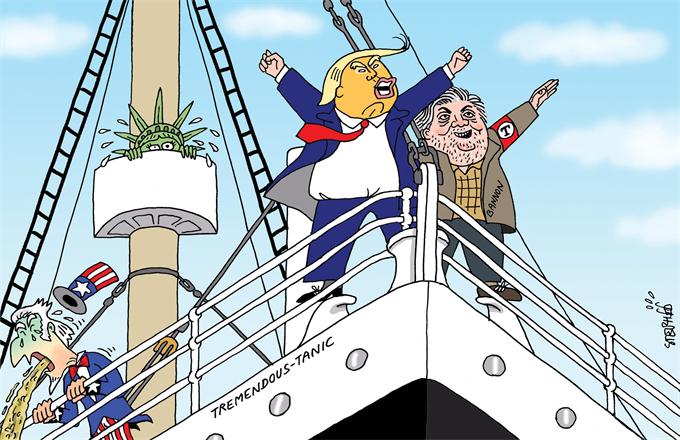
During his election campaign, President Donald Trump threatened to impose 35 to 45 percent tariffs on Chinese imports to force China into renegotiating its trade balance with the US. The immediate result of that would be a fierce trade war that America would almost certainly lose.
Trump is now entering uncharted waters. He has already demonstrated his ignorance of Asian affairs in a number of recent developments.
For the moment, China has decided to wait for the US to make the first move. A trade war would be problematic for the region, not least for South East Asia, which would be most likely to suffer negative fallout as a major trade partner to both the US and to China. But it would not be a disaster for China, mainly because the US needs China more than vice versa.
Unfortunately for Trump, it’s not the 80s anymore. Twenty years ago, the situation might have been different. China was dramatically underdeveloped, and it wanted access to Western technology and manufacturing techniques. China has most of what it needs now, and what it doesn’t have it can easily obtain from vendors outside the US.
The fastest growing markets for the best items China produces, like laptop computers and cell phones, are in developing regions such as India, Latin America and Africa. In contrast, China itself is a market that the US can hardly ignore. By the end of 2015, Chinese consumers had bought 131 million iPhones. The total sales to US customers during the same period stood at only 110 million. And iPhones are only a small part of US exports. Boeing, which employs 150,000 workers in the US, estimates that China will buy some 6,810 airplanes over the next 20 years, and that market alone will be worth more than US$1 trillion.
Were Trump to start a trade war, the most immediate effects would probably be felt by companies like Walmart, which import billions of dollars of cheap goods that are bought mostly by the people who voted Trump into office. The prices on almost all of these items would quickly skyrocket beyond the reach of the lower economic brackets — not because of manufacturing costs, but because of the tariffs. The result would be an economic war of attrition that China is infinitely better positioned to win.
China’s foreign currency reserves now stand at about US$3 trillion. In contrast, the US has foreign exchange reserves that hover at around US$120 billion. Trump’s tariffs would automatically trigger penalties against the US in the World Trade Organization (WTO), and might even lead to the WTO’s collapse, which would lead to higher tariffs against US exports. While it might take a while for that to happen, the turmoil would be catastrophic for American business and employment.
China, on the other hand, would emerge relatively unscathed.
In fact, the importance of the US-China relationship is already being challenged by other players. Apple’s iPhone sales in China are running into competition from local Chinese manufacturers, and Samsung is more than happy to fill any void that the Chinese can’t deal with.
Likewise, the Chinese would happily shift their trillion dollars in future aircraft purchases to Airbus, a European firm that is already building a plant in China to finish assembly of large, twin-aisle jets.
Both China and leading economic experts hope that a trade war won’t happen. The American political system is relatively mature with checks and balances, but with a president who often acts uniquely based on his own beliefs regarding complex issues, almost anything is possible.
Professor Winter Nie is the regional director of Southeast Asia and Oceania for IMD business school. Shanghai Daily condensed the article for space.