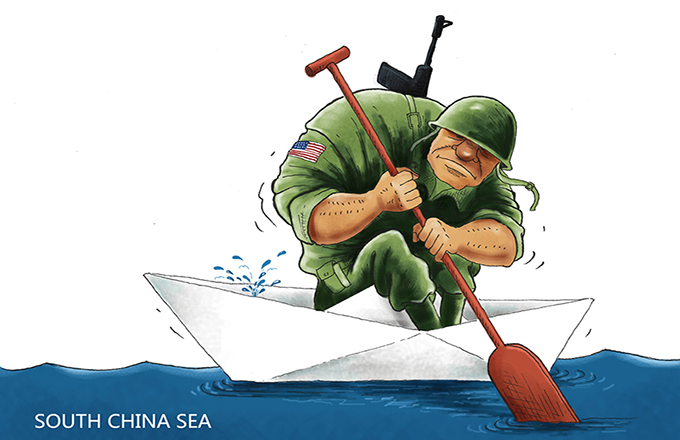
US must make right choice in South China Sea
 |
|
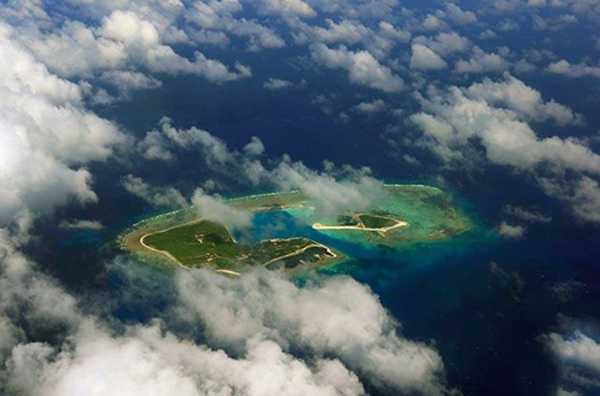
File photo of South China Sea. [Photo/Xinhua] |
A few days ago, USS Decatur, a guided missile destroyer of the US Navy, intruded into the territorial sea of China's Xisha Islands (Paracel Islands). China responded by dispatching two ships and a JH-7 fighter-bomber to expel the US vessel from the waters.
Why did the United States' military vessel enter the South China Sea?
The US' intention was to challenge China's maritime claims in the South China Sea, as it claimed the baselines of Chinese territorial sea were unlawful. The US claim is baseless.
More that 20 years ago, Beijing issued the Declaration on the Baseline of the Territorial Sea of China, marking the base points and baselines of the Xisha Islands and the scope of China's territorial sea, which conformed to the customary international law and international practice. This has been recognized by the international community.
There were two reasons behind the US' action. The first was to cast a shadow over the China-Philippines rapprochement. The US ship entered the Xisha Islands waters at a time when Philippine President Rodrigo Duterte was paying a state visit to China, which most observers believed would improve Beijing-Manila relations, especially because the two sides announced they would resolve their dispute in the South China Sea through peaceful dialogue.
The US intrusion came when the "breaking up" of Washington-Manila relations was grabbing the headlines. Manila had decided to stop acting as Washington's pawn, making the US "nervous". The so-called freedom of navigation operation by the US was thus aimed at preventing any improvement in Beijing-Manila ties.
The second reason was to check the momentum of dialogue and consultation among the parties to the disputes in the South China Sea. China and ASEAN member states have made good progress on the effective implementation of the Declaration on the Conduct of the Parties in the South China Sea (DOC) and negotiations on the Code of Conduct for the South China Sea (COC).
The US is perturbed by these developments. Its action has made people realize that despite its claims of supporting a peaceful resolution to the South China Sea disputes, the US is keen on stirring up more trouble in the region.
Contrary to what the US expected, the so-called ruling of the arbitral tribunal on the South China Sea dispute between China and the Philippines has not heightened the tensions in the region. In fact, dialogue is favored by the disputing parties to resolve the disputes.
Unable to accept this, the US and its ally Japan-has been flexing its muscles in the South China Sea and thus resorting to "militarization" in the region.
The US presidential election is just a week away, and ensuring a stable transition of bilateral relations is the top priority for both Beijing and Washington, for which defusing the tensions in the South China Sea is a necessary condition. In nearly eight years of the Barack Obama administration, thanks to the joint efforts of both sides, China-US relations have made a lot of progress, which should not be a sacrificed on the altar of narrow gains.
The last few months of the Obama administration should not be marked by heightened tensions between Beijing and Washington in the South China Sea, because that can harm bilateral ties. According to an old Chinese saying, wise men ride with the tides, while the fool row against the flow. Weighing the importance of long-term China-US relations, Washington therefore could and should make the right choice.
The author is a Beijing-based observer on international issues.
- Trump more likely to get in war over South China Sea if he wins, says US expert
- US' divisiveness and intervention unwelome in South China Sea
- People's Daily says China will never allow US to run amok in South China Sea
- China-Philippine united front on South China Sea
- US officials told to 'move on' over South China Sea
- China slams Japanese defense chief's remarks on South China Sea
- China-Russia naval joint drill held in South China Sea