 |
|
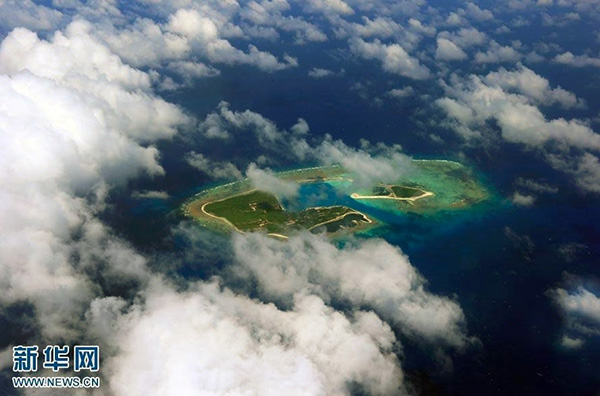
File photo of South China Sea. [Photo/Xinhua] |
The Philippines' decision to move the Permanent Court of Arbitration against China over the South China Sea dispute could influence the situation in the region. The tribunal will pass its ruling on July 12, but China's solemn stance and countermeasures, the United States' uncalled-for intervention and some countries' attitudes at the G7 Summit and the Conference on Interaction and Confidence-Building Measures in Asia have already further complicated the situation.
The case has drawn global attention because The Hague-based tribunal has expanded its jurisdiction to arbitrate in the Beijing-Manila dispute, which is surely going to affect the established rules of navigation and the seas based on the United Nations Convention on the Law of the Sea. It could prompt all coastal, and even some landlocked, states to consider themselves as part of the maritime dispute and, depending on their political considerations, take sides either with the US and the Philippines, or with China.
In response to Manila's unilateral move, Beijing has been reiterating its "non-participation and non-acceptance" stance, that is, it will neither participate in the arbitration nor accept its ruling. And considering the arbitration tribunal's ruling has less binding force than a verdict given by the International Court of Justice or the International Tribunal for the Law of the Sea, and since Manila doesn't have any legal basis for the case, the arbitration is not likely to have any direct impact on China. As such, China will continue to defend its territorial and maritime rights in the South China Sea.
The arbitration case, however, will create some trouble for China on the diplomatic and public opinion front. The US' intervention in and efforts to hype up the case seem to have cost China dear in terms of public opinion; some even called China a "bad boy" after it declared that it would not appear in court or accept its ruling.
For Beijing, the arbitration case is not about a legal issue being dealt by a court but about the negative influence of the abuse of arbitration procedure by Manila. Some countries covertly supporting the Philippines may not care about the "outcome" of the case, but they should know that whether or not the case is handled legitimately and fairly will influence the development of the rules of the sea.
If most of the countries accept the manner in which the Philippines has handled its maritime dispute with China, then it might become the norm for settling all maritime disputes between or among countries-and that would be extremely detrimental to the international maritime order.
China has been consistently telling the international community that there are procedural problems with the arbitration. In a document issued in December 2014, China's Foreign Ministry said the sovereignty over some islands and reefs mentioned in the case was beyond the scope of UNCLOS and thus they were not applicable to the UN convention's articles.
Besides, China has repeatedly made it clear that its dispute with the Philippines should be resolved through bilateral talks, which is exactly what China-Philippines agreements and the Declaration on the Conduct of Parties in the South China Sea say.
More than 60 countries, including Russia, India, some ASEAN member states, and some Central and West Asian nations, have agreed with China that the Beijing-Manila dispute should be settled through consultations and talks. And a communiqué issued by the Shanghai Cooperation Organization foreign ministers' meeting recently opposed the "internationalization of the South China Sea" and called for safeguarding against "interventions from outside forces".
Therefore, despite the arbitration case, China will continue to expand its "circle of friends" and object to "judicial violence" forced upon it by the Philippines and the US. What China has been doing is not only to maintain its own interests and legal proposals, but also to safeguard international justice and the international maritime order.
The author is a researcher at the Institute of Ocean Research, Peking University.



Copyright 1995 - . All rights reserved. The content (including but not limited to text, photo, multimedia information, etc) published in this site belongs to China Daily Information Co (CDIC). Without written authorization from CDIC, such content shall not be republished or used in any form. Note: Browsers with 1024*768 or higher resolution are suggested for this site.
License for publishing multimedia online 0108263 Registration Number: 130349